Nour-Eldine Wared, Manaph Nimshitha Pavathuparambil Abdul, Ltaief Samia M, Abdel Aati Nazim, Mansoori Monaa Hussain, Al Abdulla Samya, Al-Shammari Abeer R
Neurological Disorders Research Center, Qatar Biomedical Research Institute, Hamad Bin Khalifa University, Qatar Foundation, Doha, Qatar.
Child Development Center, Rumailah Hospital, Hamad Medical Corporation, Doha, Qatar.
Front Psychiatry. 2024 Feb 13;15:1333534. doi: 10.3389/fpsyt.2024.1333534. eCollection 2024.
Autism spectrum disorder (ASD) is a heterogeneous neurodevelopmental disorder characterized by impaired social interaction and communication and the occurrence of stereotyped and repetitive behaviors. Several studies have reported altered cytokine profiles in ASD and hence may serve as potential diagnostic biomarkers of the disorder. This study aims to identify diagnostic biomarkers for ASD in a well-defined study cohort in Qatar.
We measured the protein levels of 45 cytokines in the plasma samples of age- and gender-matched children (2-4 years) with ASD (n = 100) and controls (n = 60) using a Luminex multiplex assay. We compared the differences in the levels of these cytokines between the two study groups and then fitted the significantly altered cytokines into a logistic regression model to examine their diagnostic potential for ASD.
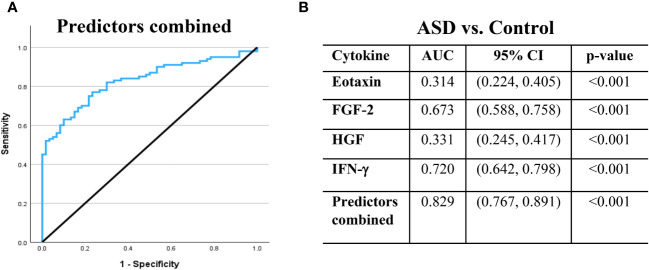
We found elevated levels of IFN-γ, FGF-2, IL-1RA, and IL-13 and reduced levels of eotaxin, HGF, IL-1 alpha, IL-22, IL-9, MCP-1, SCF, SDF-1 alpha, VEGFA, and IP-10 in the plasma of children with ASD compared to controls. Furthermore, we observed that elevated levels of IFN-γ (odds ratio (OR) = 1.823; 95% (confidence interval) CI = 1.206, 2.755; p = 0.004) and FGF-2 (OR = 2.528; 95% CI = 1.457, 4.385; p < 0.001) were significantly associated with increased odds of ASD, whereas reduced levels of eotaxin (OR = 0.350; 95% CI = 0.160, 0.765; p = 0.008) and HGF (OR = 0.220; 95% CI = 0.070, 0.696; p = 0.010) were significantly associated with lower odds of ASD relative to controls. The combination of these four cytokines revealed an area under the curve (ROC-AUC) of 0.829 (95% CI = 0.767, 0.891; p < 0.001), which demonstrates the diagnostic accuracy of the four-cytokine signature.
Our results identified a panel of cytokines that could discriminate between children with ASD and controls in Qatar. In addition, our findings support the predominance of a Th1 immune phenotype in ASD children and emphasize the need to validate these results in larger populations.
自闭症谱系障碍(ASD)是一种异质性神经发育障碍,其特征为社交互动和沟通受损,以及出现刻板和重复行为。多项研究报告了ASD患者细胞因子谱的改变,因此细胞因子可能作为该疾病潜在的诊断生物标志物。本研究旨在在卡塔尔一个明确界定的研究队列中识别ASD的诊断生物标志物。
我们使用Luminex多重检测法测量了年龄和性别匹配的2至4岁ASD儿童(n = 100)和对照组儿童(n = 60)血浆样本中45种细胞因子的蛋白水平。我们比较了两个研究组之间这些细胞因子水平的差异,然后将显著改变的细胞因子纳入逻辑回归模型,以检验它们对ASD的诊断潜力。
我们发现,与对照组相比,ASD儿童血浆中IFN-γ、FGF-2、IL-1RA和IL-13水平升高,而嗜酸性粒细胞趋化因子、HGF、IL-1α、IL-22、IL-9、MCP-1、SCF、SDF-1α、VEGFA和IP-10水平降低。此外,我们观察到,IFN-γ水平升高(比值比(OR)= 1.823;95%置信区间(CI)= 1.206, 2.755;p = 0.004)和FGF-2水平升高(OR = 2.528;95% CI = 1.457, 4.385;p < 0.001)与ASD患病几率增加显著相关,而嗜酸性粒细胞趋化因子水平降低(OR = 0.350;95% CI = 0.160, 0.765;p = 0.008)和HGF水平降低(OR = 0.220;95% CI = 0.070, 0.696;p = 0.010)与ASD相对于对照组的较低患病几率显著相关。这四种细胞因子的组合显示曲线下面积(ROC-AUC)为0.829(95% CI = 0.767, 0.891;p < 0.001),这证明了四种细胞因子特征的诊断准确性。
我们的结果确定了一组细胞因子,可用于区分卡塔尔的ASD儿童和对照组儿童。此外,我们的研究结果支持ASD儿童中Th1免疫表型占主导地位,并强调需要在更大规模人群中验证这些结果。