Division of Rheumatology, Allergy, and Clinical Immunology, Department of Internal Medicine, University of California, Davis, Davis, California; MIND Institute, University of California, Davis, Davis, California.
Division of Research, Kaiser Permanente Northern California, Oakland, California.
Biol Psychiatry. 2019 Aug 15;86(4):255-264. doi: 10.1016/j.biopsych.2019.04.037. Epub 2019 May 15.
The identification of an early biomarker for autism spectrum disorder (ASD) would improve the determination of risk, leading to earlier diagnosis and, potentially, earlier intervention and improved outcomes.
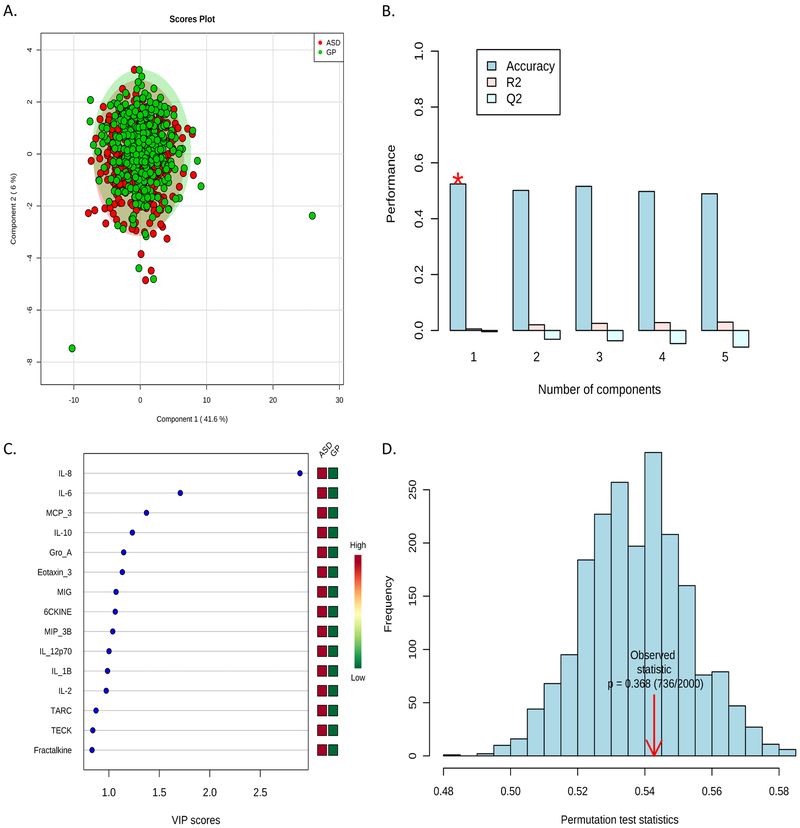
Data were generated from the Early Markers for Autism study, a population-based case-control study of prenatal and neonatal biomarkers of ASD. Newborn bloodspots of children with ASD (n = 370), children with developmental delay (n = 140), and general population (GP) controls (n = 378) were analyzed for 42 different immune markers using a Luminex multiplex platform. Comparisons of immune marker concentrations between groups were examined using logistic regression and partial least squares discriminant analysis.
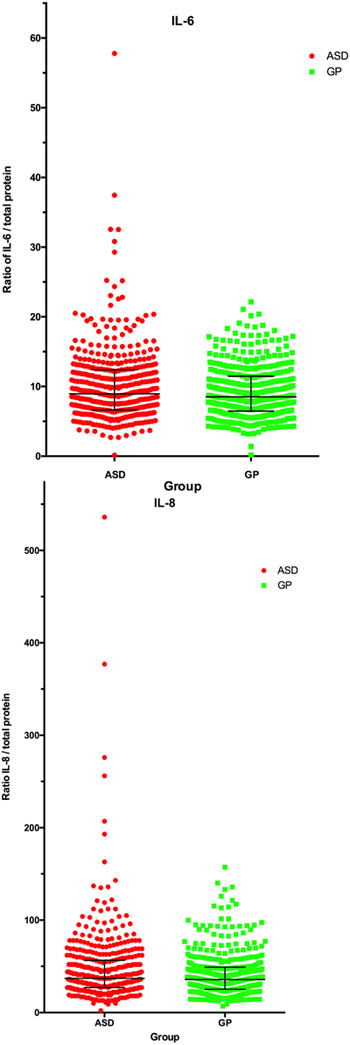
Children with ASD had significantly increased neonatal levels of interleukin-6 (IL-6) and IL-8 compared with GP controls. An increase in IL-8 was especially significant in the ASD group with early onset compared with the GP group, with an adjusted odds ratio of 1.97 (95% confidence interval, 1.39-2.83; p = .00014). In addition, children with ASD had significantly elevated levels of eotaxin-1, interferon-γ, and IL-12p70 relative to children with developmental delay. We observed no significant differences in levels of immune markers between the developmental delay and GP groups.
Elevated levels of some inflammatory markers in newborn bloodspots indicated a higher degree of immune activation at birth in children who were subsequently diagnosed with ASD. The data from this exploratory study suggest that with further expansion, the development of neonatal bloodspot testing for cytokine/chemokine levels might lead to the identification of biomarkers that provide an accurate assessment of ASD risk at birth.
自闭症谱系障碍(ASD)的早期生物标志物的识别将改善风险的确定,从而更早地诊断,并可能更早地进行干预和改善结果。
数据来自自闭症早期标志物研究,这是一项基于人群的 ASD 产前和新生儿生物标志物病例对照研究。对自闭症儿童(n=370)、发育迟缓儿童(n=140)和普通人群(GP)对照组(n=378)的新生儿血斑进行了 42 种不同免疫标志物的分析,使用 Luminex 多重平台。使用逻辑回归和偏最小二乘判别分析比较了各组之间免疫标志物浓度的差异。
与 GP 对照组相比,自闭症儿童的新生儿白细胞介素 6(IL-6)和白细胞介素 8(IL-8)水平显著升高。在具有早期发病的 ASD 组中,IL-8 的增加尤其显著,与 GP 组相比,调整后的优势比为 1.97(95%置信区间,1.39-2.83;p=.00014)。此外,与发育迟缓儿童相比,自闭症儿童的嗜酸性粒细胞趋化因子-1、干扰素-γ和 IL-12p70 水平显著升高。我们观察到发育迟缓组和 GP 组之间的免疫标志物水平没有显著差异。
新生儿血斑中某些炎症标志物水平升高表明,随后被诊断为 ASD 的儿童在出生时具有更高程度的免疫激活。这项探索性研究的数据表明,随着进一步扩展,新生儿血斑细胞因子/趋化因子水平检测的开发可能会识别出能够在出生时提供 ASD 风险准确评估的生物标志物。