Department of Community Health Sciences, University of Manitoba, Winnipeg, Canada.
Department of Epidemiology, Biostatistics, and Occupational Health, McGill University, Montreal, Canada.
Int J Popul Data Sci. 2023 Nov 27;8(1):2176. doi: 10.23889/ijpds.v8i1.2176. eCollection 2023.
Administrative health records (AHRs) are used to conduct population-based post-market drug safety and comparative effectiveness studies to inform healthcare decision making. However, the cost of data extraction, and the challenges associated with privacy and securing approvals can make it challenging for researchers to conduct methodological research in a timely manner using real data. Generating synthetic AHRs that reasonably represent the real-world data are beneficial for developing analytic methods and training analysts to rapidly implement study protocols. We generated synthetic AHRs using two methods and compared these synthetic AHRs to real-world AHRs. We described the challenges associated with using synthetic AHRs for real-world study.
The real-world AHRs comprised prescription drug records for individuals with healthcare insurance coverage in the Population Research Data Repository (PRDR) from Manitoba, Canada for the 10-year period from 2008 to 2017. Synthetic data were generated using the Observational Medical Dataset Simulator II (OSIM2) and a modification (ModOSIM). Synthetic and real-world data were described using frequencies and percentages. Agreement of prescription drug use measures in PRDR, OSIM2 and ModOSIM was estimated with the concordance coefficient.
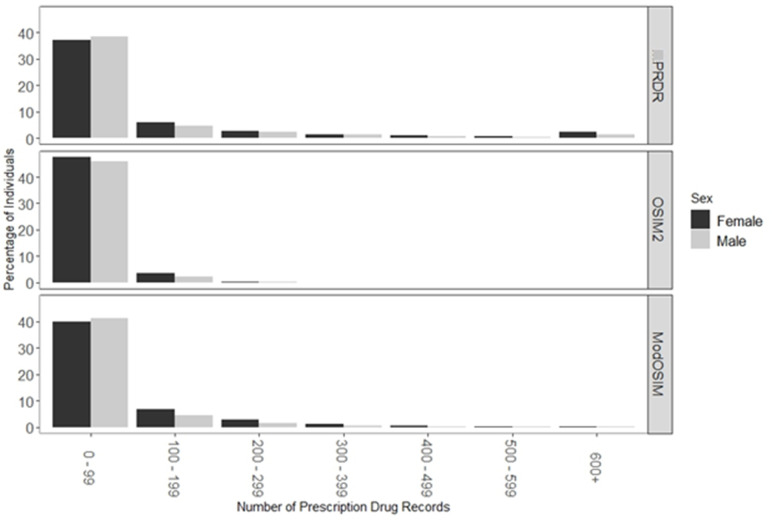
The PRDR cohort included 169,586,633 drug records and 1,395 drug types for 1,604,734 individuals. Synthetic data for 1,000,000 individuals were generated using OSIM2 and ModOSIM. Sex and age group distributions were similar in the real-world and synthetic AHRs. However, there were significant differences in the number of drug records and number of unique drugs per person for OSIM2 and ModOSIM when compared with PRDR. For the average number of days of drug use, concordance with the PRDR was 16% (95% confidence interval [CI]: 12%-19%) for OSIM2 and 88% (95% CI: 87%-90%) for ModOSIM.
ModOSIM data were more similar to PRDR than OSIM2 data on many measures. Synthetic AHRs consistent with those found in real-world settings can be generated using ModOSIM. Synthetic data will benefit rapid implementation of methodological studies and data analyst training.
行政健康记录(AHR)用于进行基于人群的药物上市后安全性和比较有效性研究,以为医疗保健决策提供信息。然而,数据提取的成本以及与隐私相关的挑战和获得批准可能会使研究人员难以及时使用真实数据进行方法学研究。生成合理代表真实世界数据的合成 AHR 有利于开发分析方法和培训分析师快速实施研究方案。我们使用两种方法生成了合成 AHR,并将这些合成 AHR 与真实世界的 AHR 进行了比较。我们描述了使用合成 AHR 进行真实世界研究所面临的挑战。
真实世界的 AHR 包括来自加拿大马尼托巴省人口研究数据存储库(PRDR)的 2008 年至 2017 年 10 年间个人医疗保险覆盖范围内的处方药记录。使用观察性医疗数据集模拟器 II(OSIM2)和修改版(ModOSIM)生成合成数据。使用频率和百分比描述合成和真实世界数据。使用一致性系数估计 PRDR、OSIM2 和 ModOSIM 中处方药使用措施的一致性。
PRDR 队列包括 169586633 份药物记录和 1395 种药物,涉及 1604734 个人。使用 OSIM2 和 ModOSIM 为 1000000 个人生成了合成数据。真实世界和合成 AHR 中的性别和年龄组分布相似。然而,与 PRDR 相比,OSIM2 和 ModOSIM 的药物记录数量和每人使用的独特药物数量存在显著差异。对于药物使用天数的平均值,与 PRDR 的一致性为 OSIM2 的 16%(95%置信区间[CI]:12%-19%)和 ModOSIM 的 88%(95% CI:87%-90%)。
在许多措施上,ModOSIM 数据比 OSIM2 数据更接近 PRDR。可以使用 ModOSIM 生成与真实世界设置一致的合成 AHR。合成数据将有利于快速实施方法学研究和数据分析师培训。