Daniels Joseph, Kyei Kofi Adesi, Badejoko-Okunade Kikelomo Adeola, Anim-Sampong Samuel, Tagoe Samuel Nii Adu, Antwi William Kwadwo, Ainuson-Quampah Joana, Alabi Adewumi, Sowunmi Anthonia, Tackie Judith Naa Odey
National Centre for Radiotherapy, Oncology and Nuclear Medicine, Korle Bu Teaching Hospital, PO Box KB 369, Korle Bu, Accra, Ghana.
Department of Radiography, University of Ghana, Legon, PO Box KB 143, Korle Bu, Accra, Ghana.
Ecancermedicalscience. 2023 Nov 10;17:1625. doi: 10.3332/ecancer.2023.1625. eCollection 2023.
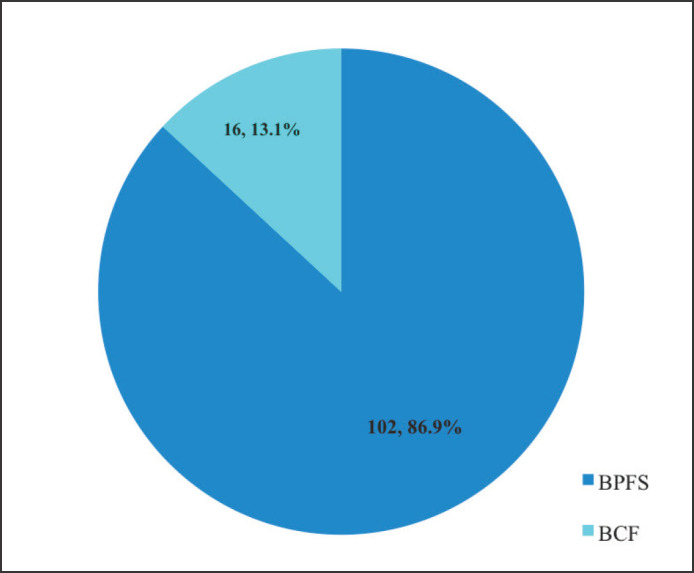
Although many patients who receive definitive radiotherapy (RT) for localised prostate cancer (CaP) experience long-term disease-free survival and better quality of life, some also have biochemical progression during follow-up. Oftentimes this implies additional treatment for patients with the accompanying challenges of cumulative treatment side effects, inconvenience and financial toxicity. This study retrospectively assessed the clinicopathological characteristics and biochemical outcomes of patients treated for localised CaP with external beam radiotherapy (EBRT) between 2015 and 2020 at a major cancer treatment centre in Accra, Ghana. Patients' socio-demographic and clinical data were collected from their hospital records and analysed with the Statistical Package for Social Sciences version 26. Biochemical failure (BCF) was defined as an increase in the level of serum prostate-specific antigen (PSA) >2 ng/mL above the nadir after curative therapy based on the Phoenix definition. The mean age was 67.6 years (SD ± 6.2). The majority of the study participants ( = 79, 64.8%) had initial PSA >20 ng/mL, with the highest recorded value of 705 ng/mL. All the patients had biopsy-proven adenocarcinoma of the prostate gland. Some patients received 3-dimensional conformal radiotherapy (3DCRT) on a cobalt-60 teletherapy machine whereas others were treated with either 3DCRT or intensity-modulated radiotherapy (IMRT) on a 6 MV Linac. In all, 13.1% of the patients experienced BCF after receiving EBRT after an average follow-up of 31.3 months. This study demonstrated a low rate of BCF among patients treated with EBRT for localised CaP in Ghana. Strong prognostic factors of biochemical outcome demonstrated in this study were the percentage of cores positive, grade group, and risk stratification. Diarrhaea and desquamation experienced by treated CaP patients were exclusively attributable to EBRT. RT produced a complete resolution of symptoms in some of the patients.
尽管许多接受局限性前列腺癌(CaP)根治性放疗(RT)的患者实现了长期无病生存且生活质量更高,但仍有一些患者在随访期间出现生化进展。这通常意味着患者需要接受额外治疗,同时还要应对累积治疗副作用、不便和经济毒性等挑战。本研究回顾性评估了2015年至2020年期间在加纳阿克拉一家主要癌症治疗中心接受外照射放疗(EBRT)治疗局限性CaP患者的临床病理特征和生化结果。从患者的医院记录中收集其社会人口统计学和临床数据,并使用社会科学统计软件包第26版进行分析。根据Phoenix定义,生化失败(BCF)定义为根治性治疗后血清前列腺特异性抗原(PSA)水平较最低点升高>2 ng/mL。平均年龄为67.6岁(标准差±6.2)。大多数研究参与者(n = 79,64.8%)初始PSA>20 ng/mL,最高记录值为705 ng/mL。所有患者均经活检证实为前列腺腺癌。一些患者在钴-60远距离治疗机上接受三维适形放疗(3DCRT),而其他患者则在6 MV直线加速器上接受3DCRT或调强放疗(IMRT)。总体而言,13.1%的患者在平均随访31.3个月后接受EBRT后出现BCF。本研究表明,在加纳接受EBRT治疗局限性CaP的患者中BCF发生率较低。本研究中显示的生化结果的强预后因素是阳性核心百分比、分级组和风险分层。接受治疗的CaP患者出现的腹泻和脱皮完全归因于EBRT。放疗使一些患者的症状完全缓解。