Kim Byung Soo, Kim Dong Hyun, Shin Bong Seok, Lee Eun-So, Jo Seong Jin, Bang Chul Hwan, Yun Yeojun, Choe Yong Beom
Department of Dermatology, School of Medicine, Pusan National University, Busan, Republic of Korea.
Department of Dermatology, CHA Bundang Medical Center, CHA University School of Medicine, Seongnam, Republic of Korea.
Ther Adv Chronic Dis. 2024 Feb 26;15:20406223241230180. doi: 10.1177/20406223241230180. eCollection 2024.
Secukinumab, a fully human monoclonal antibody, was approved in Korea for the treatment of moderate to severe psoriasis in September 2015.
To assess the safety and effectiveness of secukinumab in patients with moderate to severe psoriasis in Korea.
Multicenter, real-world, noninterventional study conducted over 6 years.
Adults with moderate to severe psoriasis were enrolled. Safety was assessed by evaluating adverse events (AEs), treatment-related AEs, and serious AEs (SAEs). Effectiveness was assessed using the change in absolute Psoriasis Area and Severity Index (PASI) score, percentage of patients achieving PASI 75/90/100 and PASI ⩽2; at weeks 12 and 24.
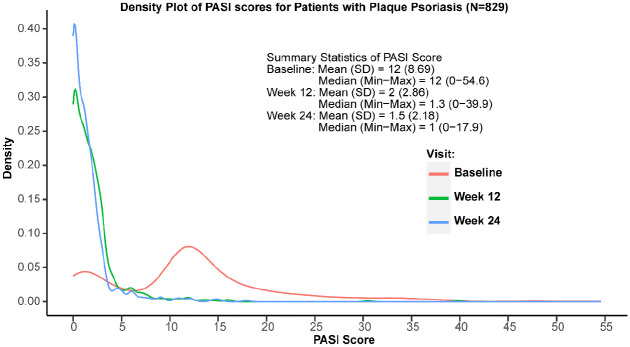
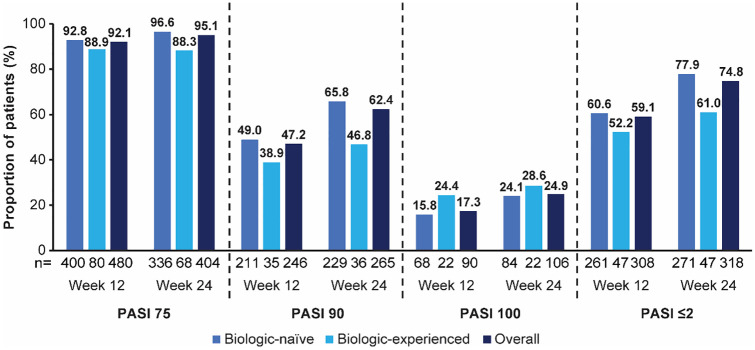
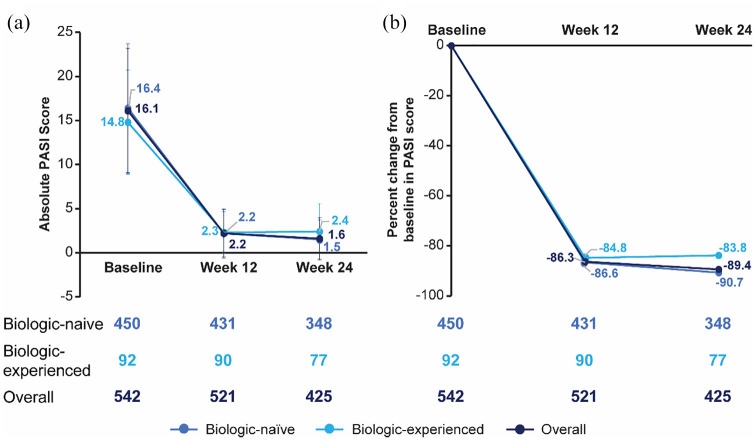
Overall, 829 and 542 patients were included in the safety and effectiveness sets, respectively. AEs, treatment-related AEs, and SAEs occurred in 29.0%, 9.5%, and 4.1% of patients, with incidence rates of 39.43, 12.98, and 5.59 per 100 patient years, respectively. The absolute PASI score decreased from 16.1 ± 7.1 (baseline) to 1.6 ± 2.4 (week 24), with a similar reduction in biologic-naïve (16.4 ± 7.3 to 1.5 ± 2.2) and biologic-experienced (14.8 ± 5.9 to 2.4 ± 3.2) groups. At week 24, PASI 75/90/100 was achieved by 95.1%, 62.4%, and 24.9% of patients. At week 24, PASI 75/90 were higher in biologic-naïve (96.6%/65.8%) than biologic-experienced patients (88.3%/48.6%), whereas PASI 100 was similar in both cohorts (24.1% and 28.6%). A similar trend in PASI ⩽ 2 was observed in both cohorts.
Secukinumab showed sustained effectiveness and favorable safety profile in adult patients with moderate to severe psoriasis in Korea.
司库奇尤单抗是一种全人源单克隆抗体,于2015年9月在韩国获批用于治疗中度至重度银屑病。
评估司库奇尤单抗在韩国中度至重度银屑病患者中的安全性和有效性。
一项为期6年的多中心、真实世界、非干预性研究。
纳入中度至重度银屑病成人患者。通过评估不良事件(AE)、治疗相关不良事件和严重不良事件(SAE)来评估安全性。使用银屑病面积和严重程度指数(PASI)绝对评分的变化、达到PASI 75/90/100和PASI≤2的患者百分比来评估有效性;在第12周和第24周时进行评估。
总体而言,分别有829例和542例患者纳入安全性和有效性数据集。AE、治疗相关AE和SAE的发生率分别为29.0%、9.5%和4.1%,每100患者年的发生率分别为39.43、12.98和5.59。PASI绝对评分从基线时的16.1±7.1降至第周24时的1.6±2.4,初治生物制剂组(16.4±7.3至1.5±2.2)和有生物制剂使用经验组(14.8±5.9至2.4±3.2)的下降情况相似。在第24周时,95.1%、62.4%和24.9%的患者达到PASI 75/90/100。在第24周时,初治生物制剂组达到PASI 75/90的比例(96.6%/65.8%)高于有生物制剂使用经验的患者(88.3%/48.6%),而两个队列达到PASI 100的比例相似(24.1%和28.6%)。两个队列中PASI≤2的情况也观察到类似趋势。
在韩国中度至重度银屑病成人患者中,司库奇尤单抗显示出持续的有效性和良好的安全性。