Kiltz Uta, Sfikakis Petros P, Gaffney Karl, Bounas Andreas, Gullick Nicola, Lespessailles Eric, Brandt-Juergens Jan, Rashkov Rasho, Schulz Barbara, Pournara Effie, Jagiello Piotr
Rheumazentrum Ruhrgebiet, Ruhr-Universität Bochum, Claudiusstr. 45, 44649, Herne, Germany.
Ruhr-Universität Bochum, Bochum, Germany.
Rheumatol Ther. 2022 Aug;9(4):1129-1142. doi: 10.1007/s40744-022-00460-x. Epub 2022 Jun 8.
Sustained improvement of high degree in clinical outcomes have been demonstrated in phase 3 trials with secukinumab in both psoriatic arthritis (PsA) and ankylosing spondylitis (AS). The objective of the SERENA study was to evaluate the effectiveness, retention rates, and safety of secukinumab in patients with PsA and AS.
SERENA is an ongoing, longitudinal, real-world observational study involving patients with moderate-to-severe psoriasis, PsA, or AS. Patients had received at least 16 weeks of secukinumab treatment before recruitment to the study. Retention rate was defined as percentage of patients who continued secukinumab treatment over the course of study. Effectiveness of secukinumab in AS and PsA cohorts was assessed using descriptive statistics.
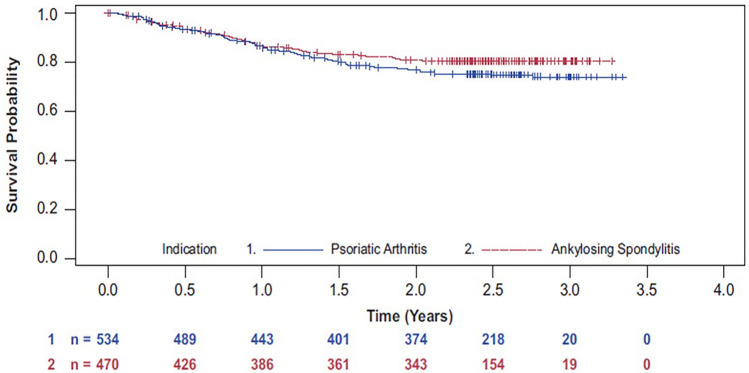
The current interim analysis included 1004 patients with PsA or AS. Overall secukinumab retention rates at 2 years after enrolment were 74.9 and 78.9% in patients with PsA and AS, respectively. At baseline and at 2 years, swollen joint count [3.3 (5.8) vs. 2.9 (5.8)], tender joint count [6.3 (9.4) vs. 5.6 (7.2)] in patients with PsA and BASDAI scores [3.2 (2.3) vs. 2.9 (2.3)] in patients with AS, suggest sustained effectiveness for patients remaining on secukinumab for at least 2 years after enrolment. A total of 73 patients had treatment interruption; 78% of these patients reinitiated secukinumab without a loading dose. No new or unexpected safety signals were reported.
After more than 2 years since initiation, secukinumab demonstrated high retention rates and favorable safety profile as well as sustained effectiveness in patients who continued secukinumab treatment.
在银屑病关节炎(PsA)和强直性脊柱炎(AS)的3期试验中,已证明司库奇尤单抗可使临床结局得到高度持续改善。SERENA研究的目的是评估司库奇尤单抗在PsA和AS患者中的有效性、保留率和安全性。
SERENA是一项正在进行的纵向真实世界观察性研究,纳入中度至重度银屑病、PsA或AS患者。患者在入选本研究前已接受至少16周的司库奇尤单抗治疗。保留率定义为在研究过程中继续接受司库奇尤单抗治疗的患者百分比。使用描述性统计评估司库奇尤单抗在AS和PsA队列中的有效性。
当前的中期分析纳入了1004例PsA或AS患者。PsA和AS患者入组2年后的司库奇尤单抗总体保留率分别为74.9%和78.9%。在基线和2年时,PsA患者的肿胀关节计数[3.3(5.8)对2.9(5.8)]、压痛关节计数[6.3(9.4)对5.6(7.2)]以及AS患者的巴斯强直性脊柱炎疾病活动指数(BASDAI)评分[3.2(2.3)对2.9(2.3)]表明,入组后继续使用司库奇尤单抗至少2年的患者持续有效。共有73例患者中断治疗;其中78%的患者重新开始使用司库奇尤单抗且未使用负荷剂量。未报告新的或意外的安全信号。
开始治疗2年多后,司库奇尤单抗在继续接受治疗的患者中显示出高保留率、良好的安全性以及持续有效性。