Global Alzheimer's Platform Foundation, Washington, District of Columbia, USA.
Kerwin Medical Center, Dallas, Texas, USA.
Alzheimers Dement. 2024 Apr;20(4):2752-2765. doi: 10.1002/alz.13722. Epub 2024 Feb 28.
Alzheimer's disease (AD) trial participants are often screened for eligibility by brain amyloid positron emission tomography/cerebrospinal fluid (PET/CSF), which is inefficient as many are not amyloid positive. Use of blood-based biomarkers may reduce screen failures.
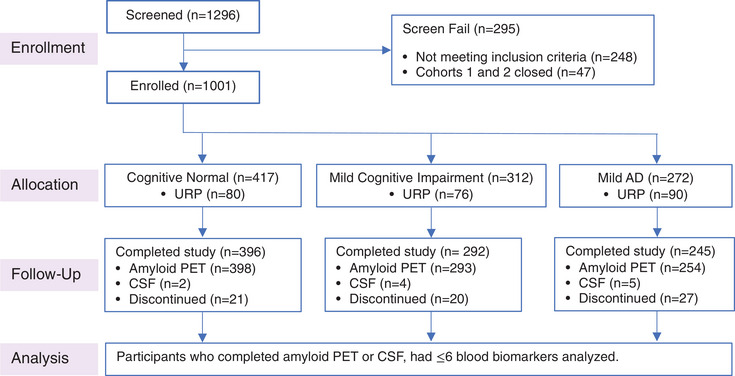
We recruited 755 non-Hispanic White, 115 Hispanic, 112 non-Hispanic Black, and 19 other minority participants across groups of cognitively normal (n = 417), mild cognitive impairment (n = 312), or mild AD (n = 272) participants. Plasma amyloid beta (Aβ)40, Aβ42, Aβ42/Aβ40, total tau, phosphorylated tau (p-tau)181, and p-tau217 were measured; amyloid PET/CSF (n = 956) determined amyloid positivity. Clinical, blood biomarker, and ethnicity/race differences associated with amyloid status were evaluated.
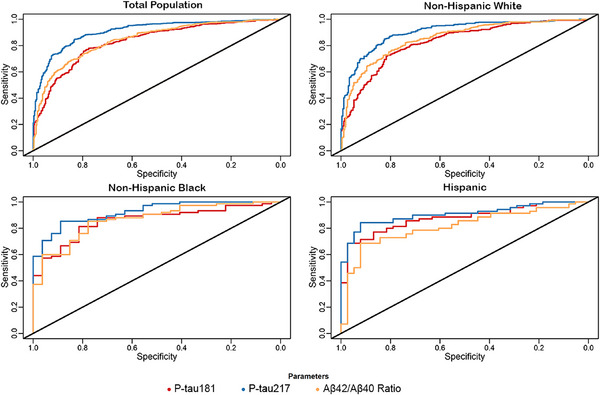
Greater impairment, older age, and carrying an apolipoprotein E (apoE) ε4 allele were associated with greater amyloid burden. Areas under the receiver operating characteristic curve for amyloid status of plasma Aβ42/Aβ40, p-tau181, and p-tau217 with amyloid positivity were ≥ 0.7117 for all ethnoracial groups (p-tau217, ≥0.8128). Age and apoE ε4 adjustments and imputation of biomarker values outside limit of quantitation provided small improvement in predictive power.
Blood-based biomarkers are highly associated with amyloid PET/CSF results in diverse populations enrolled at clinical trial sites.
Amyloid beta (Aβ)42/Aβ40, phosphorylated tau (p-tau)181, and p-tau 217 blood-based biomarkers predicted brain amyloid positivity. P-tau 217 was the strongest predictor of brain amyloid positivity. Biomarkers from diverse ethnic, racial, and clinical cohorts predicted brain amyloid positivity. Community-based populations have similar Alzheimer's disease (AD) biomarker levels as other populations. A prescreen process with blood-based assays may reduce the number of AD trial screen failures.
阿尔茨海默病(AD)试验参与者通常通过脑淀粉样蛋白正电子发射断层扫描/脑脊液(PET/CSF)进行资格筛选,由于许多人并非淀粉样蛋白阳性,因此该方法效率低下。使用基于血液的生物标志物可能会减少筛选失败。
我们招募了 755 名非西班牙裔白人、115 名西班牙裔、112 名非西班牙裔黑人和 19 名其他少数民族参与者,分为认知正常组(n=417)、轻度认知障碍组(n=312)和轻度 AD 组(n=272)。测量了血浆淀粉样蛋白β(Aβ)40、Aβ42、Aβ42/Aβ40、总 tau、磷酸化 tau(p-tau)181 和 p-tau217;测定了淀粉样蛋白 PET/CSF(n=956)以确定淀粉样蛋白阳性。评估了与淀粉样蛋白状态相关的临床、血液生物标志物和种族/民族差异。
认知障碍程度更高、年龄更大以及携带载脂蛋白 E(apoE)ε4 等位基因与更大的淀粉样蛋白负担相关。在所有种族群体中,血浆 Aβ42/Aβ40、p-tau181 和 p-tau217 的淀粉样蛋白状态的受试者工作特征曲线下面积(AUC)均≥0.7117(p-tau217,≥0.8128)。年龄和 apoE ε4 调整以及对定量限外的生物标志物值的插补仅略微提高了预测能力。
在临床试验点招募的不同人群中,基于血液的生物标志物与淀粉样蛋白 PET/CSF 结果高度相关。
Aβ42/Aβ40、磷酸化 tau(p-tau)181 和 p-tau217 血液生物标志物可预测脑淀粉样蛋白阳性。p-tau217 是脑淀粉样蛋白阳性的最强预测因子。来自不同种族、种族和临床队列的生物标志物预测了脑淀粉样蛋白阳性。社区人群的阿尔茨海默病(AD)生物标志物水平与其他人群相似。基于血液的检测预筛选过程可能会减少 AD 试验筛选失败的数量。