Unit for Early and Exploratory Clinical Development, The University of Tokyo Hospital, 7-3-1 Hongo, Bunkyo-Ku, Tokyo, 113-0033, Japan.
Clinical Memory Research Unit, Department of Clinical Sciences Malmö, Lund University, Malmö, Sweden.
Alzheimers Res Ther. 2024 May 23;16(1):115. doi: 10.1186/s13195-024-01469-w.
Maximizing the efficiency to screen amyloid-positive individuals in asymptomatic and non-demented aged population using blood-based biomarkers is essential for future success of clinical trials in the early stage of Alzheimer's disease (AD). In this study, we elucidate the utility of combination of plasma amyloid-β (Aβ)-related biomarkers and tau phosphorylated at threonine 217 (p-tau217) to predict abnormal Aβ-positron emission tomography (PET) in the preclinical and prodromal AD.
We designed the cross-sectional study including two ethnically distinct cohorts, the Japanese trial-ready cohort for preclinica and prodromal AD (J-TRC) and the Swedish BioFINDER study. J-TRC included 474 non-demented individuals (CDR 0: 331, CDR 0.5: 143). Participants underwent plasma Aβ and p-tau217 assessments, and Aβ-PET imaging. Findings in J-TRC were replicated in the BioFINDER cohort including 177 participants (cognitively unimpaired: 114, mild cognitive impairment: 63). In both cohorts, plasma Aβ(1-42) (Aβ42) and Aβ(1-40) (Aβ40) were measured using immunoprecipitation-MALDI TOF mass spectrometry (Shimadzu), and p-tau217 was measured with an immunoassay on the Meso Scale Discovery platform (Eli Lilly).
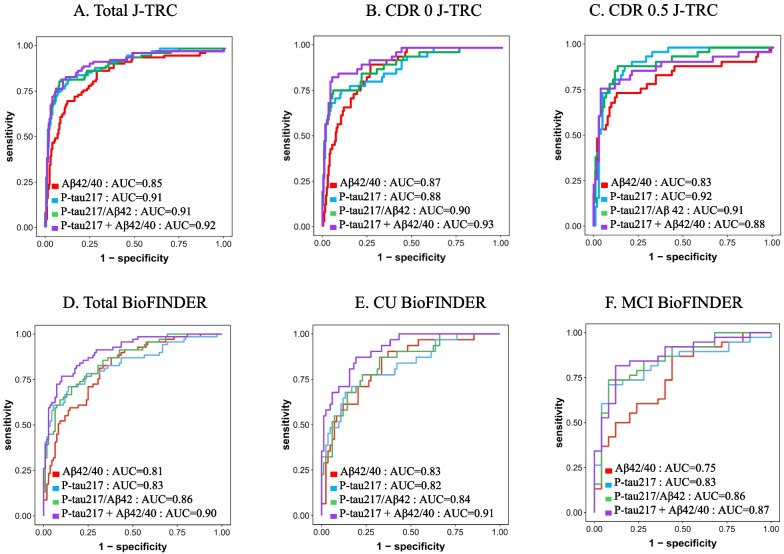
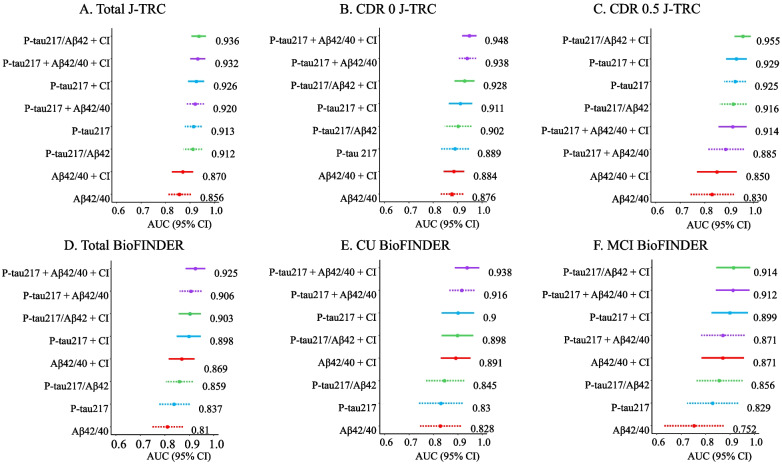
Aβ-PET was abnormal in 81 participants from J-TRC and 71 participants from BioFINDER. Plasma Aβ42/Aβ40 ratio and p-tau217 individually showed moderate to high accuracies when detecting abnormal Aβ-PET scans, which were improved by combining plasma biomarkers and by including age, sex and APOE genotype in the models. In J-TRC, the highest AUCs were observed for the models combining p-tau217/Aβ42 ratio, APOE, age, sex in the whole cohort (AUC = 0.936), combining p-tau217, Aβ42/Aβ40 ratio, APOE, age, sex in the CDR 0 group (AUC = 0.948), and combining p-tau217/Aβ42 ratio, APOE, age, sex in the CDR 0.5 group (AUC = 0.955), respectively. Each subgroup results were replicated in BioFINDER, where the highest AUCs were seen for models combining p-tau217, Aβ42/40 ratio, APOE, age, sex in cognitively unimpaired (AUC = 0.938), and p-tau217/Aβ42 ratio, APOE, age, sex in mild cognitive impairment (AUC = 0.914).
Combination of plasma Aβ-related biomarkers and p-tau217 exhibits high performance when predicting Aβ-PET positivity. Adding basic clinical information (i.e., age, sex, APOE ε genotype) improved the prediction in preclinical AD, but not in prodromal AD. Combination of Aβ-related biomarkers and p-tau217 could be highly useful for pre-screening of participants in clinical trials of preclinical and prodromal AD.
使用基于血液的生物标志物最大限度地提高对无症状和非痴呆老年人群中淀粉样蛋白阳性个体的筛查效率,对于未来在阿尔茨海默病(AD)的早期进行临床试验的成功至关重要。在这项研究中,我们阐明了组合使用血浆淀粉样蛋白-β(Aβ)相关生物标志物和磷酸化 tau 蛋白在苏氨酸 217 位(p-tau217)预测临床前和前驱 AD 中异常 Aβ-正电子发射断层扫描(PET)的效用。
我们设计了一项包括两个种族不同队列的横断面研究,即日本临床前和前驱 AD 试验准备队列(J-TRC)和瑞典生物标志物发现者研究(BioFINDER)。J-TRC 包括 474 名非痴呆个体(CDR 0:331,CDR 0.5:143)。参与者接受了血浆 Aβ和 p-tau217 评估以及 Aβ-PET 成像。在 J-TRC 中发现的结果在包括 177 名参与者的 BioFINDER 队列中得到了复制(认知正常:114,轻度认知障碍:63)。在两个队列中,使用免疫沉淀-MALDI TOF 质谱法(岛津)测量血浆 Aβ(1-42)(Aβ42)和 Aβ(1-40)(Aβ40),使用 Meso Scale Discovery 平台(Eli Lilly)上的免疫测定法测量 p-tau217。
J-TRC 中有 81 名参与者和 BioFINDER 中有 71 名参与者的 Aβ-PET 异常。当检测异常 Aβ-PET 扫描时,血浆 Aβ42/Aβ40 比值和 p-tau217 单独显示出中等至高度的准确性,通过结合血浆生物标志物并在模型中纳入年龄、性别和 APOE 基因型,可以提高准确性。在 J-TRC 中,在整个队列中,观察到最高 AUC 的模型是结合了 p-tau217/Aβ42 比值、APOE、年龄、性别(AUC=0.936),在 CDR 0 组中,观察到最高 AUC 的模型是结合了 p-tau217、Aβ42/Aβ40 比值、APOE、年龄、性别(AUC=0.948),在 CDR 0.5 组中,观察到最高 AUC 的模型是结合了 p-tau217/Aβ42 比值、APOE、年龄、性别(AUC=0.955)。每个亚组的结果在 BioFINDER 中得到了复制,在认知正常组中,观察到最高 AUC 的模型是结合了 p-tau217、Aβ42/40 比值、APOE、年龄、性别(AUC=0.938),在轻度认知障碍组中,观察到最高 AUC 的模型是结合了 p-tau217、Aβ42/Aβ40 比值、APOE、年龄、性别(AUC=0.914)。
组合使用 Aβ 相关生物标志物和 p-tau217 可以高度准确地预测 Aβ-PET 阳性。添加基本临床信息(即年龄、性别、APOE ε 基因型)可以提高临床前 AD 中的预测能力,但不能提高前驱 AD 中的预测能力。Aβ 相关生物标志物和 p-tau217 的组合可能对临床前和前驱 AD 临床试验的参与者进行预筛选非常有用。