Key Laboratory of Carcinogenesis and Translational Research (Ministry of Education/Beijing), Department of Psycho-Oncology, Peking University Cancer Hospital and Institute, Fu-Cheng Road 52, Hai-Dian District, Beijing, 100142, China.
Key Laboratory of Carcinogenesis and Translational Research (Ministry of Education/Beijing), Department of Bresat Oncology, Peking University Cancer Hospital & Institute, Beijing, China.
Sci Rep. 2024 Feb 28;14(1):4892. doi: 10.1038/s41598-024-52574-7.
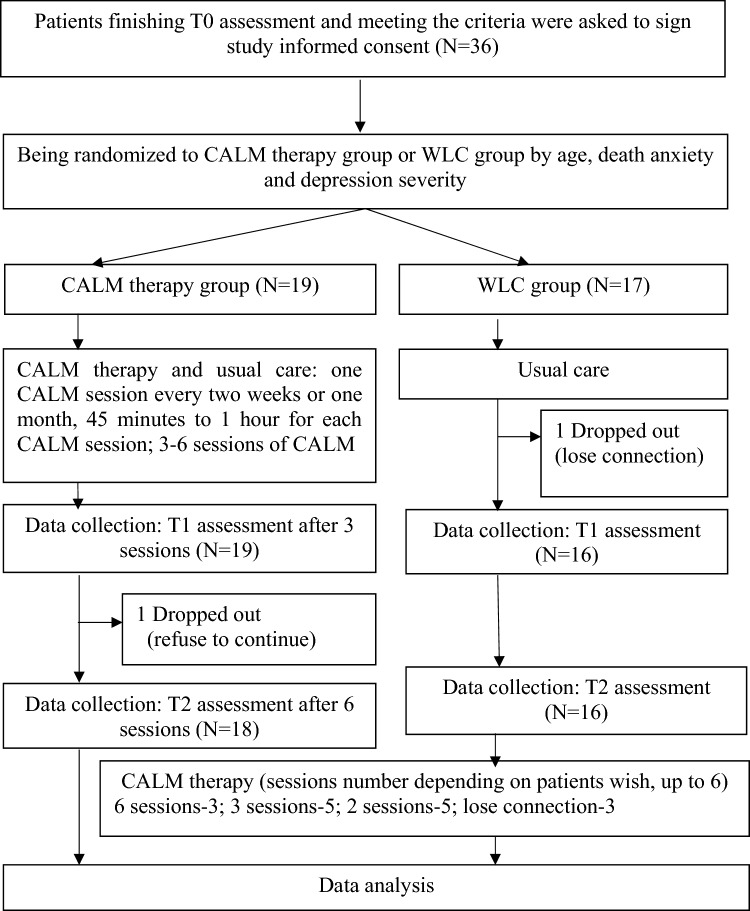
Metastatic breast cancer could cause various psychological symptoms. Managing Cancer and Living Meaningfully (CALM) is a brief, manualized psychotherapy that has been validated for advanced cancer patients. We conducted a pilot randomized control trial (RCT) to verify the feasibility and preliminary efficacy of CALM therapy in this population. Patients who met the inclusion criteria were randomly assigned into CALM or Wait-list Control (WLC) groups. Patients in the CALM group received CALM therapy and usual care; patients in WLC group first received usual care and then underwent CALM therapy after completing all assessments. All patients were asked to complete three assessments: T0(baseline), T1(3 months), and T2(6 months). The primary outcomes was death anxiety; other outcomes were depression, distress, suicide ideation, attachment security, spiritual well-being and quality of life at the end of life. Analysis of Covariance (ANCOVA) and t-test were used for statistics analysis. Thirty-six patients were randomly assigned to either of the two groups, with 34 patients completing the three assessments. At six months, we found significant between group differences in suicide ideation, distress, and life completion between the CALM and WLC groups. At T2, patients in CALM group reported lower levels of depression (F = 5.016, p = 0.033, partial η = 0.143), distress (F = 7.969, p = 0.010, partial η = 0.257), attachment avoidance (F = 4.407, p = 0.044, partial η = 0.128), and better sense of life completion (F = 5.493, p = 0.026, partial η = 0.155) than patients in the WLC group. Compared with results of the T0 assessments, we found significant differences in socres for depression (T2&T0, t = - 2.689, p = 0.011, Cohen's d = 0.940) and distress (T2&T0, t = - 2.453, p = 0.022, Cohen's d = 0.965) between the two groups. CALM therapy was well received by the study population, and CALM therapy can reduce depression, distress, attachment avoidance while improving quality of life in Chinese metastatic breast cancer patients. A Phase III RCT was recommended to verify the impact of CALM therapy on psychological burden and survival in this population.Trial registration: This study is part of the "Preliminary application study for Managing Cancer and Living Meaningfully (CALM) therapy in Chinese advanced cancer patients" clinical trial, with the Trial Registration Number of ChiCTR1900023129 (13/05/2019) in the Chinese Clinical Trial Registry (ChiCTR) website. ( https://www.chictr.org.cn/index.html ).
转移性乳腺癌可能导致各种心理症状。《管理癌症,有意义地生活》(CALM)是一种经过验证的针对晚期癌症患者的简短、规范化的心理治疗方法。我们进行了一项初步的随机对照试验(RCT),以验证 CALM 疗法在该人群中的可行性和初步疗效。符合纳入标准的患者被随机分配到 CALM 或候补名单对照(WLC)组。CALM 组的患者接受 CALM 治疗和常规护理;WLC 组的患者首先接受常规护理,然后在完成所有评估后接受 CALM 治疗。所有患者均被要求完成三项评估:T0(基线)、T1(3 个月)和 T2(6 个月)。主要结局是死亡焦虑;其他结局包括抑郁、痛苦、自杀意念、依恋安全性、精神幸福感和生命终末期的生活质量。协方差分析(ANCOVA)和 t 检验用于统计分析。36 名患者被随机分配到两组中的任何一组,其中 34 名患者完成了三项评估。在 6 个月时,我们发现 CALM 组和 WLC 组在自杀意念、痛苦和生活完成方面存在显著的组间差异。在 T2 时,CALM 组的患者报告的抑郁(F=5.016,p=0.033,部分η=0.143)、痛苦(F=7.969,p=0.010,部分η=0.257)、依恋回避(F=4.407,p=0.044,部分η=0.128)得分较低,而 WLC 组的患者则较好地感受到生活的完成(F=5.493,p=0.026,部分η=0.155)。与 T0 评估的结果相比,我们发现两组之间的抑郁(T2&T0,t=-2.689,p=0.011,Cohen's d=0.940)和痛苦(T2&T0,t=-2.453,p=0.022,Cohen's d=0.965)评分存在显著差异。CALM 疗法受到研究人群的欢迎,CALM 疗法可以降低中国转移性乳腺癌患者的抑郁、痛苦和依恋回避程度,同时提高生活质量。建议进行 III 期 RCT 以验证 CALM 疗法对该人群心理负担和生存的影响。
本研究是《管理癌症,有意义地生活》(CALM)疗法在中国晚期癌症患者中的初步应用研究的一部分,临床试验注册号为 ChiCTR1900023129(2019 年 5 月 13 日)在中国临床试验注册中心(ChiCTR)网站。(https://www.chictr.org.cn/index.html)。