All authors: Princess Margaret Cancer Centre; Gary Rodin, Christopher Lo, Rinat Nissim, Madeline Li, Camilla Zimmermann, and Sarah Hales, University of Toronto; Toronto, Ontario, Canada.
J Clin Oncol. 2018 Aug 10;36(23):2422-2432. doi: 10.1200/JCO.2017.77.1097. Epub 2018 Jun 29.
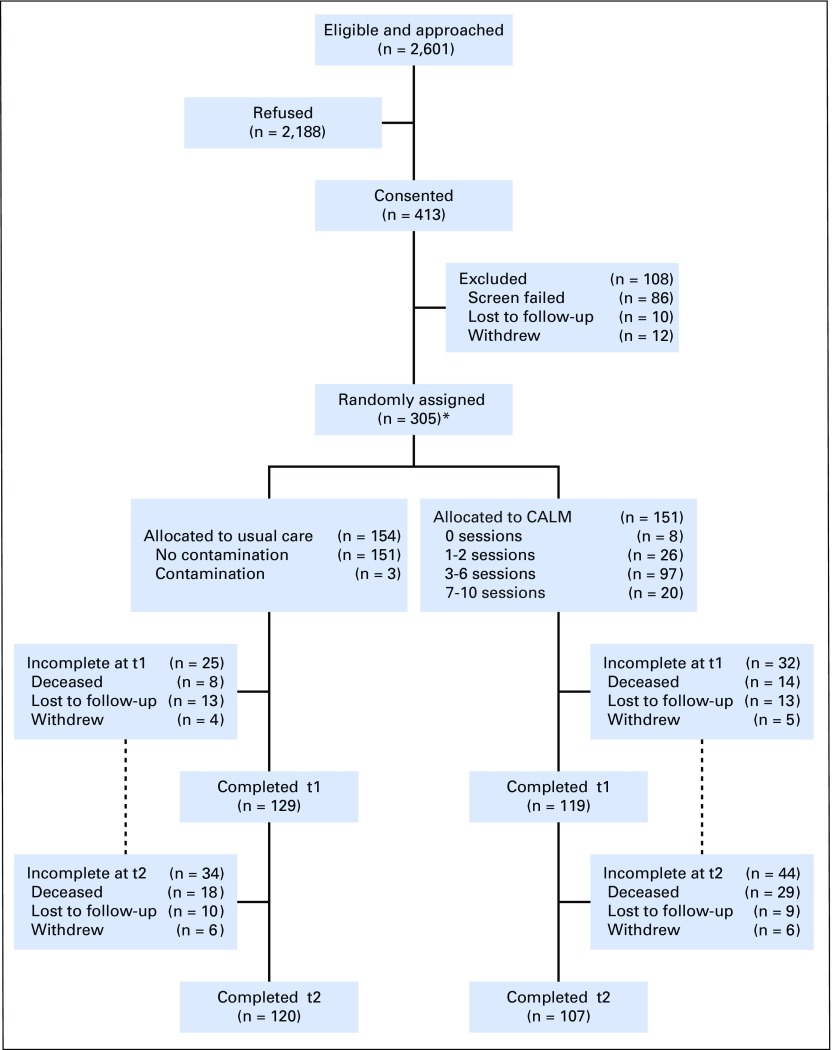
Purpose Individuals with advanced cancer experience substantial distress in response to disease burden and impending mortality. Managing Cancer And Living Meaningfully (CALM) is a novel, brief, manualized psychotherapeutic intervention intended to treat and prevent depression and end-of-life distress in patients with advanced cancer. We conducted a randomized controlled trial to compare CALM with usual care (UC) in this population. Methods Patients with advanced cancer were recruited from outpatient oncology clinics at a comprehensive cancer center into an unblinded randomized controlled trial. Permuted block randomization stratified by Patient Health Questionnaire-9 depression score allocated participants to CALM plus UC or to UC alone. Assessments of depressive symptoms (primary outcome), death-related distress, and other secondary outcomes were conducted at baseline, 3 months (primary end point), and 6 months (trial end point). Analyses were by intention to treat. Analysis of covariance was used to test for outcome differences between groups at follow-up, controlling for baseline. Mixed-model results are reported. Results Participants (n = 305) were recruited between February 3, 2012, and March 4, 2016, and randomly assigned to CALM (n = 151) or UC (n = 154). CALM participants reported less-severe depressive symptoms than UC participants at 3 months (Δ = 1.09; P = .04; Cohen's d = 0.23; 95% CI, 0.04 to 2.13) and at 6 months (Δ = 1.29; P = .02; d = 0.29; 95% CI, 0.24 to 2.35). Significant findings for greater end-of-life preparation at 6 months also favored CALM versus UC. No adverse effects were identified. Conclusion Findings suggest that CALM is an effective intervention that provides a systematic approach to alleviating depressive symptoms in patients with advanced cancer and addresses the predictable challenges these patients face.
患有晚期癌症的个体在应对疾病负担和即将到来的死亡时会经历严重的痛苦。“管理癌症和有意义地生活(CALM)”是一种新的、简短的、规范化的心理治疗干预措施,旨在治疗和预防晚期癌症患者的抑郁和生命末期痛苦。我们进行了一项随机对照试验,比较了 CALM 与常规护理(UC)在该人群中的效果。
从一家综合性癌症中心的门诊肿瘤诊所招募患有晚期癌症的患者参加这项非盲随机对照试验。采用患者健康问卷-9(PHQ-9)抑郁评分的随机区组分层分配参与者至 CALM 加 UC 组或 UC 组。在基线、3 个月(主要终点)和 6 个月(试验终点)时评估抑郁症状(主要结局)、与死亡相关的痛苦和其他次要结局。分析采用意向治疗。采用协方差分析检验随访时两组之间的结局差异,控制基线。报告混合模型结果。
2012 年 2 月 3 日至 2016 年 3 月 4 日期间招募参与者,随机分配至 CALM 组(n = 151)或 UC 组(n = 154)。CALM 组参与者在 3 个月(Δ=1.09;P =.04;Cohen's d = 0.23;95%CI,0.04 至 2.13)和 6 个月(Δ=1.29;P =.02;d = 0.29;95%CI,0.24 至 2.35)时报告的抑郁症状较轻。6 个月时CALM 与 UC 相比,在临终准备方面有显著改善。未发现不良反应。
结果表明,CALM 是一种有效的干预措施,为缓解晚期癌症患者的抑郁症状提供了一种系统的方法,并解决了这些患者面临的可预测的挑战。