Lähde Niina, Basnyat Pabitra, Raitanen Jani, Kämppi Leena, Lehtimäki Kai, Rosti-Otajärvi Eija, Peltola Jukka
Department of Neurology, Tampere University Hospital, Tampere, Finland.
Faculty of Medicine and Health Technology, Tampere University, Tampere, Finland.
Front Psychiatry. 2024 Feb 14;15:1349201. doi: 10.3389/fpsyt.2024.1349201. eCollection 2024.
There is a paucity of clinical studies examining the long-term effects of vagus nerve stimulation (VNS) on cognition, although a recent study of patients with drug-resistant epilepsy (DRE) treated with VNS therapy demonstrated significant improvement in executive functions as measured by the EpiTrack composite score. The present study aimed to investigate performance variability in three cognitive tests assessing executive functions and working memory in a cohort of DRE patients receiving VNS therapy during a follow-up duration of up to 5 years.
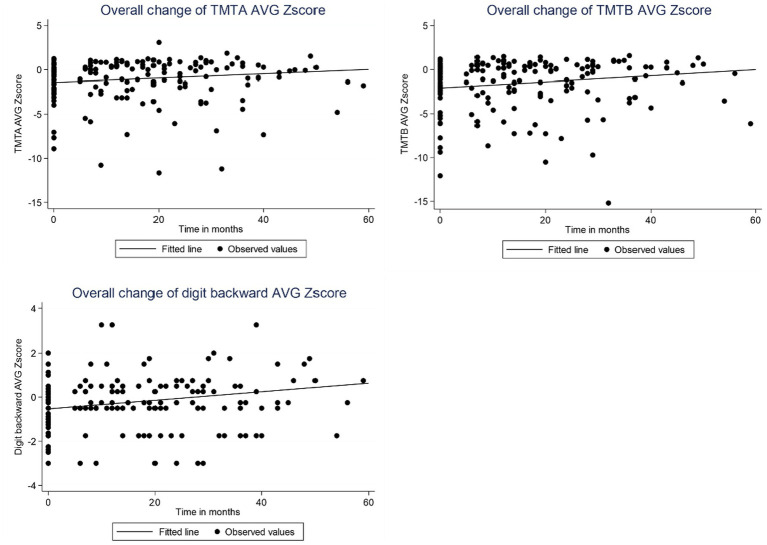
The study included 46 DRE patients who were assessed with the Trail Making Test (TMT) (Parts A and B) and Digit Span Backward (DB) task prior to VNS implantation, 6 months and 12 months after implantation, and yearly thereafter as a part of the clinical VNS protocol. A linear mixed-effects (LME) model was used to analyze changes in test z scores over time, accounting for variations in follow-up duration when predicting changes over 5 years. Additionally, we conducted descriptive analyses to illustrate individual changes.
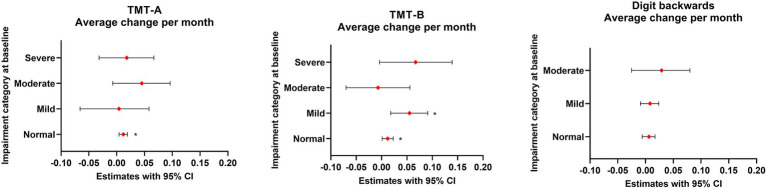
On average, TMT-A z scores improved by 0.024 units (95% confidence interval (CI): 0.006 to 0.042, = 0.009), TMT-B z scores by 0.034 units (95% CI: 0.012 to 0.057, = 0.003), and DB z scores by 0.019 units per month (95% CI: 0.011 to 0.028, < 0.001). Patients with psychiatric comorbidities achieved the greatest improvements in TMT-B and DB z scores among all groups (0.0058 units/month, = 0.036 and 0.028 units/month, = 0.003, respectively). TMT-A z scores improved the most in patients taking 1-2 ASMs as well as in patients with psychiatric comorbidities (0.042 units/month, = 0.002 and = 0.003, respectively).
Performance in all three tests improved at the group level during the follow-up period, with the most robust improvement observed in TMT-B, which requires inhibition control and set-switching in addition to the visuoperceptual processing speed that is crucial in TMT-A and working-memory performance that is essential in DB. Moreover, the improvement in TMT-B was further enhanced if the patient had psychiatric comorbidities.
尽管最近一项关于接受迷走神经刺激(VNS)治疗的耐药性癫痫(DRE)患者的研究表明,通过EpiTrack综合评分测量,执行功能有显著改善,但关于VNS对认知的长期影响的临床研究却很少。本研究旨在调查一组接受VNS治疗长达5年的DRE患者在三项评估执行功能和工作记忆的认知测试中的表现变异性。
该研究纳入了46名DRE患者,在VNS植入前、植入后6个月和12个月以及此后每年进行连线测验(TMT)(A和B部分)和数字倒背(DB)任务评估,这是临床VNS方案的一部分。使用线性混合效应(LME)模型分析测试z分数随时间的变化,在预测5年期间的变化时考虑随访时间的差异。此外,我们进行了描述性分析以说明个体变化。
平均而言,TMT-A的z分数提高了0.024个单位(95%置信区间(CI):0.006至0.042,P = 0.009),TMT-B的z分数提高了0.034个单位(95%CI:0.012至0.057,P = 0.003),DB的z分数每月提高0.019个单位(95%CI:0.011至0.028,P < 0.001)。在所有组中,患有精神疾病共病的患者在TMT-B和DB的z分数上改善最大(分别为0.0058个单位/月,P = 0.036和0.028个单位/月,P = 0.003)。服用1 - 2种抗癫痫药物(ASM)的患者以及患有精神疾病共病的患者中,TMT-A的z分数改善最为明显(分别为0.042个单位/月,P = 0.002和P = 0.003)。
在随访期间,所有三项测试的组水平表现均有所改善,其中TMT-B的改善最为显著,TMT-B除了需要TMT-A中至关重要的视觉感知处理速度和DB中必不可少的工作记忆表现外,还需要抑制控制和任务切换。此外,如果患者患有精神疾病共病,TMT-B的改善会进一步增强。