Al Helou Hiba, Kassis Joul, Zaidani Wael, Bylasani Tareq
Head of the Department of Prosthodontics at Arab Private University of Science and Technology (AUST), Hama Homs international road, Tel Qartal Junction, Syria.
Researcher at the Department of Oral and Maxillofacial Surgery, Damascus University, Fayez Mansour Highway, Mazzeh, Damascus, Syria.
Saudi Dent J. 2024 Feb;36(2):296-300. doi: 10.1016/j.sdentj.2023.11.002. Epub 2023 Nov 2.
This study aimed to evaluate the effect of multiple baking cycles of porcelain on its shear bond strength to a cobalt-chromium (Co-Cr) alloy that is three-dimensionally printed using Selective Laser Melting (SLM) technique.
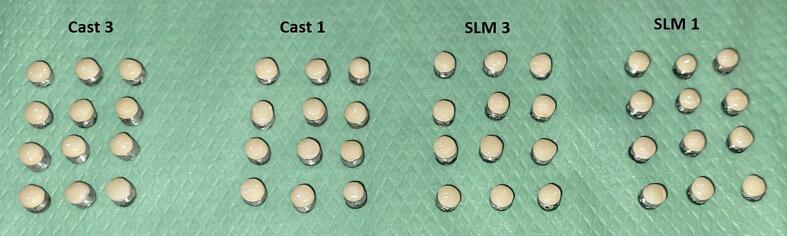
The research sample comprised forty-eight discs measuring 5 mm × 3 mm, divided into four groups according to: the manufacturing method (SLM, casting) and the number of porcelain baking cycles (1, 3) as follows: Group A: Co-Cr alloy by SLM with one baking cycle; Group B: Co-Cr alloy by SLM with three baking cycles; Group C: Ni-Cr alloy by casting with one baking cycle; Group D: Ni-Cr alloy by casting with three baking cycles. Then, porcelain was melted on disks, shear testing was performed and the values of the Shear Bond Strength (SBS) in MegaPascals (MPa) were calculated.
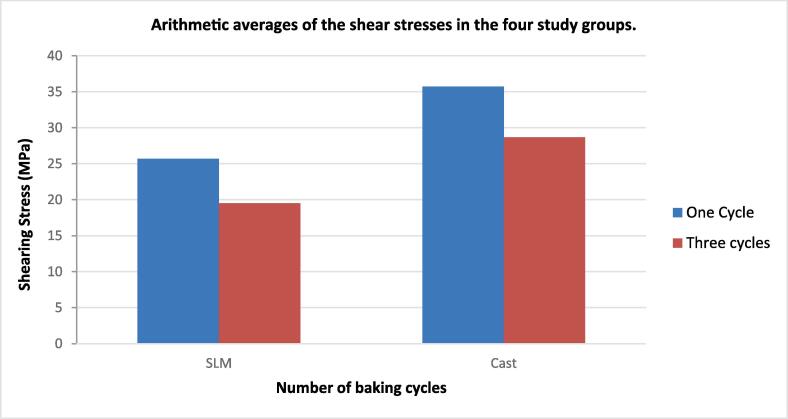
The mean SBS values for each group were (A: 25.69 - B: 19.51 - C: 35.72 - D: 28.67 MPa). Statistical analysis showed that the manufacturing method and the number of porcelain baking cycles had a significant influence on shear bond durability (P > 0.05): the strength of this bond decreased when baking cycles increased. The Co-Cr samples manufactured by SLM also showed a decrease in binding strength compared to the Ni-Cr samples made by casting.
Repeated baking of porcelain reduces the strength of the porcelain bond with the Co-Cr alloy made by Selective Laser Melting (SLM) technique.
本研究旨在评估烤瓷多次烘烤循环对其与采用选择性激光熔化(SLM)技术进行三维打印的钴铬(Co-Cr)合金之间的剪切粘结强度的影响。
研究样本包括48个尺寸为5毫米×3毫米的圆盘,根据制造方法(SLM、铸造)和烤瓷烘烤循环次数(1次、3次)分为四组,如下:A组:通过SLM制造的Co-Cr合金,1次烘烤循环;B组:通过SLM制造的Co-Cr合金,3次烘烤循环;C组:通过铸造制造的Ni-Cr合金,1次烘烤循环;D组:通过铸造制造的Ni-Cr合金,3次烘烤循环。然后,在圆盘上熔化烤瓷,进行剪切测试,并计算出以兆帕(MPa)为单位的剪切粘结强度(SBS)值。
每组的平均SBS值分别为(A组:25.69 - B组:19.51 - C组:35.72 - D组:28.67 MPa)。统计分析表明,制造方法和烤瓷烘烤循环次数对剪切粘结耐久性有显著影响(P > 0.05):随着烘烤循环次数增加,这种粘结的强度降低。与通过铸造制造的Ni-Cr样本相比,通过SLM制造的Co-Cr样本的粘结强度也有所下降。
烤瓷的反复烘烤会降低其与采用选择性激光熔化(SLM)技术制造的Co-Cr合金之间的粘结强度。