• 文献检索
  • 文档翻译
  • 深度研究
  • 学术资讯
  • Suppr Zotero 插件Zotero 插件
  • 邀请有礼
  • 套餐&价格
  • 历史记录
应用&插件
Suppr Zotero 插件Zotero 插件浏览器插件Mac 客户端Windows 客户端微信小程序
定价
高级版会员购买积分包购买API积分包
服务
文献检索文档翻译深度研究API 文档MCP 服务
关于我们
关于 Suppr公司介绍联系我们用户协议隐私条款
关注我们

Suppr 超能文献

核心技术专利:CN118964589B侵权必究
粤ICP备2023148730 号-1Suppr @ 2026

文献检索

告别复杂PubMed语法,用中文像聊天一样搜索,搜遍4000万医学文献。AI智能推荐,让科研检索更轻松。

立即免费搜索

文件翻译

保留排版,准确专业,支持PDF/Word/PPT等文件格式,支持 12+语言互译。

免费翻译文档

深度研究

AI帮你快速写综述,25分钟生成高质量综述,智能提取关键信息,辅助科研写作。

立即免费体验

非自愿分离与寻求联系的社会过程。

The social process of involuntary separation and the search for connection.

作者信息

Glasier Willow, Arbeau Kelly, Launeanu Mihaela, Kwee Janelle

机构信息

Trinity Western University, Canada.

Existential Analysis Society Canada, Canada.

出版信息

Health Psychol Open. 2024 Feb 9;11:20551029231224368. doi: 10.1177/20551029231224368. eCollection 2024 Jan-Dec.

DOI:10.1177/20551029231224368
PMID:38420186
原文链接:https://pmc.ncbi.nlm.nih.gov/articles/PMC10898822/
Abstract

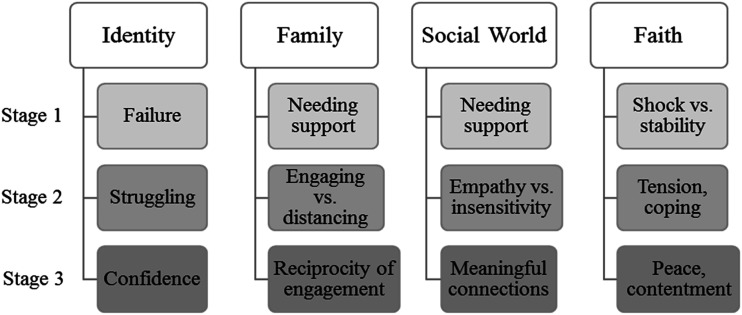
Placing a loved one in care does not relieve informal caregivers' physical and emotional stresses. This study identified the unique psycho-social-spiritual processes of involuntary separation among spouses following long-term care admission. Participants were 17 spouse-caregivers (12 women and 5 men) with a mean age of 84 years who had been involuntarily separated for an average of 20 months. The basic psycho-social-spiritual process of spouse-caregiver involuntary separation was hich had three distinct stages: (1) Initial coping, (2) Adjusting to the new situation, and (3) Moving forward. Movement through the three stages was influenced by individuals' capacity and willingness to reach out for connection and by the abilities of others to extend accurate empathy and practical help. The implications of this study highlight spouse-caregivers' needs for connection and support not only during the crisis of separation, but in the months and years that follow.

摘要

将亲人安置在护理机构并不能减轻非正式照料者的身体和情感压力。本研究确定了长期护理入院后配偶间非自愿分离所特有的心理-社会-精神过程。研究对象为17名配偶照料者(12名女性和5名男性),平均年龄84岁,他们非自愿分离的平均时间为20个月。配偶照料者非自愿分离的基本心理-社会-精神过程有三个不同阶段:(1)初始应对,(2)适应新情况,(3)向前迈进。经历这三个阶段受到个体寻求联系的能力和意愿以及他人给予准确共情和实际帮助能力的影响。本研究的意义突出了配偶照料者不仅在分离危机期间,而且在随后的数月和数年中对联系和支持的需求。

https://cdn.ncbi.nlm.nih.gov/pmc/blobs/3388/10898822/c52220701f66/10.1177_20551029231224368-fig4.jpg
https://cdn.ncbi.nlm.nih.gov/pmc/blobs/3388/10898822/bdccfba2e46d/10.1177_20551029231224368-fig1.jpg
https://cdn.ncbi.nlm.nih.gov/pmc/blobs/3388/10898822/3b72dc4a92fa/10.1177_20551029231224368-fig2.jpg
https://cdn.ncbi.nlm.nih.gov/pmc/blobs/3388/10898822/bb7149a05df5/10.1177_20551029231224368-fig3.jpg
https://cdn.ncbi.nlm.nih.gov/pmc/blobs/3388/10898822/c52220701f66/10.1177_20551029231224368-fig4.jpg
https://cdn.ncbi.nlm.nih.gov/pmc/blobs/3388/10898822/bdccfba2e46d/10.1177_20551029231224368-fig1.jpg
https://cdn.ncbi.nlm.nih.gov/pmc/blobs/3388/10898822/3b72dc4a92fa/10.1177_20551029231224368-fig2.jpg
https://cdn.ncbi.nlm.nih.gov/pmc/blobs/3388/10898822/bb7149a05df5/10.1177_20551029231224368-fig3.jpg
https://cdn.ncbi.nlm.nih.gov/pmc/blobs/3388/10898822/c52220701f66/10.1177_20551029231224368-fig4.jpg

相似文献

1
The social process of involuntary separation and the search for connection.非自愿分离与寻求联系的社会过程。
Health Psychol Open. 2024 Feb 9;11:20551029231224368. doi: 10.1177/20551029231224368. eCollection 2024 Jan-Dec.
2
Caregiving Spouses and the Experience of Involuntary Separation.照顾配偶和非自愿分离的经历。
Gerontologist. 2019 May 17;59(3):465-473. doi: 10.1093/geront/gnx163.
3
Anticipatory grief and experience of providing at-home palliative care among informal caregivers of spouses in Croatia: a qualitative study.克罗地亚配偶非专业照护者的预期悲伤和提供家庭姑息治疗的体验:一项定性研究。
BMC Palliat Care. 2022 Nov 18;21(1):199. doi: 10.1186/s12904-022-01093-1.
4
From spouse to caregiver and back: a grounded theory study of post-intensive care unit spousal caregiving.从配偶到照料者再回归:一项关于重症监护病房后配偶照料的扎根理论研究
J Adv Nurs. 2015 Aug;71(8):1892-903. doi: 10.1111/jan.12657. Epub 2015 Apr 1.
5
The caring experience in multiple sclerosis: Caregiving tasks, coping strategies and psychological well-being.多发性硬化症患者的关怀体验:照护任务、应对策略和心理健康。
Health Soc Care Community. 2020 Jan;28(1):236-246. doi: 10.1111/hsc.12858. Epub 2019 Sep 16.
6
[Qualitative approach of medical support of spouse caregivers of Alzheimer patients].[阿尔茨海默病患者配偶照顾者医疗支持的质性研究方法]
Geriatr Psychol Neuropsychiatr Vieil. 2014 Jun;12(2):155-62. doi: 10.1684/pnv.2014.0475.
7
Family carers' experiences of dysphagia after a stroke: An exploratory study of spouses living in a large metropolitan city.中风后吞咽困难患者家属的体验:对居住在大都市的配偶的探索性研究。
Int J Lang Commun Disord. 2022 Sep;57(5):924-936. doi: 10.1111/1460-6984.12724. Epub 2022 Apr 19.
8
Social Networks Effects on Spouse and Adult-Child Dementia Caregivers' Experiences: A Cross-Sectional Study.社会网络对配偶和成年子女痴呆症照顾者体验的影响:一项横断面研究。
J Am Med Dir Assoc. 2023 Sep;24(9):1374-1380.e1. doi: 10.1016/j.jamda.2023.04.006. Epub 2023 May 23.
9
[Evaluation of gender differences of family caregivers with reference to the mode of caregiving at home and caregiver distress in Japan].[参照日本家庭护理模式及护理者困扰对家庭护理者性别差异的评估]
Nihon Koshu Eisei Zasshi. 2004 Apr;51(4):240-51.
10
The health and well-being of caregivers of children with cerebral palsy.脑瘫患儿照料者的健康与幸福。
Pediatrics. 2005 Jun;115(6):e626-36. doi: 10.1542/peds.2004-1689.

本文引用的文献

1
Religious Involvement, Depressive Symptoms, and Burden in Caregivers of Terminally Ill Patients.宗教参与、抑郁症状与绝症患者照顾者的负担。
J Hosp Palliat Nurs. 2021 Jun 1;23(3):271-276. doi: 10.1097/NJH.0000000000000754.
2
"Being in-Between": Spouses That Cohabit With and Provide Care for Their Partners in Nursing Homes.“在两者之间”:与居住在养老院的伴侣共同生活并为其提供护理的配偶。
J Appl Gerontol. 2020 Apr;39(4):377-384. doi: 10.1177/0733464818803007. Epub 2018 Sep 30.
3
Love, Intimacy and Sexuality in Residential Dementia Care: A Spousal Perspective.
住院痴呆症护理中的爱、亲密关系与性行为:配偶视角
Dementia (London). 2019 Apr;18(3):936-950. doi: 10.1177/1471301217697467. Epub 2017 Mar 21.
4
Caregiving Spouses and the Experience of Involuntary Separation.照顾配偶和非自愿分离的经历。
Gerontologist. 2019 May 17;59(3):465-473. doi: 10.1093/geront/gnx163.
5
The impact of both spousal caregivers' and care recipients' health on relationship satisfaction in the Caregiver Health Effects Study.在照料者健康效应研究中,配偶照料者和被照料者的健康对关系满意度的影响。
J Health Psychol. 2019 Oct;24(12):1744-1755. doi: 10.1177/1359105317699682. Epub 2017 Mar 23.
6
Spouses' daily feelings of appreciation and self-reported well-being.配偶的日常感恩之情与自我报告的幸福感。
Health Psychol. 2017 Dec;36(12):1135-1139. doi: 10.1037/hea0000527. Epub 2017 Jul 20.
7
The experiences of family caregivers of people with advanced dementia living in nursing homes, with a specific focus on spouses: A narrative literature review.居住在养老院的晚期痴呆症患者家庭照料者的经历,特别关注配偶:一项叙述性文献综述。
Dementia (London). 2019 Jan;18(1):303-322. doi: 10.1177/1471301216671418. Epub 2016 Nov 18.
8
Constructing togetherness throughout the phases of dementia: a qualitative study exploring how spouses maintain relationships with partners with dementia who live in institutional care.在痴呆症各个阶段构建亲密关系:一项定性研究,探索配偶如何与住在机构护理中的痴呆症伴侣维持关系。
J Clin Nurs. 2016 Oct;25(19-20):3010-25. doi: 10.1111/jocn.13320. Epub 2016 Jul 19.
9
The loss of a shared lifetime: a qualitative study exploring spouses' experiences of losing couplehood with their partner with dementia living in institutional care.共享人生的失落:一项质性研究,探索配偶与住在机构照料中的痴呆伴侣失去夫妻关系的经历。
J Clin Nurs. 2015 Jan;24(1-2):121-30. doi: 10.1111/jocn.12648. Epub 2014 Jul 7.
10
Transition from the spouse dementia caregiver role: A change for the better?从配偶痴呆症照顾者角色转变:是更好的改变吗?
Dementia (London). 2016 Jul;15(4):756-73. doi: 10.1177/1471301214539337. Epub 2014 Jun 16.