
在基于大样本的研究中,通过探索粪便免疫化学检测粪便样本中的肠道 DNA 病毒组,揭示了与生活方式的关联。
Exploring the gut DNA virome in fecal immunochemical test stool samples reveals associations with lifestyle in a large population-based study.
机构信息
Centre for Bioinformatics, Department of Informatics, University of Oslo, Oslo, Norway.
Department of Tumor Biology, Institute of Cancer Research, Oslo University Hospital, Oslo, Norway.
出版信息
Nat Commun. 2024 Feb 29;15(1):1791. doi: 10.1038/s41467-024-46033-0.
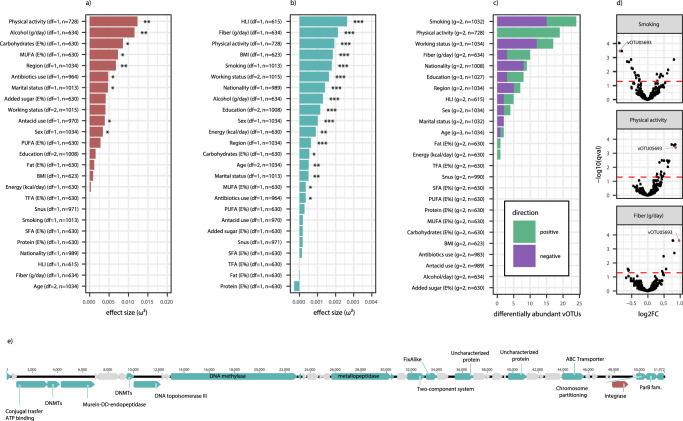
Stool samples for fecal immunochemical tests (FIT) are collected in large numbers worldwide as part of colorectal cancer screening programs. Employing FIT samples from 1034 CRCbiome participants, recruited from a Norwegian colorectal cancer screening study, we identify, annotate and characterize more than 18000 DNA viruses, using shotgun metagenome sequencing. Only six percent of them are assigned to a known taxonomic family, with Microviridae being the most prevalent viral family. Linking individual profiles to comprehensive lifestyle and demographic data shows 17/25 of the variables to be associated with the gut virome. Physical activity, smoking, and dietary fiber consumption exhibit strong and consistent associations with both diversity and relative abundance of individual viruses, as well as with enrichment for auxiliary metabolic genes. We demonstrate the suitability of FIT samples for virome analysis, opening an opportunity for large-scale studies of this enigmatic part of the gut microbiome. The diverse viral populations and their connections to the individual lifestyle uncovered herein paves the way for further exploration of the role of the gut virome in health and disease.
粪便样本的免疫化学检测(FIT)在全世界范围内作为结直肠癌筛查计划的一部分被大量采集。我们利用来自挪威结直肠癌筛查研究的 1034 名 CRCbiome 参与者的 FIT 样本,通过鸟枪法宏基因组测序来识别、注释和描述超过 18000 种 DNA 病毒。其中只有 6%被分配到已知的分类家族,其中微病毒科是最常见的病毒科。将个体图谱与全面的生活方式和人口统计学数据相关联,表明 25 个变量中的 17 个与肠道病毒组有关。体力活动、吸烟和膳食纤维的摄入与个体病毒的多样性和相对丰度以及辅助代谢基因的富集都有着强烈和一致的关联。我们证明了 FIT 样本适用于病毒组分析,为这一神秘的肠道微生物组部分的大规模研究开辟了机会。本文揭示了多样化的病毒群体及其与个体生活方式的联系,为进一步探索肠道病毒组在健康和疾病中的作用铺平了道路。


 Zotero 插件