Saw Swee Hock School of Public Health, National University of Singapore and National University Health System, Singapore, Singapore.
Health Services Research Unit, Singapore General Hospital, Singapore, Singapore.
Orphanet J Rare Dis. 2024 Feb 29;19(1):93. doi: 10.1186/s13023-024-03099-9.
While health care and societal costs are routinely modelled for most diseases, there is a paucity of comprehensive data and cost-of-illness (COI) studies for inherited retinal diseases (IRDs). This lack of data can lead to underfunding or misallocation of resources. A comprehensive understanding of the COI of IRDs would assist governmental and healthcare leaders in determining optimal resource allocation, prioritizing funding for research, treatment, and support services for these patients.
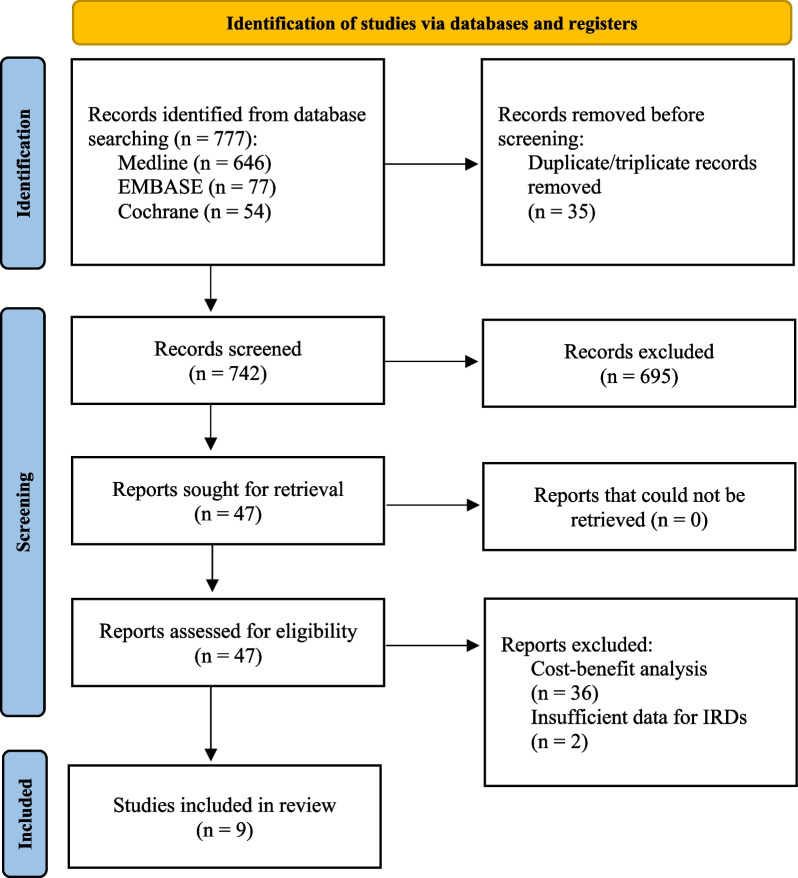
Following PRISMA guidelines, a literature search was conducted using Medline, EMBASE and Cochrane databases, from database inception up to 30 Jun 2023, to identify COI studies related to IRD. Original studies in English, primarily including patients with IRDs, and whose main study objective was the estimation of the costs of IRDs and had sufficiently detailed methodology to assess study quality were eligible for inclusion. To enable comparison across countries and studies, all annual costs were standardized to US dollars, adjusted for inflation to reflect their current value and recalculated on a "per patient" basis wherever possible. The review protocol was registered in PROSPERO (registration number CRD42023452986).
A total of nine studies were included in the final stage of systematic review and they consistently demonstrated a significant disease burden associated with IRDs. In Singapore, the mean total cost per patient was roughly US$6926/year. In Japan, the mean total cost per patient was US$20,833/year. In the UK, the mean total cost per patient with IRD ranged from US$21,658 to US$36,549/year. In contrast, in the US, the mean total per-patient costs for IRDs ranged from about US$33,017 to US$186,051 per year. In Canada, these mean total per-patient costs varied between US$16,470 and US$275,045/year. Non-health costs constituted the overwhelming majority of costs as compared to healthcare costs; 87-98% of the total costs were due to non-health costs, which could be attributed to diminished quality of life, poverty, and increased informal caregiving needs for affected individuals.
IRDs impose a disproportionate societal burden outside health systems. It is vital for continued funding into IRD research, and governments should incorporate societal costs in the evaluation of cost-effectiveness for forthcoming IRD interventions, including genomic testing and targeted therapies.
虽然医疗保健和社会成本通常是针对大多数疾病进行建模的,但对于遗传性视网膜疾病 (IRD),缺乏全面的数据和疾病成本研究。这种数据的缺乏可能导致资源的不足或分配不当。全面了解 IRD 的疾病成本将有助于政府和医疗保健领导人确定最佳资源分配,为这些患者的研究、治疗和支持服务确定优先资金。
根据 PRISMA 指南,使用 Medline、EMBASE 和 Cochrane 数据库进行文献检索,从数据库建立到 2023 年 6 月 30 日,以确定与 IRD 相关的疾病成本研究。符合纳入标准的原始研究为英语,主要包括 IRD 患者,且主要研究目标是估计 IRD 的成本,并具有足够详细的方法学来评估研究质量。为了能够在各国和研究之间进行比较,所有年度成本均按美元标准化,根据通货膨胀进行调整以反映其当前价值,并在可能的情况下按“每位患者”重新计算。审查方案在 PROSPERO(注册号 CRD42023452986)中进行了注册。
共有 9 项研究进入系统评价的最后阶段,它们一致表明 IRD 与重大疾病负担相关。在新加坡,每位患者的平均总成本约为每年 6926 美元。在日本,每位患者的平均总成本为每年 20833 美元。在英国,IRD 患者的平均总成本为每年 21658 至 36549 美元。相比之下,在美国,IRD 的每位患者的平均总费用约为每年 33017 至 186051 美元。在加拿大,这些每位患者的平均总成本在 16470 至 275045 美元之间。与医疗保健成本相比,非医疗成本构成了成本的绝大多数;总成本的 87-98%归因于非医疗成本,这可能是由于个人生活质量下降、贫困和对受影响个体的非正式护理需求增加所致。
IRD 在卫生系统之外造成了不成比例的社会负担。继续为 IRD 研究提供资金至关重要,政府应将社会成本纳入即将进行的 IRD 干预措施(包括基因组测试和靶向治疗)的成本效益评估中。