Medical Physics Unit, McGill University, Montreal, Quebec, Canada.
J Appl Clin Med Phys. 2024 Jul;25(7):e14314. doi: 10.1002/acm2.14314. Epub 2024 Feb 29.
This study aims to address the lack of spatial dose comparisons of planned and delivered rectal doses during prostate radiotherapy by using dose-surface maps (DSMs) to analyze dose delivery accuracy and comparing these results to those derived using DVHs.
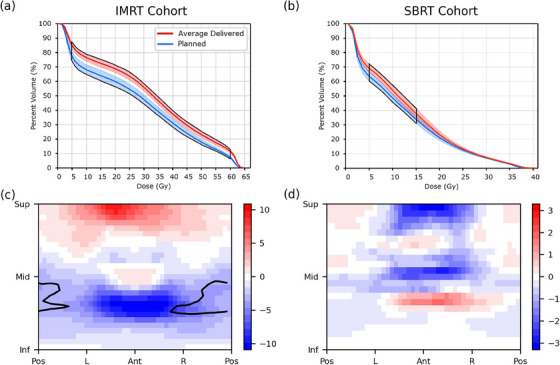
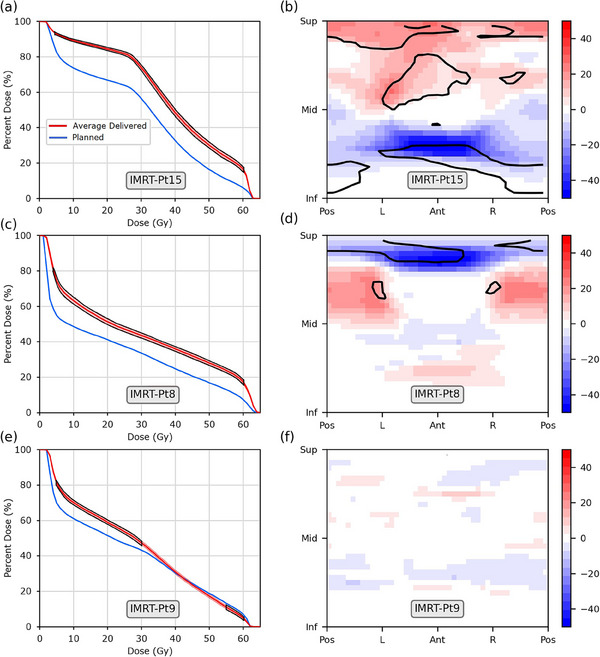
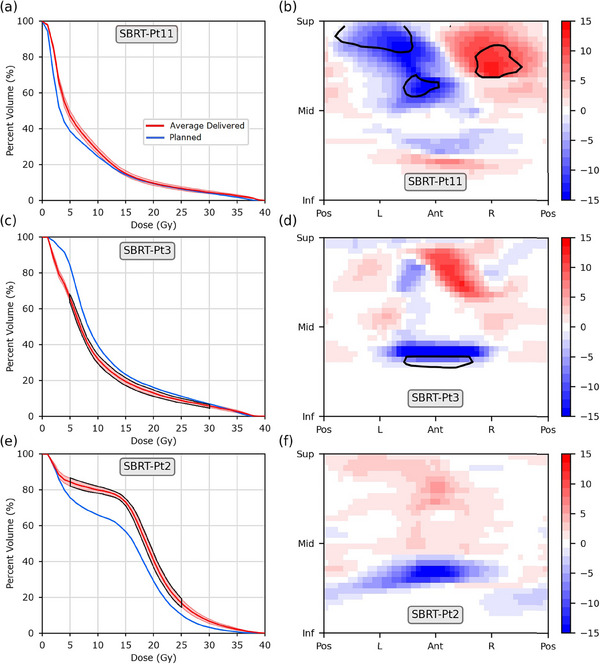
Two independent cohorts were used in this study: twenty patients treated with 36.25 Gy in five fractions (SBRT) and 20 treated with 60 Gy in 20 fractions (IMRT). Daily delivered rectum doses for each patient were retrospectively calculated using daily CBCT images. For each cohort, planned and average-delivered DVHs were generated and compared, as were planned and accumulated DSMs. Permutation testing was used to identify DVH metrics and DSM regions where significant dose differences occurred. Changes in rectal volume and position between planning and delivery were also evaluated to determine possible correlation to dosimetric changes.
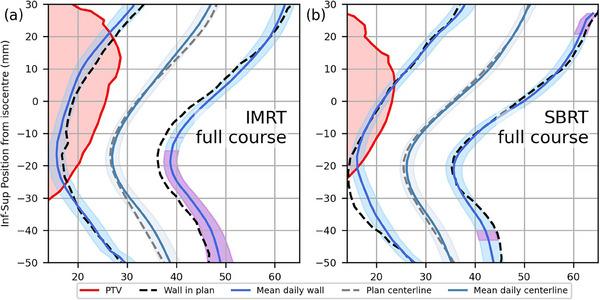
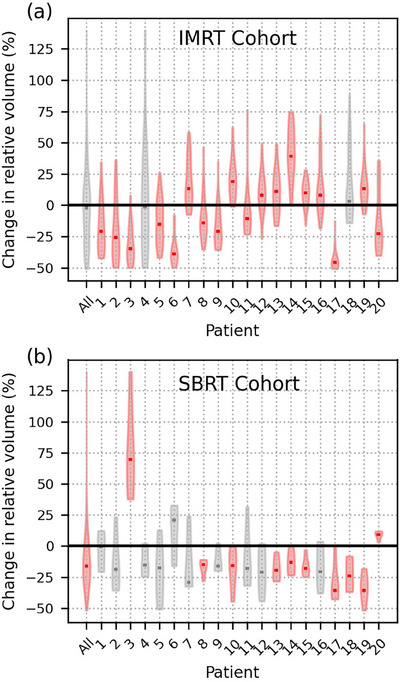
For both cohorts, DVHs and DSMs reported conflicting findings on how planned and delivered rectum doses differed from each other. DVH analysis determined average-delivered DVHs were on average 7.1% ± 7.6% (p ≤ 0.002) and 5.0 ± 7.4% (p ≤ 0.021) higher than planned for the IMRT and SBRT cohorts, respectively. Meanwhile, DSM analysis found average delivered posterior rectal wall dose was 3.8 ± 0.6 Gy (p = 0.014) lower than planned in the IMRT cohort and no significant dose differences in the SBRT cohort. Observed dose differences were moderately correlated with anterior-posterior rectal wall motion, as well as PTV superior-inferior motion in the IMRT cohort. Evidence of both these relationships were discernable in DSMs.
DSMs enabled spatial investigations of planned and delivered doses can uncover associations with interfraction motion that are otherwise masked in DVHs. Investigations of dose delivery accuracy in radiotherapy may benefit from using DSMs over DVHs for certain organs such as the rectum.
本研究旨在通过剂量-表面图(DSM)分析来解决前列腺放射治疗中计划和递送直肠剂量缺乏空间剂量比较的问题,并将这些结果与使用 DVH 得出的结果进行比较。
本研究使用了两个独立的队列:20 例接受 36.25 Gy 五分数(SBRT)治疗的患者和 20 例接受 60 Gy 二十分数(IMRT)治疗的患者。使用每日 CBCT 图像对每位患者的每日递送直肠剂量进行回顾性计算。对于每个队列,生成并比较了计划和平均递送的 DVH,并比较了计划和累积的 DSM。使用置换检验来识别剂量差异发生的 DVH 指标和 DSM 区域。还评估了直肠体积和位置在计划和交付之间的变化,以确定与剂量变化相关的可能相关性。
对于两个队列,DVH 和 DSM 的报告结果都表明计划和递送直肠剂量之间存在差异。DVH 分析确定平均递送的 DVH 平均比计划高 7.1%±7.6%(p≤0.002)和 5.0±7.4%(p≤0.021),分别用于 IMRT 和 SBRT 队列。同时,DSM 分析发现 IMRT 队列中平均递送的后直肠壁剂量比计划低 3.8±0.6 Gy(p=0.014),而 SBRT 队列中没有显著的剂量差异。观察到的剂量差异与前后直肠壁运动以及 PTV 上下运动中度相关,IMRT 队列中可以明显看出这些关系。
DSM 能够对计划和递送剂量进行空间研究,可以揭示与分次间运动的关联,而这些关联在 DVH 中被掩盖。对于直肠等某些器官,剂量递送准确性的放射治疗研究可能受益于使用 DSM 而不是 DVH。