Chen Jian, Yang Zhe, Gao Fengqiang, Zhou Zhisheng, Chen Junli, Lu Di, Wang Kai, Sui Meihua, Wang Zhengxin, Guo Wenzhi, Lyu Guoyue, Qi Haizhi, Cai Jinzhen, Yang Jiayin, Zheng Shusen, Xu Xiao
Zhejiang University School of Medicine, Hangzhou 310030, China.
Institute of Organ Transplantation, Zhejiang University, Hangzhou 310030, China.
Cancer Biol Med. 2024 Feb 28;21(4):347-62. doi: 10.20892/j.issn.2095-3941.2023.0453.
Sex-specific differences are observed in various liver diseases, but the influence of sex on the outcomes of hepatocellular carcinoma (HCC) after liver transplantation (LT) remains to be determined. This study is the first Chinese nationwide investigation of the role of sex in post-LT outcomes in patients with HCC.
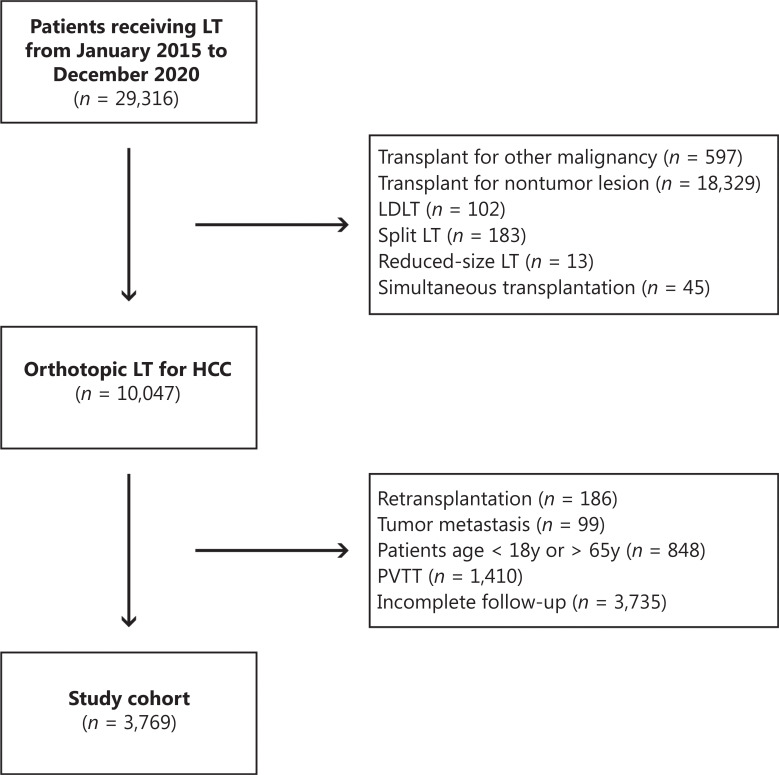
Data for recipients with HCC registered in the China Liver Transplant Registry between January 2015 and December 2020 were analyzed. The associations between donor, recipient, or donor-recipient transplant patterns by sex and the post-LT outcomes were studied with propensity score matching (PSM). The survival associated with different sex-based donor-recipient transplant patterns was further studied.
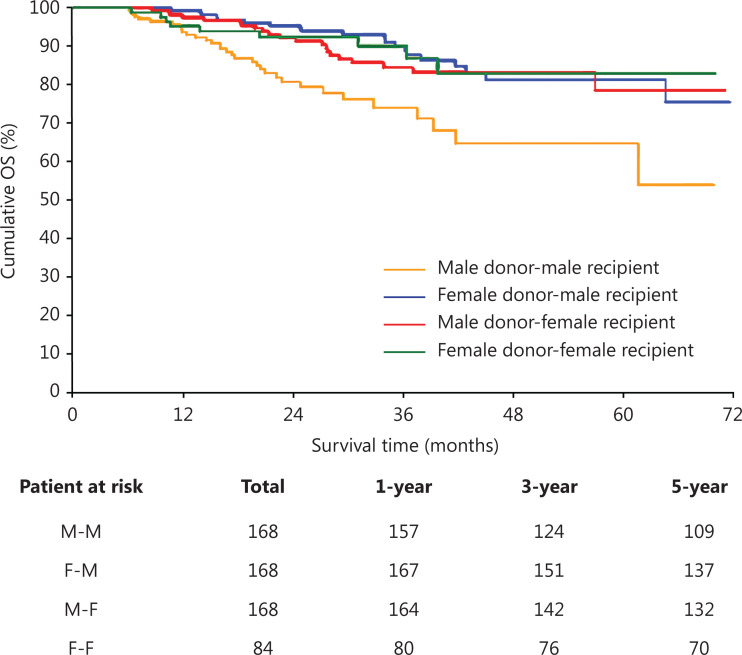
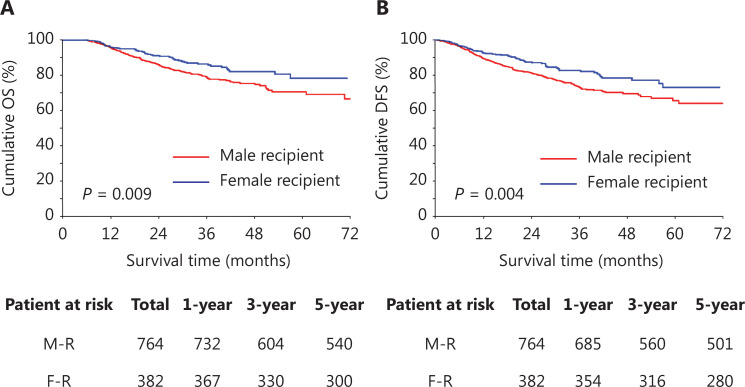
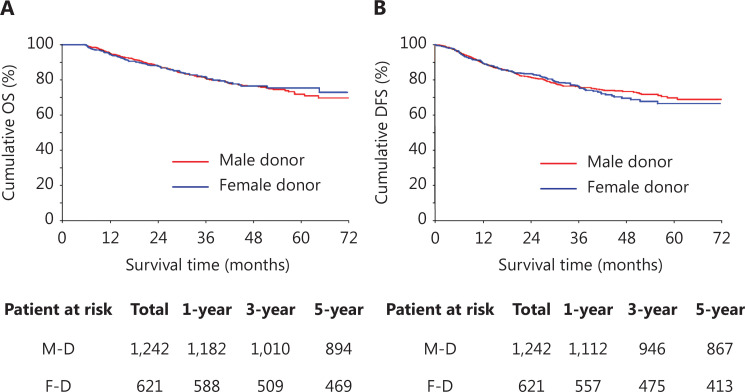
Among 3,769 patients enrolled in this study, the 1-, 3-, and 5-year overall survival (OS) rates of patients with HCC after LT were 96.1%, 86.4%, and 78.5%, respectively, in female recipients, and 95.8%, 79.0%, and 70.7%, respectively, in male recipients after PSM ( = 0.009). However, the OS was comparable between recipients with female donors and male donors. Multivariate analysis indicated that male recipient sex was a risk factor for post-LT survival (HR = 1.381, = 0.046). Among the donor-recipient transplant patterns, the male-male donor-recipient transplant pattern was associated with the poorest post-LT survival ( < 0.05).
Our findings highlighted that the post-LT outcomes of female recipients were significantly superior to those of male recipients, and the male-male donor-recipient transplant pattern was associated with the poorest post-LT survival. Livers from male donors may provide the most benefit to female recipients. Our results indicate that sex should be considered as a critical factor in organ allocation.
在各种肝脏疾病中均观察到性别差异,但性别对肝移植(LT)后肝细胞癌(HCC)结局的影响仍有待确定。本研究是中国首次针对性别在HCC患者LT后结局中的作用进行的全国性调查。
分析2015年1月至2020年12月在中国肝移植登记处登记的HCC受者的数据。采用倾向评分匹配(PSM)研究按性别分类的供体、受体或供体-受体移植模式与LT后结局之间的关联。进一步研究不同性别供体-受体移植模式相关的生存率。
本研究纳入的3769例患者中,PSM后女性受者LT后HCC患者的1年、3年和5年总生存率(OS)分别为96.1%、86.4%和78.5%,男性受者分别为95.8%、79.0%和70.7%(P = 0.009)。然而,女性供体受者和男性供体受者的OS相当。多因素分析表明,男性受者性别是LT后生存的危险因素(HR = 1.381,P = 0.046)。在供体-受体移植模式中,男性-男性供体-受体移植模式与LT后生存最差相关(P < 0.05)。
我们的研究结果突出表明,女性受者的LT后结局显著优于男性受者,且男性-男性供体-受体移植模式与LT后生存最差相关。男性供体的肝脏可能对女性受者最有益。我们的结果表明,性别应被视为器官分配中的一个关键因素。