Department of Hepatobiliary and Pancreatic Surgery, The Center for Integrated Oncology and Precision Medicine, Affiliated Hangzhou First People's Hospital, Zhejiang University School of Medicine, 261 HuanSha Road, Hangzhou, 310006, China.
Department of Electrical Engineering and Computer Science, Syracuse University, 4-206 Center for Science and Technology, Syracuse, NY, 13244-4100, USA.
Hepatol Int. 2022 Jun;16(3):577-589. doi: 10.1007/s12072-022-10321-y. Epub 2022 Mar 29.
There is a growing need for new improved classifiers of prognosis in hepatocellular carcinoma (HCC) patients to stratify them effectively.
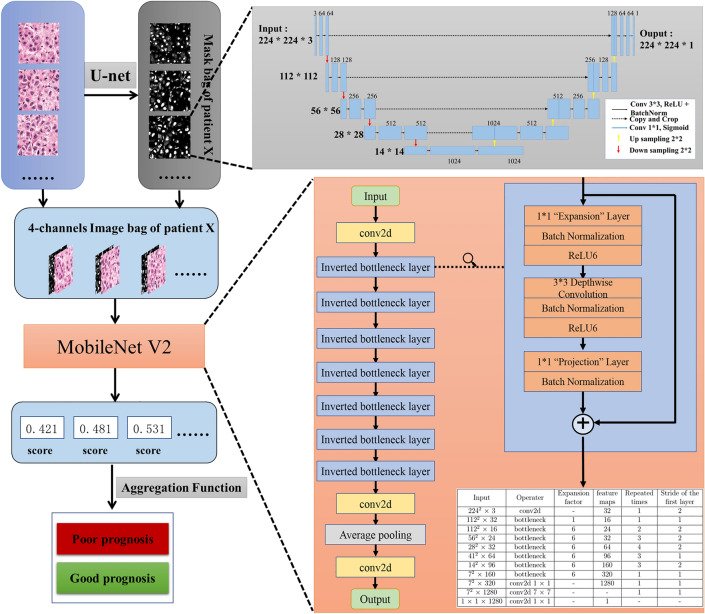
A deep learning model was developed on a total of 1118 patients from 4 independent cohorts. A nucleus map set (n = 120) was used to train U-net to capture the nuclear architecture. The training set (n = 552) included HCC patients that had been treated by resection. The liver transplantation (LT) set (n = 144) contained patients with HCC that had been treated by LT. The train set and its nuclear architectural information extracted by U-net were used to train the MobileNet V2-based classifier (MobileNetV2_HCC_class). The classifier was then independently tested on the LT set and externally validated on the TCGA set (n = 302). The primary outcome was recurrence free survival (RFS).
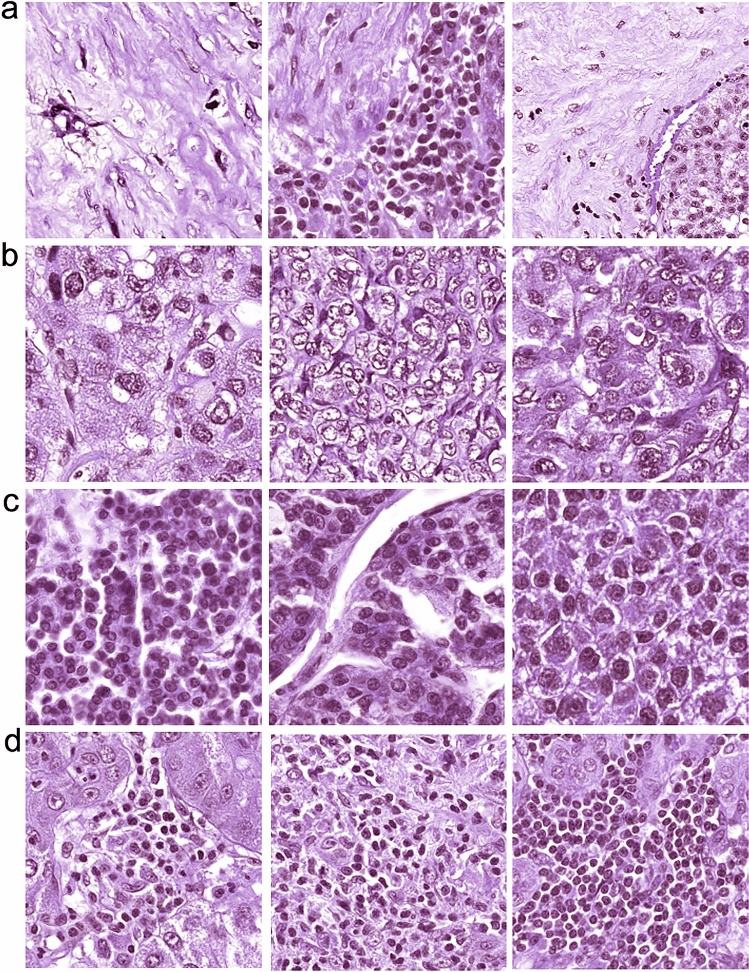
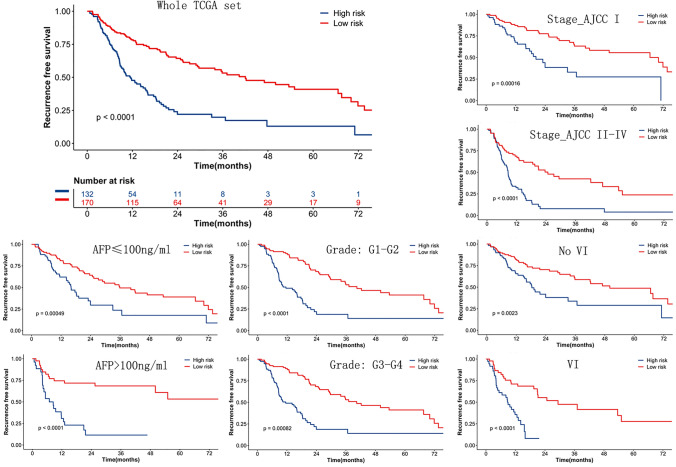
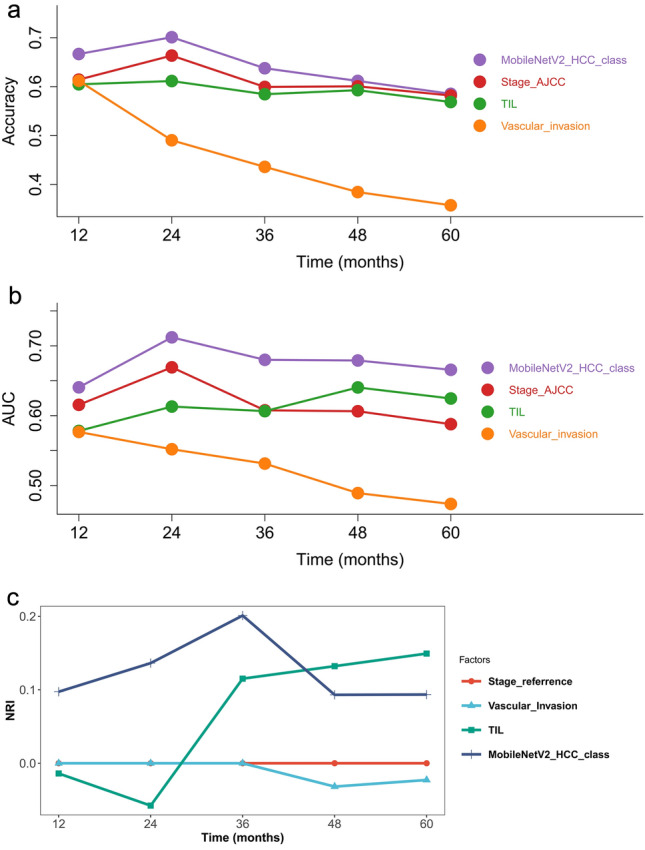
The MobileNetV2_HCC_class was a strong predictor of RFS in both LT set and TCGA set. The classifier provided a hazard ratio of 3.44 (95% CI 2.01-5.87, p < 0.001) for high risk versus low risk in the LT set, and 2.55 (95% CI 1.64-3.99, p < 0.001) when known prognostic factors, remarkable in univariable analyses on the same cohort, were adjusted. The MobileNetV2_HCC_class maintained a relatively higher discriminatory power [time-dependent accuracy and area under curve (AUC)] than other factors after LT or resection in the independent validation set (LT and TCGA set). Net reclassification improvement (NRI) analysis indicated MobileNetV2_HCC_class exhibited better net benefits for the Stage_AJCC beyond other independent factors. A pathological review demonstrated that tumoral areas with the highest recurrence predictability featured the following features: the presence of stroma, a high degree of cytological atypia, nuclear hyperchromasia, and a lack of immune cell infiltration.
A prognostic classifier for clinical purposes had been proposed based on the use of deep learning on histological slides from HCC patients. This classifier assists in refining the prognostic prediction of HCC patients and identifies patients who have been benefited from more intensive management.
肝细胞癌 (HCC) 患者需要新的预后改善分类器来对其进行有效分层,这一需求日益增长。
在来自 4 个独立队列的总共 1118 名患者中开发了一种深度学习模型。一组核图谱(n=120)用于训练 U-net 以捕获核结构。训练集(n=552)包含已接受切除术治疗的 HCC 患者。肝移植 (LT) 组(n=144)包含已接受 LT 治疗的 HCC 患者。训练集及其通过 U-net 提取的核结构信息用于训练基于 MobileNet V2 的分类器(MobileNetV2_HCC_class)。然后,该分类器在 LT 组中进行独立测试,并在 TCGA 组(n=302)中进行外部验证。主要结局是无复发生存率 (RFS)。
MobileNetV2_HCC_class 是 LT 组和 TCGA 组中 RFS 的强有力预测因子。该分类器在 LT 组中为高危与低危提供了 3.44(95%CI 2.01-5.87,p<0.001)的风险比,而当调整已知预后因素时,在同一队列的单变量分析中显著,风险比为 2.55(95%CI 1.64-3.99,p<0.001)。在独立验证集(LT 和 TCGA 组)中,在 LT 或切除术后,MobileNetV2_HCC_class 比其他因素保持相对较高的判别能力[时间依赖性准确性和曲线下面积 (AUC)]。净重新分类改进 (NRI) 分析表明,MobileNetV2_HCC_class 在其他独立因素之外为 AJCC 分期 A 提供了更好的净收益。病理回顾表明,具有最高复发预测性的肿瘤区域具有以下特征:基质存在、细胞异型性程度高、核深染和免疫细胞浸润缺乏。
基于对 HCC 患者组织学幻灯片的深度学习,提出了一种用于临床目的的预后分类器。该分类器有助于细化 HCC 患者的预后预测,并确定从更强化管理中受益的患者。