de Santana Beatriz Raz Franco, Borim Flávia Silva Arbex, de Assumpção Daniela, Neri Anita Liberalesso, Yassuda Mônica Sanches
Postgraduate Program in Gerontology, Faculdade de Ciências Médicas, Universidade Estadual de Campinas, Campinas SP, Brazil.
Gerontolgy, Escola de Artes, Ciências e Humanidades, Universidade de São Paulo, São Paulo SP, Brazil.
Dement Neuropsychol. 2024 Feb 9;18:e20230051. doi: 10.1590/1980-5764-DN-2023-0051. eCollection 2024.
Frailty is defined as a recognizable state of increased vulnerability resulting from age-associated decline of function in various physiological systems, such that the ability to deal with acute or everyday stressors is compromised.
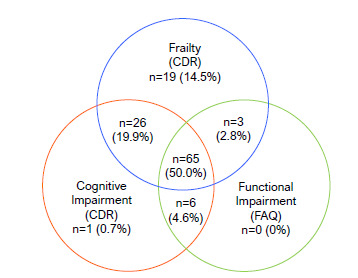
The aim of the study was to characterize the sample of older adults with cognitive impairment, according to the frailty status indirectly assessed by family members, other clinical and sociodemographic variables; and to assess the overlap of clinical conditions evaluated in this sample with cognitive impairment.
Data were extracted from the follow-up database of the Frailty in Brazilian Older Adults (FIBRA) study (2016-2017). The sample consisted of 130 elderly people with cognitive impairment assessed by the Mini Mental State Examination (MMSE). The scores for the Clinical Dementia Scale (CDR), Cornell Scale for Depression in Dementia and Functional Activities Questionnaire were described. Frailty was indirectly measured through questions answered by family members about the five criteria that compose the frailty phenotype.
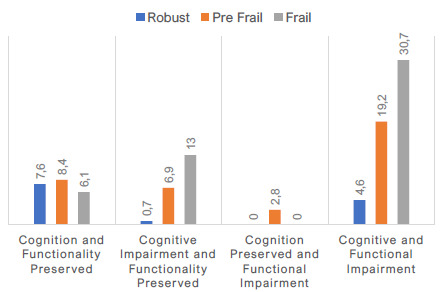
The sample consisted mostly of older women (n=91) with a mean age of 82.4 (SD=5.3) years, mean schooling of 3.3 years (SD=3.07), widowed (47.7%) and who lived with children and/or grandchildren (68%). More than half had multimorbidity (74.90%), 39.5% had depression symptoms suggestive of major depression, 57% had impaired functionality, 49.3% were frail, 37.6% pre-frail, and 13.10% robust.
Among older adults with cognitive impairment, frailty and functional limitations are common.
衰弱被定义为一种可识别的脆弱状态,这种状态是由各种生理系统中与年龄相关的功能衰退导致的,以至于应对急性或日常应激源的能力受到损害。
本研究的目的是根据家庭成员间接评估的衰弱状态、其他临床和社会人口学变量,对患有认知障碍的老年人样本进行特征描述;并评估该样本中评估的临床状况与认知障碍的重叠情况。
数据从巴西老年人衰弱(FIBRA)研究(2016 - 2017年)的随访数据库中提取。样本包括130名通过简易精神状态检查表(MMSE)评估患有认知障碍的老年人。描述了临床痴呆评定量表(CDR)、康奈尔痴呆抑郁量表和功能活动问卷的得分。通过家庭成员回答的关于构成衰弱表型的五个标准的问题间接测量衰弱。
样本主要由老年女性(n = 91)组成,平均年龄为82.4(标准差 = 5.3)岁,平均受教育年限为3.3年(标准差 = 3.07),丧偶(47.7%),与子女和/或孙辈一起生活(68%)。超过一半的人患有多种疾病(74.90%),39.5%有提示重度抑郁的抑郁症状,57%功能受损,49.3%衰弱,37.6%为衰弱前期,13.10%健康。
在患有认知障碍的老年人中,衰弱和功能受限很常见。