Song Zhiwei, Li Wangyu, Han Yupeng, Xu Yiya, Wang Yinzhou
Department of Neurology, Fujian Provincial Hospital, Shengli Clinical Medical College of Fujian Medical University, Fuzhou, Fujian, China.
Department of Pain Management, Fujian Provincial Hospital, Shengli Clinical Medical College of Fujian Medical University, Fuzhou, Fujian, China.
Front Aging Neurosci. 2024 Feb 15;16:1358996. doi: 10.3389/fnagi.2024.1358996. eCollection 2024.
The epidemiological association between frailty and insomnia is well established, yet the presence of a common genetic etiology is still uncertain. Further exploration is needed to ascertain the causal relationship between frailty and insomnia.
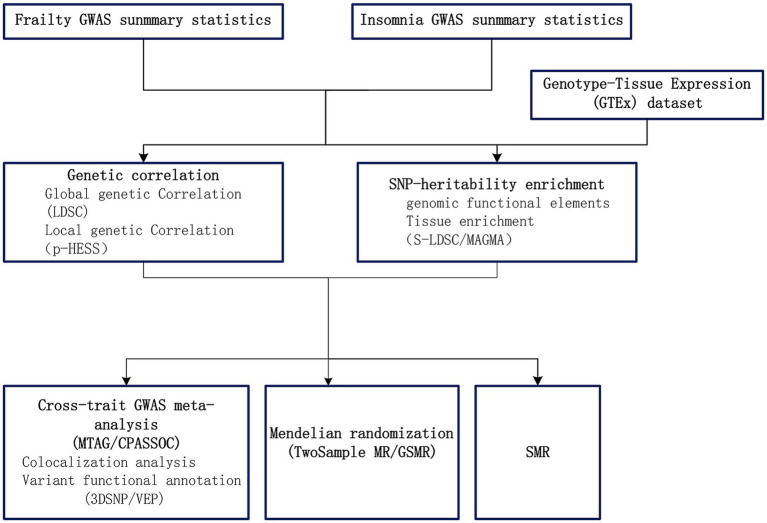
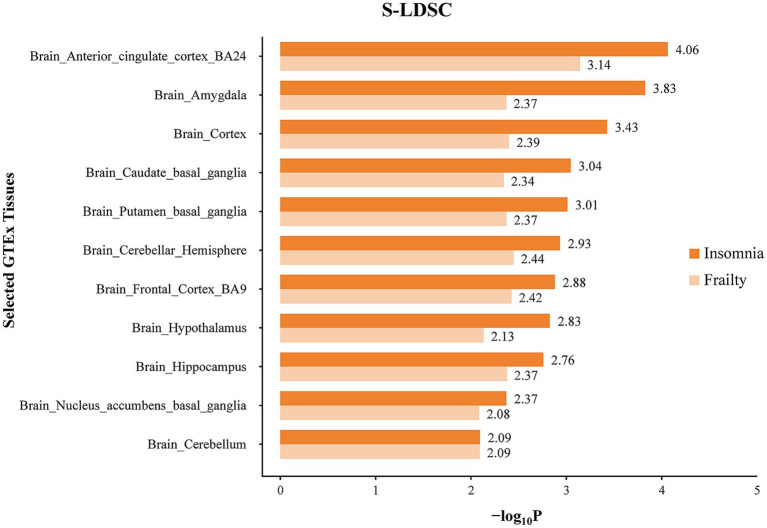
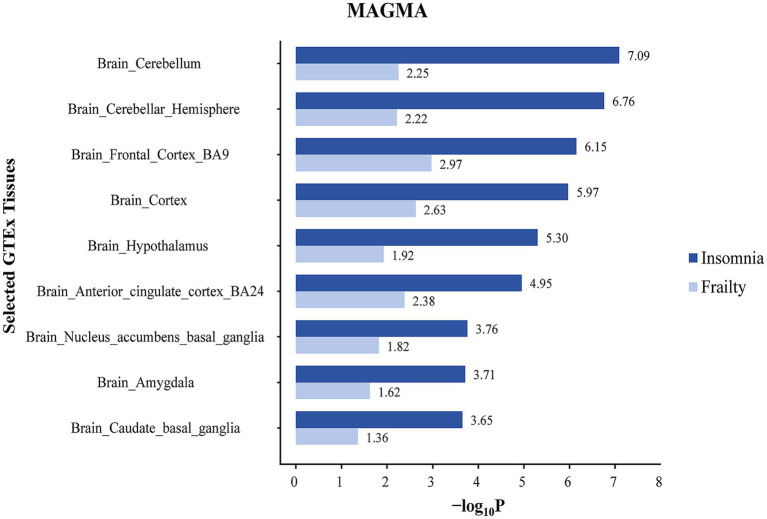
Utilizing data obtained from genome-wide association studies (GWAS) summaries, we utilized the linkage disequilibrium score regression (LDSC) to determine the genetic correlation existing between frailty and insomnia. The determination of causality was achieved through the application of two-sample Mendelian randomization. We investigated the enrichment of single nucleotide polymorphism (SNP) at various tissue types utilizing stratified LD score regression (S-LDSC) and multimarker analysis of genome annotation (MAGMA). Common risk SNPs were identified using Multi-Trait Analysis of GWAS (MTAG) and Cross-Phenotype Association (CPASSOC). We further investigated the expression profiles of risk genes in tissues using Summary-data-based Mendelian randomization(SMR) based on pooled data, to explore potential functional genes.
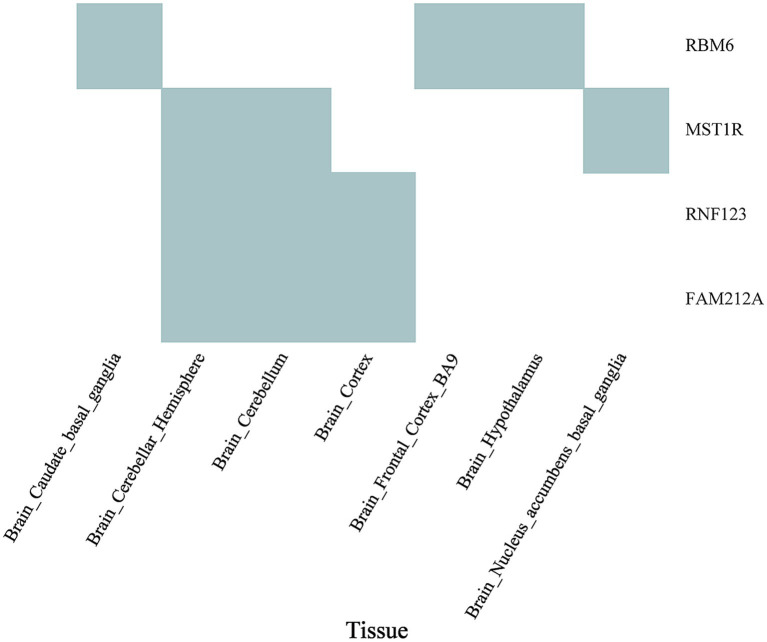
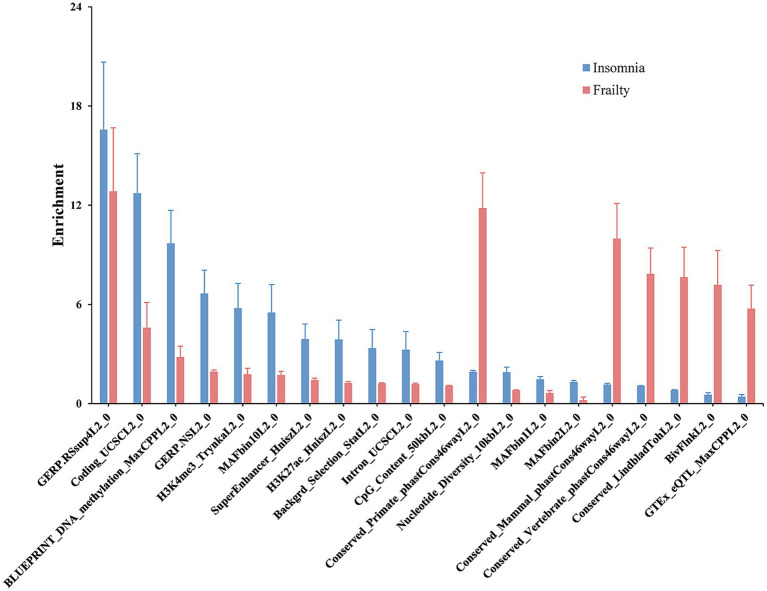
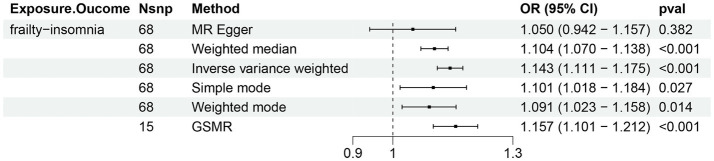
Our findings indicated a significant genetic correlation between frailty and insomnia, highlighting SNPs sharing risk (rs34290943, rs10865954), with a pronounced correlation in the localized genomic region 3p21.31. Partitioned genetic analysis revealed 24 functional elements significantly associated with both frailty and insomnia. Furthermore, mendelian randomization revealed a causal connection between frailty and insomnia. The genetic correlation between frailty and insomnia showed enrichment in 11 brain regions (S-LDSC) and 9 brain regions (MAGMA), where four functional genes (RMB6, MST1R, RF123, and FAM212A) were identified.
This study suggests the existence of a genetic correlation and common risk genes between frailty and insomnia, contributing to a deeper comprehension of their pathogenesis and assists in identifying potential therapeutic targets.
衰弱与失眠之间的流行病学关联已得到充分证实,但其共同遗传病因的存在仍不确定。需要进一步探索以确定衰弱与失眠之间的因果关系。
利用从全基因组关联研究(GWAS)汇总数据中获得的数据,我们使用连锁不平衡评分回归(LDSC)来确定衰弱与失眠之间存在的遗传相关性。通过应用两样本孟德尔随机化来确定因果关系。我们利用分层LD评分回归(S-LDSC)和基因组注释多标记分析(MAGMA)研究了各种组织类型中单核苷酸多态性(SNP)的富集情况。使用GWAS多性状分析(MTAG)和跨表型关联(CPASSOC)鉴定常见风险SNP。我们基于汇总数据,使用基于汇总数据的孟德尔随机化(SMR)进一步研究了组织中风险基因的表达谱,以探索潜在功能基因。
我们的研究结果表明衰弱与失眠之间存在显著的遗传相关性,突出了共享风险的SNP(rs34290943,rs10865954),在局部基因组区域3p21.31中具有明显的相关性。分区遗传分析显示24个功能元件与衰弱和失眠均显著相关。此外,孟德尔随机化揭示了衰弱与失眠之间的因果关系。衰弱与失眠之间的遗传相关性在11个脑区(S-LDSC)和9个脑区(MAGMA)中显示出富集,其中鉴定出四个功能基因(RMB6、MST1R、RF123和FAM212A)。
本研究表明衰弱与失眠之间存在遗传相关性和共同风险基因,有助于更深入地理解其发病机制,并有助于识别潜在的治疗靶点。