
血清分泌磷蛋白 1 水平与冠心病患者斑块易损性相关。
Serum secreted phosphoprotein 1 level is associated with plaque vulnerability in patients with coronary artery disease.
机构信息
Department of Vascular and Cardiology, Rui Jin Hospital Shanghai Jiaotong University School of Medicine, Shanghai, China.
Institute of Cardiovascular Diseases, Shanghai Jiaotong University, School of Medicine, Shanghai, China.
出版信息
Front Immunol. 2024 Feb 15;15:1285813. doi: 10.3389/fimmu.2024.1285813. eCollection 2024.
BACKGROUND
Vulnerable plaque was associated with recurrent cardiovascular events. This study was designed to explore predictive biomarkers of vulnerable plaque in patients with coronary artery disease.
METHODS
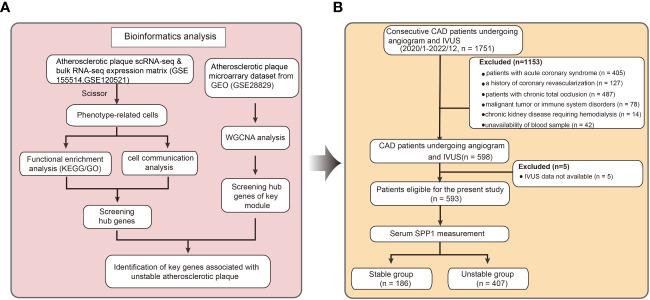
To reveal the phenotype-associated cell type in the development of vulnerable plaque and to identify hub gene for pathological process, we combined single-cell RNA and bulk RNA sequencing datasets of human atherosclerotic plaques using Single-Cell Identification of Subpopulations with Bulk Sample Phenotype Correlation (Scissor) and Weighted gene co-expression network analysis (WGCNA). We also validated our results in an independent cohort of patients by using intravascular ultrasound during coronary angiography.
RESULTS
Macrophages were found to be strongly correlated with plaque vulnerability while vascular smooth muscle cell (VSMC), fibrochondrocyte (FC) and intermediate cell state (ICS) clusters were negatively associated with unstable plaque. Weighted gene co-expression network analysis showed that Secreted Phosphoprotein 1 (SPP1) in the turquoise module was highly correlated with both the gene module and the clinical traits. In a total of 593 patients, serum levels of SPP1 were significantly higher in patients with vulnerable plaques than those with stable plaque (113.21 [73.65 - 147.70] ng/ml versus 71.08 [20.64 - 135.68] ng/ml; < 0.001). Adjusted multivariate regression analysis revealed that serum SPP1 was an independent determinant of the presence of vulnerable plaque. Receiver operating characteristic curve analysis indicated that the area under the curve was 0.737 (95% CI 0.697 - 0.773; < 0.001) for adding serum SPP1 in predicting of vulnerable plaques.
CONCLUSION
Elevated serum SPP1 levels confer an increased risk for plaque vulnerability in patients with coronary artery disease.
背景
易损斑块与复发性心血管事件有关。本研究旨在探讨冠心病患者易损斑块的预测生物标志物。
方法
为了揭示易损斑块发生过程中与表型相关的细胞类型,并确定病理过程的枢纽基因,我们使用单细胞识别亚群与批量样本表型相关性(Scissor)和加权基因共表达网络分析(WGCNA)组合了人类动脉粥样硬化斑块的单细胞 RNA 和批量 RNA 测序数据集。我们还通过冠状动脉造影期间的血管内超声在一个独立的患者队列中验证了我们的结果。
结果
巨噬细胞与斑块易损性密切相关,而血管平滑肌细胞(VSMC)、纤维软骨细胞(FC)和中间细胞状态(ICS)簇与不稳定斑块呈负相关。加权基因共表达网络分析显示,绿松石模块中的分泌磷蛋白 1(SPP1)与基因模块和临床特征高度相关。在总共 593 名患者中,易损斑块患者的血清 SPP1 水平明显高于稳定斑块患者(113.21[73.65-147.70]ng/ml 与 71.08[20.64-135.68]ng/ml;<0.001)。调整后的多变量回归分析表明,血清 SPP1 是易损斑块存在的独立决定因素。受试者工作特征曲线分析表明,曲线下面积为 0.737(95%CI 0.697-0.773;<0.001),用于添加血清 SPP1 预测易损斑块。
结论
血清 SPP1 水平升高可增加冠心病患者斑块易损性的风险。



 Zotero 插件