Ran Linhao, Liu Ying, Jiang Li
Department of Radiology, People's Hospital of Chongqing Banan District, Chongqing 401320, P.R. China.
Department of Ultrasound, People's Hospital of Chongqing Banan District, Chongqing 401320, P.R. China.
Oncol Lett. 2024 Feb 15;27(4):156. doi: 10.3892/ol.2024.14289. eCollection 2024 Apr.
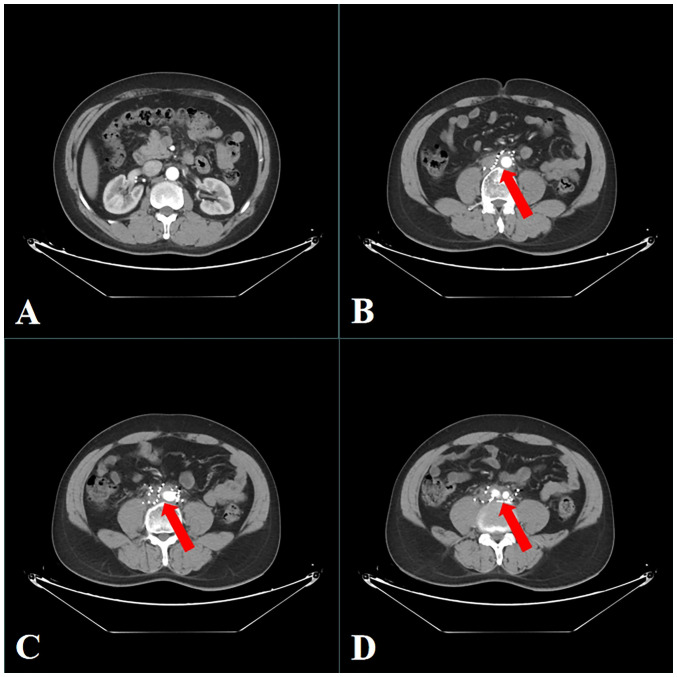
Testicular seminoma is a relatively rare malignant tumor, with the most common site of recurrence and metastasis being the retroperitoneal lymph nodes. Since seminoma is highly sensitive to radiotherapy and chemotherapy, even if it metastasizes, its cure rate is still >95%. However, the long-term toxicity and side effects of radiotherapy and chemotherapy cannot be ignored. Iodine-125 seeds represent a low-energy radioactive source that kills tumor cells while protecting the surrounding normal tissues, and brachytherapy using iodine-125 seeds has been widely used for the treatment of various malignancies. In addition, carboplatin can be used as an alternative to cisplatin-based combination chemotherapy to reduce the incidence of pulmonary toxicity, neurological damage and renal toxicity. In the present study, a case in which iodine-125 seeds were implanted for the treatment of retroperitoneal metastatic seminoma is reported. The patient was diagnosed with postoperative recurrence of seminoma that metastasized to the retroperitoneal lymph nodes. Since the tumor was large and surrounded blood vessels, surgical intervention and external radiotherapy were not considered. Moreover, considering the potential long-term toxic side effects of standard chemotherapy, a treatment plan for the patient using iodine-125 seed implantation combined with carboplatin (AUC7) therapy was finally formulated. No disease recurrence or toxic reactions occurred during the 3-year follow-up after treatment. The present case therefore demonstrated the antitumor efficacy and reduced toxicity of iodine-125 seeds combined with carboplatin for treating seminoma.
睾丸精原细胞瘤是一种相对罕见的恶性肿瘤,最常见的复发和转移部位是腹膜后淋巴结。由于精原细胞瘤对放疗和化疗高度敏感,即使发生转移,其治愈率仍>95%。然而,放疗和化疗的长期毒性和副作用不容忽视。碘-125粒子是一种低能量放射源,在杀死肿瘤细胞的同时可保护周围正常组织,使用碘-125粒子的近距离放射治疗已广泛应用于各种恶性肿瘤的治疗。此外,卡铂可作为基于顺铂的联合化疗的替代药物,以降低肺毒性、神经损伤和肾毒性的发生率。在本研究中,报告了1例采用碘-125粒子植入治疗腹膜后转移性精原细胞瘤的病例。该患者被诊断为精原细胞瘤术后复发并转移至腹膜后淋巴结。由于肿瘤较大且包绕血管,未考虑手术干预和外照射放疗。此外,考虑到标准化疗潜在的长期毒副作用,最终为该患者制定了碘-125粒子植入联合卡铂(AUC7)治疗的方案。治疗后3年随访期间未出现疾病复发或毒性反应。因此,本病例证明了碘-125粒子联合卡铂治疗精原细胞瘤的抗肿瘤疗效及降低毒性的作用。