
心理词汇的探索:网络结构、词汇搜索和词汇检索。
Navigating the Mental Lexicon: Network Structures, Lexical Search and Lexical Retrieval.
机构信息
Departamento de Filologías Modernas, Universidad de La Rioja, Logroño, Spain.
Departamento de Matemáticas y Computación, Universidad de La Rioja, Logroño, Spain.
出版信息
J Psycholinguist Res. 2024 Mar 1;53(2):21. doi: 10.1007/s10936-024-10059-8.
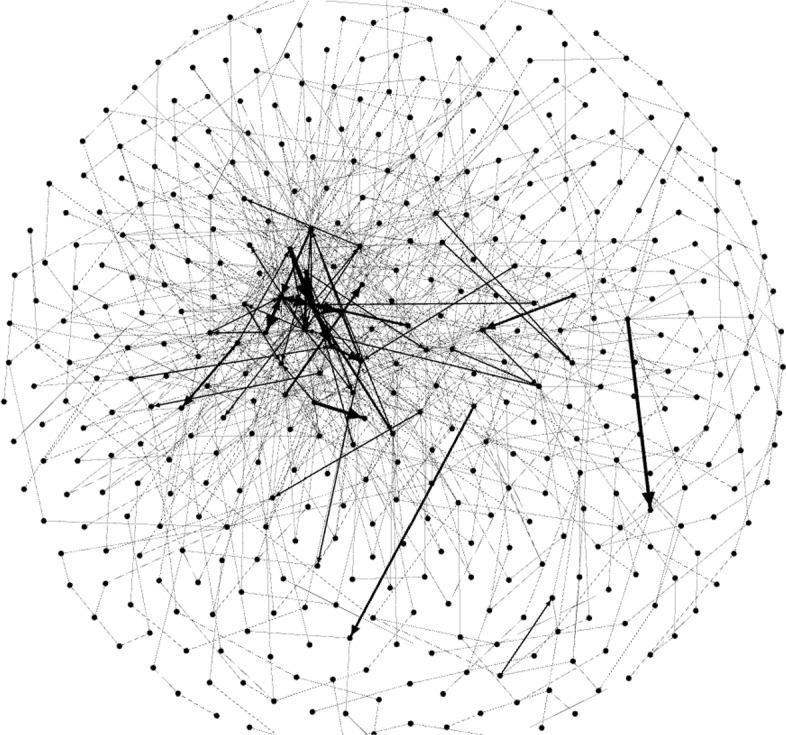
This paper examines the implications of the association patterns in our understanding of the mental lexicon. By applying the principles of graph theory to word association data, we intend to explore which measures tap better into lexical knowledge. To that end, we had different groups of English as Foreign language learners complete a lexical fluency task. Based on these empirical data, a study was undertaken on the corresponding lexical availability graph (LAG). It is observed that the aggregation (mentioned through human coding) of all lexical tokens on a given topic allows the emergence of some lexical-semantic patterns. The most important one is the existence of some key terms, featuring both high centrality in the sense of network theory and high availability in the LAG, which define a hub of related terms. These communities of words, each one organized around an anchor term, or most central word, are nicely apprehended by a well-known network metric called modularity. Interestingly enough, each module seems to describe a conceptual class, showing that the collective lexicon, at least as approximated by LA Graphs, is organised and traversed by semantic mechanisms or associations via hyponymy or hiperonymy, for instance. Another empirical observation is that these conceptual hubs can be appended, resulting in high diameters compared to same-sized random graphs; even so it seems that the small-world hypothesis holds in LA Graphs, as in other social and natural networks.
本文探讨了关联模式在我们对心理词汇理解中的意义。通过将图论原理应用于词联想数据,我们旨在探索哪些衡量标准更能反映词汇知识。为此,我们让不同组的英语作为外语的学习者完成了词汇流畅性任务。基于这些实证数据,对相应的词汇可用性图(LAG)进行了研究。观察到,在给定主题上聚合(通过人工编码提及)所有词汇标记可以出现一些词汇语义模式。最重要的一个模式是存在一些关键术语,这些术语在网络理论的中心度和 LAG 中的可用性方面都很高,它们定义了相关术语的中心。这些围绕一个锚定词或最中心词组织的单词社区,可以通过一种称为模块性的知名网络度量很好地理解。有趣的是,每个模块似乎都描述了一个概念类别,这表明集体词汇,至少如 LA 图所近似的那样,是通过语义机制或联想(例如通过下义词或上义词)组织和遍历的。另一个经验观察是,这些概念中心可以附加,与同大小的随机图相比,直径较大;即便如此,LA 图似乎符合小世界假设,就像在其他社会和自然网络中一样。



 Zotero 插件