Graduate School of Bengbu Medical College, Bengbu, Anhui, China.
Department of Endocrinology, Xuzhou Central Hospital, Xuzhou Institute of Medical Sciences, Xuzhou Clinical School of Nanjing Medical University, Affiliated Hospital of Medical School of Southeast University, Xuzhou, Jiangsu, China.
PLoS One. 2024 Mar 1;19(3):e0290132. doi: 10.1371/journal.pone.0290132. eCollection 2024.
Bone mineral density is an important indicator of osteoporosis, and its variation with volatile organic compounds exposure has rarely been studied. However, the relationship between chloroform (an essential volatile organic compounds component) and bone mineral density remains unclear. Consequently, we aimed to explore the relationship between chloroform alone and bone mineral density or bone mineral content.
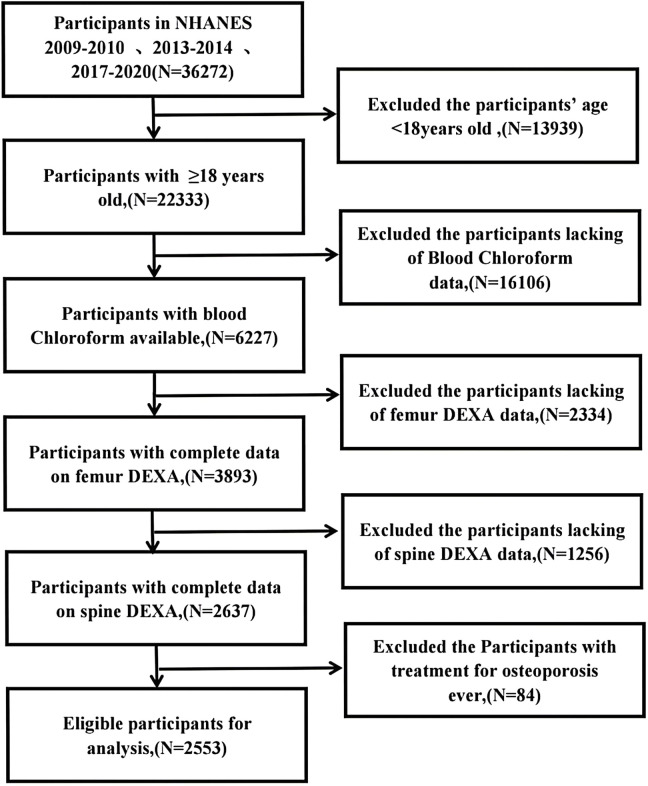
Herein, 2,553 individuals aged 18 and above from the National Health and Nutrition Examination Surveys (NHANES) in 2009-2010, 2013-2014, and 2017-2020, were included. We employed two independent t-tests and multi-linear regression models to statistically assess the relationship between chloroform exposure and BMD/BMC in the spine and femoral area.
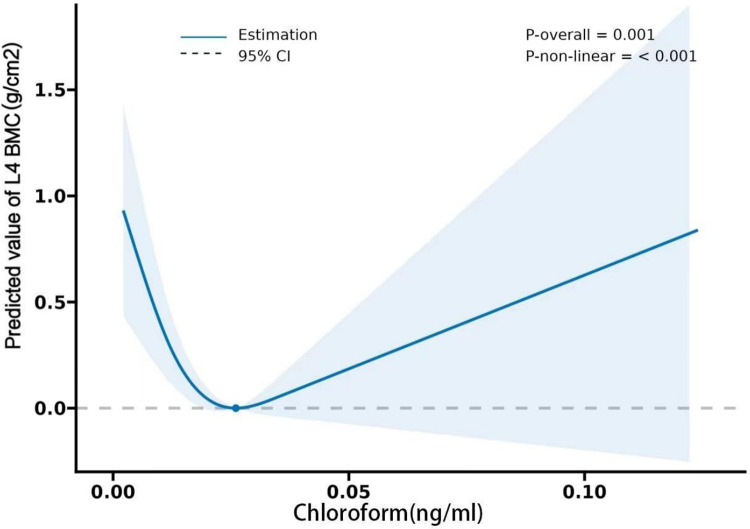
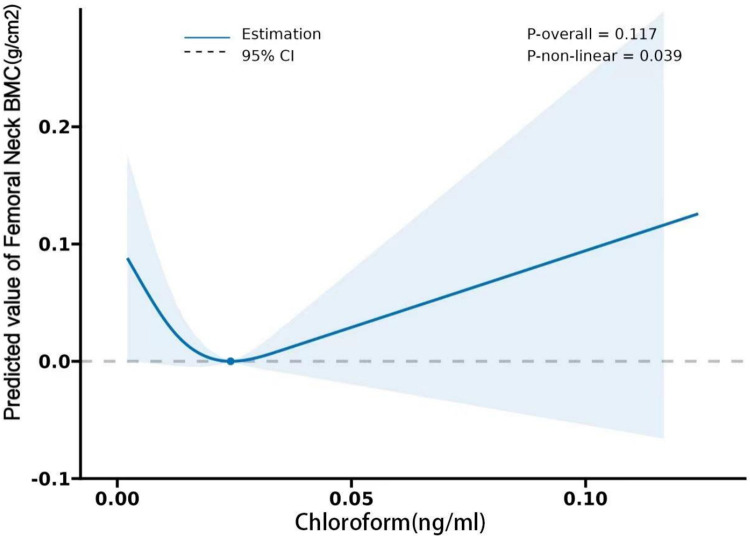
A "V"-shaped correlation between chloroform exposure and bone mineral density or bone mineral content (BMD/BMC) was observed in the unadjusted model, particularly in the Ward's triangle and femoral neck as a whole. A negative correlation was specifically observed for the Ward's triangle BMD/BMC and L4 BMD/BMC. On the other hand, in the adjusted model, a dominantly negative correlation between the L4 BMC and chloroform exposure was observed over a range of exposure levels. The subgroup analysis revealed a negative correlation between chloroform concentrations and BMC in the femur and spine, especially in women and the 65-80 age population.
Our study revealed a "V" shaped correlation between chloroform and BMD/BMC of the femur and spine in U.S. adults. This finding highlights the fact that prolonged exposure to chloroform may cause the changes in BMD/BMC.
骨密度是骨质疏松症的一个重要指标,其与挥发性有机化合物暴露的变化关系鲜有研究。然而,三氯甲烷(一种重要的挥发性有机化合物成分)与骨密度之间的关系仍不清楚。因此,我们旨在探讨三氯甲烷单独与骨密度或骨矿物质含量之间的关系。
本研究纳入了 2009-2010 年、2013-2014 年和 2017-2020 年全国健康与营养调查(NHANES)中 2553 名年龄在 18 岁及以上的个体。我们采用了两个独立的 t 检验和多元线性回归模型来统计评估三氯甲烷暴露与脊柱和股骨区域骨密度/骨矿物质含量(BMD/BMC)之间的关系。
在未调整模型中,三氯甲烷暴露与骨密度或骨矿物质含量(BMD/BMC)之间呈现出“V”形关系,尤其是在整体的三角区和股骨颈部位。三角区 BMD/BMC 和 L4 BMD/BMC 呈现出负相关。另一方面,在调整模型中,在一定的暴露水平范围内,L4 BMC 与三氯甲烷暴露之间呈现出明显的负相关。亚组分析显示,三氯甲烷浓度与股骨和脊柱的 BMC 之间呈负相关,尤其是在女性和 65-80 岁的人群中。
本研究揭示了美国成年人中三氯甲烷与股骨和脊柱 BMD/BMC 之间呈“V”形相关。这一发现强调了长期暴露于三氯甲烷可能导致 BMD/BMC 变化的事实。