Department of Psychiatry, Renmin Hospital of Wuhan University, Wuhan, China.
PET/CT/MRI and Molecular Imaging Center, Renmin Hospital of Wuhan University, Wuhan, China.
Neuroimage Clin. 2024;41:103581. doi: 10.1016/j.nicl.2024.103581. Epub 2024 Feb 28.
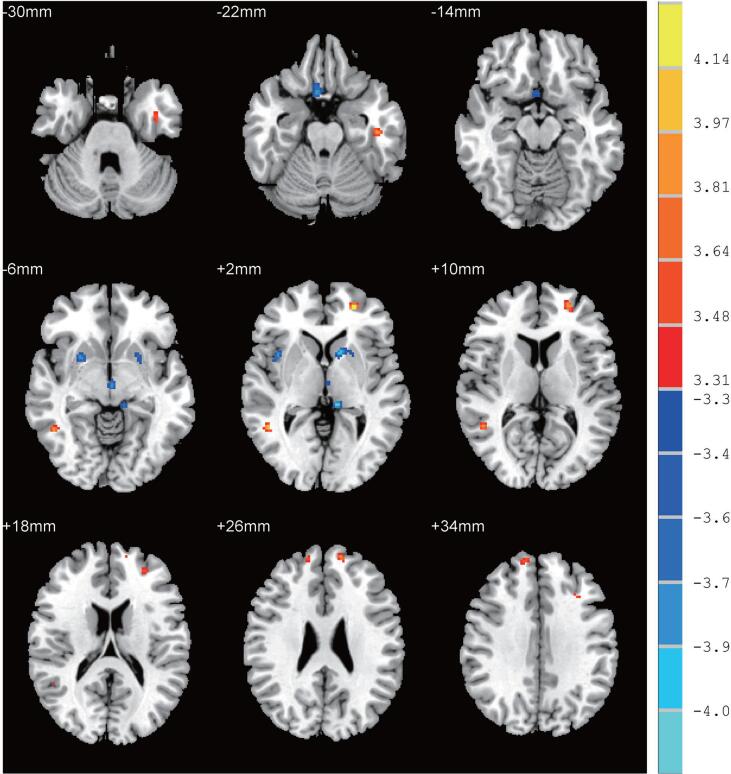
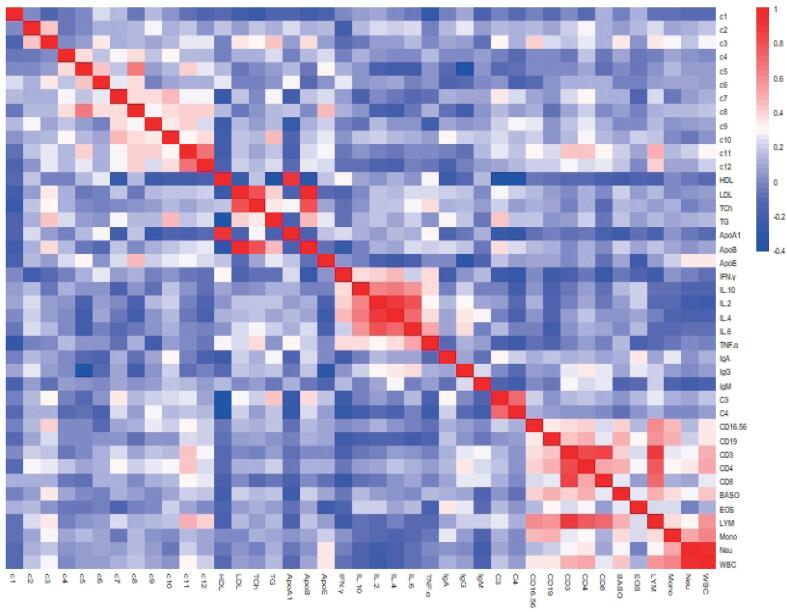
Arterial spin labeling (ASL) can be used to detect differences in perfusion for multiple brain regions thought to be important in major depressive disorder (MDD). However, the potential of cerebral blood flow (CBF) to predict MDD and its correlations between the blood lipid levels and immune markers, which are closely related to MDD and brain function change, remain unclear. The 451 individuals - 298 with MDD and 133 healthy controls who underwent MRI at a single time point with arterial spin labelling and a high resolution T1-weighted structural scan. A proportion of MDD also provided blood samples for analysis of lipid and immune markers. We performed CBF case-control comparisons, random forest model construction, and exploratory correlation analyses. Moreover, we investigated the relationship between gray matter volume (GMV), blood lipids, and the immune system within the same sample to assess the differences in CBF and GMV. We found that the left inferior parietal but supramarginal and angular gyrus were significantly different between the MDD patients and HCs (voxel-wise P < 0.001, cluster-wise FWE correction). And bilateral inferior temporal (ITG), right middle temporal gyrus and left precentral gyrus CBF predict MDD (the area under the receiver operating characteristic curve of the random forest model is 0.717) and that CBF is a more sensitive predictor of MDD than GMV. The left ITG showed a positive correlation trend with immunoglobulin G (r = 0.260) and CD4 counts (r = 0.283). The right ITG showed a correlation trend with Total Cholesterol (r = -0.249) and tumour necrosis factor-alpha (r = -0.295). Immunity and lipids were closely related to CBF change, with the immunity relationship potentially playing a greater role. The interactions between CBF, plasma lipids and immune index could therefore represent an MDD pathophysiological mechanism. The current findings provide evidence for targeted regulation of CBF or immune properties in MDD.
动脉自旋标记 (ASL) 可用于检测多个脑区的灌注差异,这些脑区被认为在重度抑郁症 (MDD) 中很重要。然而,脑血流 (CBF) 预测 MDD 的潜力及其与血脂水平和免疫标志物的相关性仍不清楚,这些标志物与 MDD 和大脑功能变化密切相关。在一个时间点对 451 名个体(298 名 MDD 患者和 133 名健康对照者)进行了 MRI 检查,包括动脉自旋标记和高分辨率 T1 加权结构扫描。一部分 MDD 患者还提供了血液样本,用于分析血脂和免疫标志物。我们进行了 CBF 病例对照比较、随机森林模型构建和探索性相关分析。此外,我们还在同一样本中研究了灰质体积 (GMV)、血脂和免疫系统之间的关系,以评估 CBF 和 GMV 的差异。我们发现,MDD 患者和 HCs 之间的左侧顶下小叶但 supramarginal 和角回的 CBF 存在显著差异(体素水平 P < 0.001,簇水平 FWE 校正)。双侧颞下回(ITG)、右颞中回和左中央前回的 CBF 可预测 MDD(随机森林模型的接收者操作特征曲线下面积为 0.717),且 CBF 是 MDD 的更敏感预测因子,优于 GMV。左侧 ITG 与免疫球蛋白 G (r = 0.260) 和 CD4 计数呈正相关趋势 (r = 0.283)。右侧 ITG 与总胆固醇 (r = -0.249) 和肿瘤坏死因子-α (r = -0.295) 呈相关趋势。免疫和脂质与 CBF 变化密切相关,免疫关系可能发挥更大作用。因此,CBF、血浆脂质和免疫指数之间的相互作用可能代表 MDD 的病理生理机制。目前的研究结果为靶向调节 MDD 中的 CBF 或免疫特性提供了证据。