Chai Yi, Man Kenneth K C, Luo Hao, Torre Carmen Olga, Wing Yun Kwok, Hayes Joseph F, Osborn David P J, Chang Wing Chung, Lin Xiaoyu, Yin Can, Chan Esther W, Lam Ivan C H, Fortin Stephen, Kern David M, Lee Dong Yun, Park Rae Woong, Jang Jae-Won, Li Jing, Seager Sarah, Lau Wallis C Y, Wong Ian C K
Centre for Safe Medication Practice and Research, Department of Pharmacology and Pharmacy, LKS Faculty of Medicine, The University of Hong Kong, Hong Kong.
The Hong Kong Jockey Club Centre for Suicide Research and Prevention, The University of Hong Kong, Hong Kong.
Epidemiol Psychiatr Sci. 2024 Mar 4;33:e9. doi: 10.1017/S2045796024000088.
Population-wide restrictions during the COVID-19 pandemic may create barriers to mental health diagnosis. This study aims to examine changes in the number of incident cases and the incidence rates of mental health diagnoses during the COVID-19 pandemic.
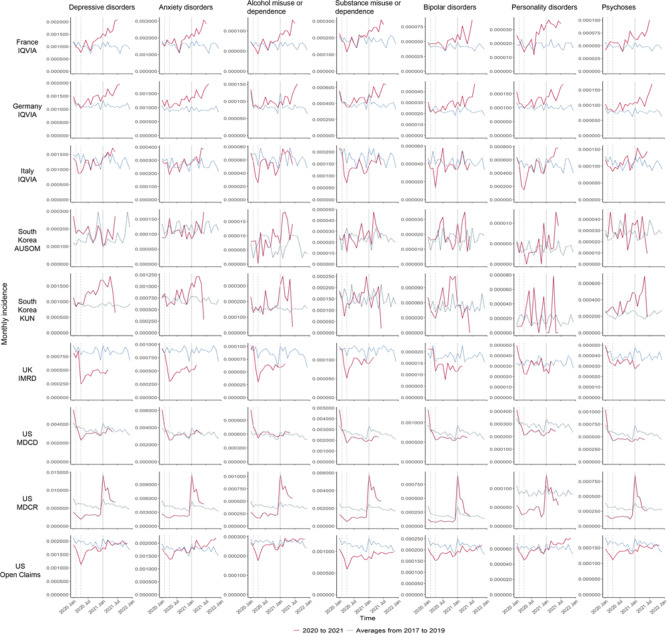
By using electronic health records from France, Germany, Italy, South Korea and the UK and claims data from the US, this study conducted interrupted time-series analyses to compare the monthly incident cases and the incidence of depressive disorders, anxiety disorders, alcohol misuse or dependence, substance misuse or dependence, bipolar disorders, personality disorders and psychoses diagnoses before (January 2017 to February 2020) and after (April 2020 to the latest available date of each database [up to November 2021]) the introduction of COVID-related restrictions.
A total of 629,712,954 individuals were enrolled across nine databases. Following the introduction of restrictions, an immediate decline was observed in the number of incident cases of all mental health diagnoses in the US (rate ratios (RRs) ranged from 0.005 to 0.677) and in the incidence of all conditions in France, Germany, Italy and the US (RRs ranged from 0.002 to 0.422). In the UK, significant reductions were only observed in common mental illnesses. The number of incident cases and the incidence began to return to or exceed pre-pandemic levels in most countries from mid-2020 through 2021.
Healthcare providers should be prepared to deliver service adaptations to mitigate burdens directly or indirectly caused by delays in the diagnosis and treatment of mental health conditions.
新冠疫情期间的全人群限制措施可能会给心理健康诊断带来障碍。本研究旨在调查新冠疫情期间心理健康诊断的新发病例数和发病率的变化。
本研究利用法国、德国、意大利、韩国和英国的电子健康记录以及美国的理赔数据,进行中断时间序列分析,以比较新冠相关限制措施实施之前(2017年1月至2020年2月)和之后(2020年4月至每个数据库的最新可用日期[截至2021年11月])抑郁症、焦虑症、酒精滥用或依赖、物质滥用或依赖、双相情感障碍、人格障碍和精神病诊断的每月新发病例数和发病率。
九个数据库共纳入629,712,954人。实施限制措施后,美国所有心理健康诊断的新发病例数立即下降(率比范围为0.005至0.677),法国、德国、意大利和美国所有疾病的发病率也下降(率比范围为0.002至0.422)。在英国,仅常见精神疾病的发病率显著下降。从2020年年中到2021年,大多数国家的新发病例数和发病率开始恢复到或超过疫情前水平。
医疗服务提供者应做好准备,调整服务,以减轻心理健康状况诊断和治疗延迟直接或间接造成的负担。