Boczkowski Maciej, Popiel Stanisław, Nawała Jakub
Institute of Chemistry, Military University of Technology, Kaliskiego 2, Warsaw 00-908, Poland.
J Am Soc Mass Spectrom. 2024 Apr 3;35(4):714-727. doi: 10.1021/jasms.3c00392. Epub 2024 Mar 3.
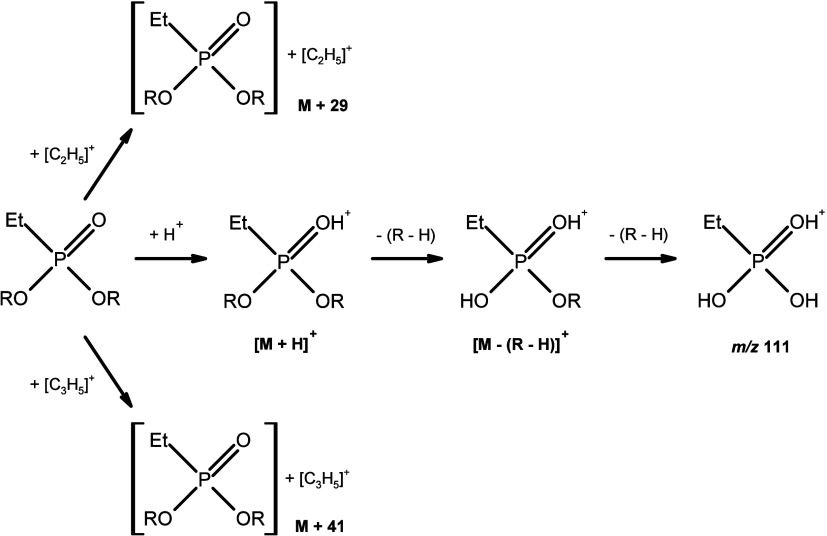
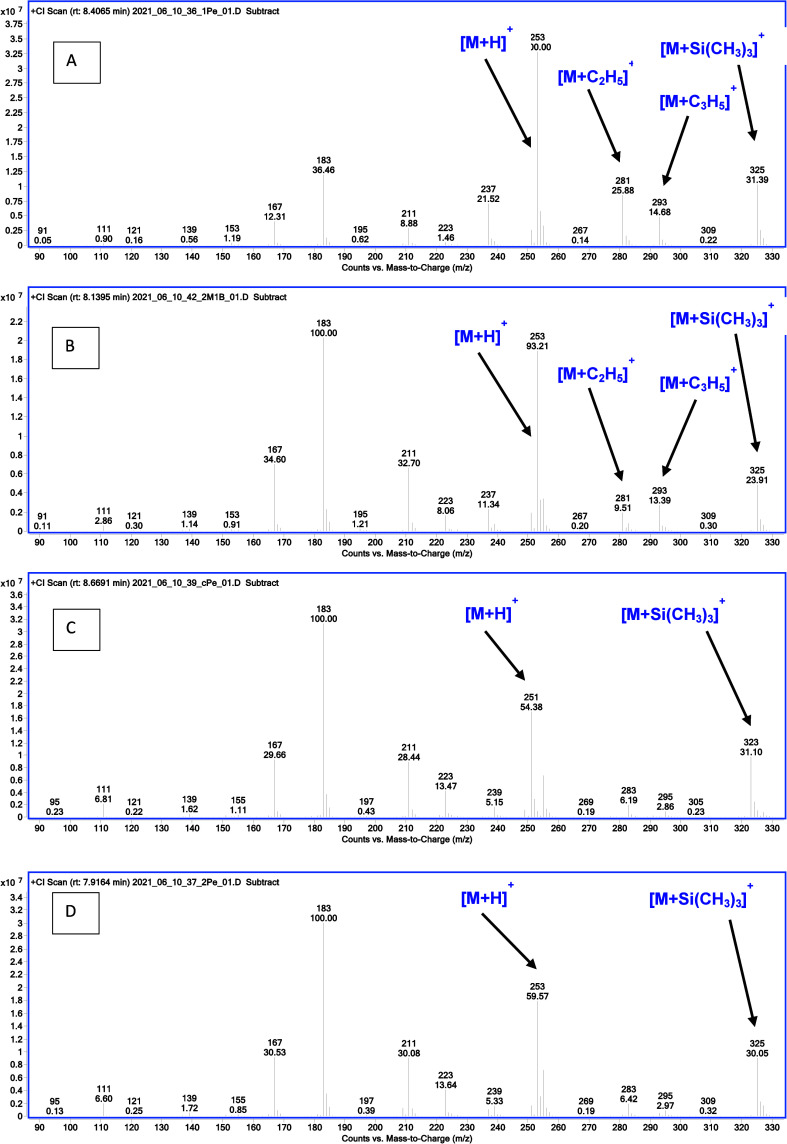
The microsynthesis of 32 dialkyl derivatives of ethylphosphonic acid and the same number of monoalkyl derivatives was carried out to perform comparative studies using gas chromatography combined with mass spectrometry in chemical ionization mode which is one of the analytical techniques recommended by the Organisation for the Prohibition of Chemical Weapons (OPCW). The huge number of possible representatives makes it difficult to have complete spectral libraries of all substances in this class. Therefore, we decided to synthesize and instrumentally analyze only representatives of the selected series of homologues in this work. The analysis of the obtained results allowed us to find the rules for predicting mass spectra and the factors determining the retention parameters. Symmetrical diesters and monoesters of ethylphosphonic acid were selected for this study. During the conducted experiments using chemical ionization with methane as the reaction gas, protonated analyte molecules with high relative intensities were obtained; in many cases, these are base peaks in the spectrum. The obtained results allow grouping of the synthesized compounds depending on the introduced alkyl substituent. Retention data of the tested analytes were collected during the research by using electron ionization. The retention parameters of the tested compounds from each homologous series were also summarized and compared. Chemical Warfare Agents (CWA) analysis continues to be an important issue, especially in the context of the regular Proficiency Tests organized by the OPCW for identifying chemical compounds that are of interest to the Chemical Weapons Convention. Five compounds were synthesized whose spectra were not available in EI mass spectral libraries, and their retention indices were unknown. The identification of these substances was supported by the CI mass spectra and retention data, using previously developed relationships. Therefore, it is reasonable to conclude that the research method used is useful and effective.
合成了32种乙基膦酸二烷基衍生物和相同数量的单烷基衍生物,以使用气相色谱-质谱联用技术在化学电离模式下进行比较研究,这是禁止化学武器组织(OPCW)推荐的分析技术之一。这类物质可能的代表物数量众多,难以拥有所有此类物质完整的光谱库。因此,在这项工作中,我们决定仅合成并仪器分析所选同系物系列的代表物。对所得结果的分析使我们能够找到预测质谱的规则以及决定保留参数的因素。本研究选择了乙基膦酸的对称二酯和单酯。在以甲烷作为反应气进行化学电离的实验过程中,获得了相对强度较高的质子化分析物分子;在许多情况下,这些是光谱中的基峰。所得结果允许根据引入的烷基取代基对合成化合物进行分组。在研究过程中,通过电子电离收集了被测分析物的保留数据。还总结并比较了每个同系物系列被测化合物的保留参数。化学战剂(CWA)分析仍然是一个重要问题,特别是在OPCW为识别《化学武器公约》所关注的化合物而定期组织的能力验证测试的背景下。合成了5种在EI质谱库中没有光谱且保留指数未知的化合物。利用先前建立的关系,通过CI质谱和保留数据对这些物质进行了鉴定。因此,有理由得出结论,所采用的研究方法是有用且有效的。