Gutierrez Sirena, Courtin Emilie, Glymour M Maria, Torres Jacqueline M
Department of Epidemiology and Biostatistics, University of California, San Francisco, San Francisco, CA, USA.
Department of Health Policy, London School of Economics and Political Science, London, United Kingdom.
SSM Popul Health. 2024 Feb 10;25:101616. doi: 10.1016/j.ssmph.2024.101616. eCollection 2024 Mar.
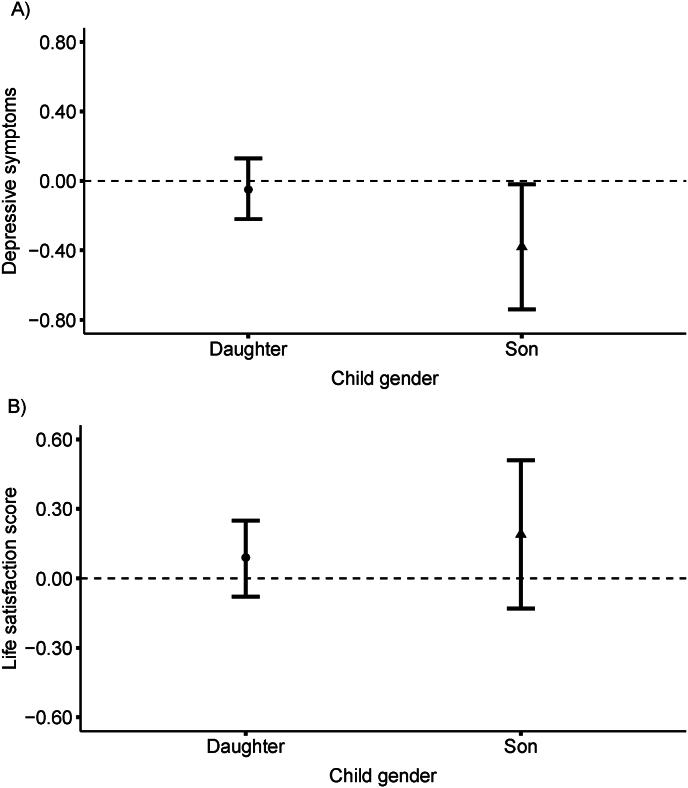
Higher adult child educational attainment may benefit older parents' psychosocial well-being in later life. This may be particularly important in low- and middle-income countries, where recent generations have experienced comparatively large increases in educational attainment. We used data from the 2012 Mexican Health and Aging Study, a nationally representative study of adults aged ≥50 years and leveraged the exogenous variation in adult child education induced by Mexico's compulsory schooling law passed in 1993. We employed two-stage least squares (2SLS) regression to estimate the effects of increased schooling among adult children on parents' (respondents') depressive symptoms and life satisfaction scores, controlling for demographic and socioeconomic characteristics. We considered heterogeneity by parent and child gender and other sociodemographic characteristics. Our study included 7186 participants with an average age of 60.1 years; 54.9% were female. In the 2SLS analyses, increased schooling among oldest adult children was associated with fewer depressive symptoms (β = -0.25; 95% CI: -0.51, 0.00) but no difference in life satisfaction (β = 0.01; 95% CI: -0.22, 0.25). Stratified models indicated differences in the magnitude of association with depressive symptoms for mothers (β = -0.27, 95% CI: -0.56, 0.01) and fathers (β = -0.18, 95% CI: -0.63, 0.26) and when considering increased schooling of oldest sons (β = -0.37; 95% CI: -0.73, -0.02) and daughters (β = -0.05, 95% CI: -0.23, 0.13). No parent and child gender differences were found for life satisfaction. Power was limited to detect heterogeneity across other sociodemographic characteristics in the second stage although first-stage estimates were larger for urban (vs. rural) dwelling and more (vs. less) highly educated respondents. Results were similar when considering the highest educated child as well as increased schooling across all children. Our findings suggest that longer schooling among current generations of adult children, particularly sons, may benefit their older parents' psychosocial well-being.
成年子女受教育程度较高可能有益于老年父母晚年的心理社会幸福感。这在低收入和中等收入国家可能尤为重要,因为最近几代人的受教育程度有了相对较大的提高。我们使用了2012年墨西哥健康与老龄化研究的数据,这是一项对50岁及以上成年人具有全国代表性的研究,并利用了1993年墨西哥义务教育法所导致的成年子女教育的外部差异。我们采用两阶段最小二乘法(2SLS)回归来估计成年子女受教育年限增加对父母(受访者)抑郁症状和生活满意度得分的影响,并控制人口统计学和社会经济特征。我们考虑了父母和子女性别以及其他社会人口学特征的异质性。我们的研究包括7186名参与者,平均年龄为60.1岁;54.9%为女性。在2SLS分析中,最大成年子女受教育年限增加与抑郁症状减少相关(β = -0.25;95%置信区间:-0.51,0.00),但生活满意度无差异(β = 0.01;95%置信区间:-0.22,0.25)。分层模型表明,母亲(β = -0.27,95%置信区间:-0.56,0.01)和父亲(β = -0.18,95%置信区间:-0.63,0.26)与抑郁症状的关联程度存在差异,以及在考虑最大儿子(β = -0.37;95%置信区间:-0.73,-0.02)和女儿(β = -0.05,95%置信区间:-0.23,0.13)受教育年限增加时也存在差异。在生活满意度方面未发现父母和子女性别差异。尽管在第二阶段检测其他社会人口学特征的异质性的效能有限,但对于居住在城市(与农村相比)以及受教育程度较高(与较低相比)的受访者,第一阶段估计值更大。当考虑受教育程度最高的孩子以及所有孩子受教育年限增加时,结果相似。我们的研究结果表明,当代成年子女,尤其是儿子,受教育时间更长可能有益于他们老年父母的心理社会幸福感。