Kashash Dalia, McArthur Eric, Hamm Caroline, Gupta Rasna, Kanjeekal Sindu, Jarrar Mohammad, Porter Lisa A, Hudson John W, Renaud Adam, Woldie Indryas
Schulich School of Medicine, University of Western Ontario, London, Ontario, Canada.
London Health Sciences Centre, London, Ontario, Canada.
J Blood Med. 2024 Feb 26;15:101-111. doi: 10.2147/JBM.S434055. eCollection 2024.
Outcomes for patients with multiple myeloma has significantly improved through the years. This is mainly related to the use of novel agents.
This is a retrospective study that reviewed presentation and outcome of 139 patients with multiple myeloma at the Windsor Essex Regional Cancer Centre from Jan. 1, 2015 to Dec. 31, 2019. Median age was 71 years and most patients had higher risk disease (65.5% either R ISS stage II or III). 30% had high risk FISH for myeloma including del.17P, t (4:14), t (14:16) and Gain (1q21). In terms of presentation, 38.8% had anemia (hemoglobin <100g/L), 18.7% had hypercalcemia, 74.1% had skeletal lytic lesions, 38.8% had pathologic fracture and 17.3% had plasmacytoma.
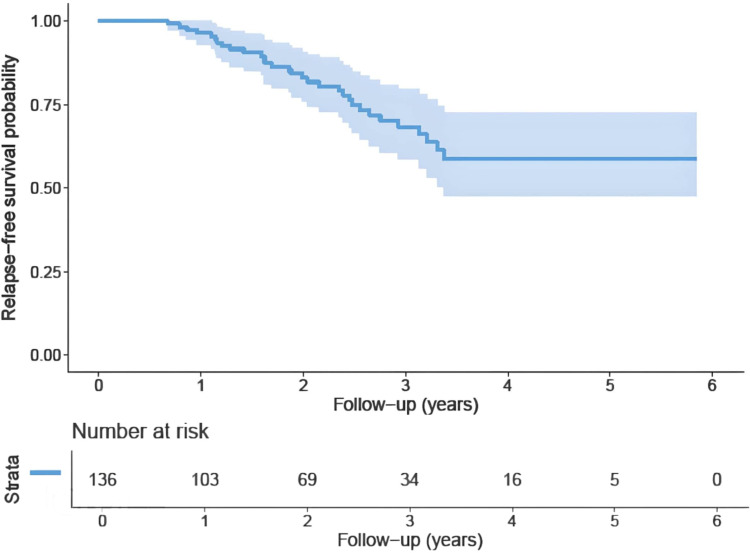
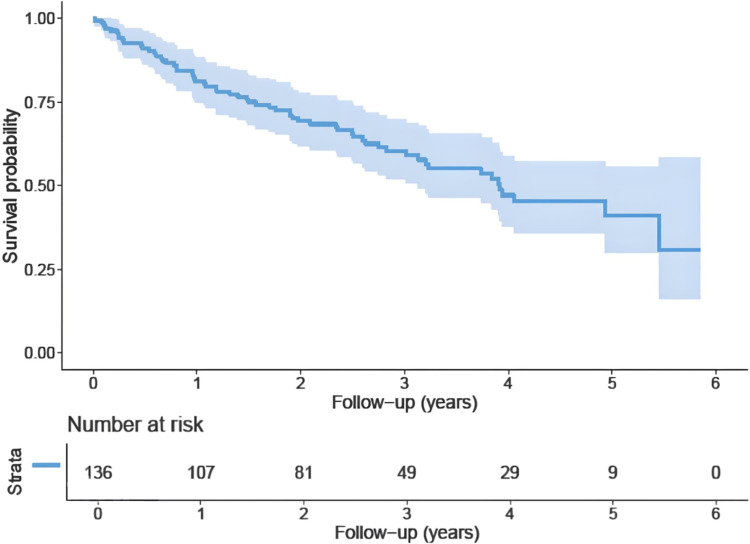
Almost all (92%) of the patients were treated using at least one novel agent (proteasome inhibitor or immunomodulators [ImiDs]). Cyclophosphamide, bortezomib, and dexamethasone (CyBorD) was the most used treatment regimen (48.9%) followed by bortezomib, melphalan and prednisone (BMP) at 28.8% and lenalidomide, dexamethasone (LenDex) at 14.4%. With respect to response to therapy, 51.8% had at least Very good partial response (VGPR), while 9.4% had progressive disease. 33% had autologous stem cell transplant. After a median follow up of 2.4 years, median overall survival was 3.7 years. 2 years overall survival and relapse-free survival were 70% and 83%, respectively.
Our study showed comparable outcome for patients with multiple myeloma despite older age and higher risk disease. Outcome is expected to improve with the introduction of more novel agents.
多年来,多发性骨髓瘤患者的治疗结果有了显著改善。这主要与新型药物的使用有关。
这是一项回顾性研究,回顾了2015年1月1日至2019年12月31日在温莎埃塞克斯地区癌症中心的139例多发性骨髓瘤患者的临床表现和治疗结果。中位年龄为71岁,大多数患者患有高危疾病(65.5%为R-ISS分期II期或III期)。30%的患者有骨髓瘤高危荧光原位杂交结果,包括17p缺失、t(4;14)、t(14;16)和1q21增益。在临床表现方面,38.8%的患者有贫血(血红蛋白<100g/L),18.7%的患者有高钙血症,74.1%的患者有骨骼溶骨性病变,38.8%的患者有病理骨折,17.3%的患者有浆细胞瘤。
几乎所有(92%)患者至少使用了一种新型药物(蛋白酶体抑制剂或免疫调节剂[免疫调节药物])。环磷酰胺、硼替佐米和地塞米松(CyBorD)是最常用的治疗方案(48.9%),其次是硼替佐米、美法仑和泼尼松(BMP),占28.8%,来那度胺、地塞米松(LenDex)占14.4%。关于治疗反应,51.8%的患者至少有非常好的部分缓解(VGPR),而9.4%的患者有疾病进展。33%的患者进行了自体干细胞移植。中位随访2.4年后,中位总生存期为3.7年。2年总生存期和无复发生存率分别为70%和83%。
我们的研究表明,尽管患者年龄较大且疾病风险较高,但多发性骨髓瘤患者的治疗结果相当。随着更多新型药物的引入,治疗结果有望改善。