Wu Tong, Wu Yangyang, Yan Jinfeng, Zhang Jinjin, Wang Shixuan
National Clinical Research Center for Obstetrical and Gynecological Diseases Tongji Hospital, Tongji Medical College, Huazhong University of Science and Technology Wuhan China.
Key Laboratory of Cancer Invasion and Metastasis, Ministry of Education Tongji Hospital, Tongji Medical College, Huazhong University of Science and Technology Wuhan China.
Bioeng Transl Med. 2023 Nov 24;9(2):e10625. doi: 10.1002/btm2.10625. eCollection 2024 Mar.
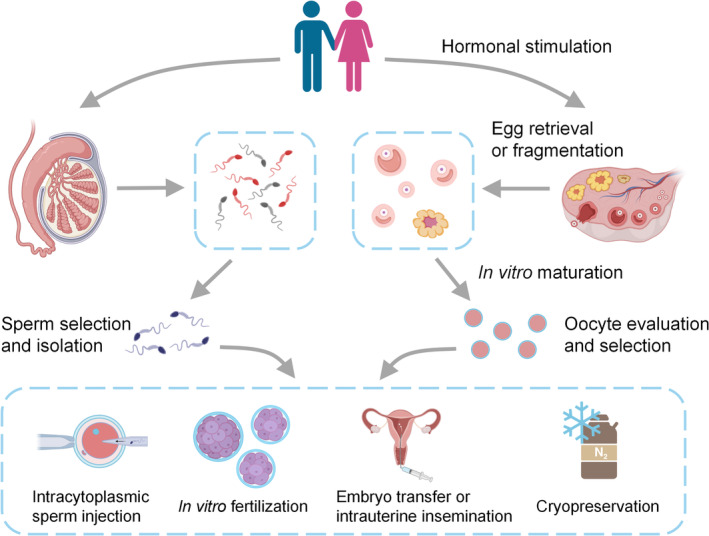
The aim of assisted reproductive technology (ART) is to select the high-quality sperm, oocytes, and embryos, and finally achieve a successful pregnancy. However, functional evaluation is hindered by intra- and inter-operator variability. Microfluidic chips emerge as the one of the most powerful tools to analyze biological samples for reduced size, precise control, and flexible extension. Herein, a systematic search was conducted in PubMed, Scopus, Web of Science, ScienceDirect, and IEEE Xplore databases until March 2023. We displayed and prospected all detection strategies based on microfluidics in the ART field. After full-text screening, 71 studies were identified as eligible for inclusion. The percentages of human and mouse studies equaled with 31.5%. The prominent country in terms of publication number was the USA ( = 13). Polydimethylsiloxane ( = 49) and soft lithography ( = 28) were the most commonly used material and fabrication method, respectively. All articles were classified into three types: sperm ( = 38), oocytes ( = 20), and embryos ( = 13). The assessment contents included motility, counting, mechanics, permeability, impedance, secretion, oxygen consumption, and metabolism. Collectively, the microfluidic chip technology facilitates more efficient, accurate, and objective evaluation in ART. It can even be combined with artificial intelligence to assist the daily activities of embryologists. More well-designed clinical studies and affordable integrated microfluidic chips are needed to validate the safety, efficacy, and reproducibility. Trial registration: The protocol was registered in the Open Science Frame REGISTRIES (identification: osf.io/6rv4a).
辅助生殖技术(ART)的目的是挑选出高质量的精子、卵母细胞和胚胎,最终实现成功妊娠。然而,操作人员内部和之间的变异性阻碍了功能评估。微流控芯片作为分析生物样品的最强大工具之一而出现,因其尺寸减小、控制精确且可灵活扩展。本文在PubMed、Scopus、Web of Science、ScienceDirect和IEEE Xplore数据库中进行了系统检索,直至2023年3月。我们展示并展望了ART领域中基于微流控的所有检测策略。经过全文筛选,确定71项研究符合纳入标准。人类和小鼠研究的百分比均为31.5%。发表数量最多的国家是美国(=13)。聚二甲基硅氧烷(=49)和软光刻(=28)分别是最常用的材料和制造方法。所有文章分为三种类型:精子(=38)、卵母细胞(=20)和胚胎(=13)。评估内容包括活力、计数、力学、渗透性、阻抗、分泌、耗氧量和代谢。总体而言,微流控芯片技术有助于在ART中进行更高效、准确和客观的评估。它甚至可以与人工智能相结合,协助胚胎学家的日常工作。需要更多精心设计的临床研究和价格合理的集成微流控芯片来验证其安全性、有效性和可重复性。试验注册:该方案已在开放科学框架注册中心注册(标识:osf.io/6rv4a)。