
慢性乙型肝炎基线病毒载量与治疗期间肝癌风险:一项针对HBeAg阳性患者的多国队列研究。
Chronic hepatitis B baseline viral load and on-treatment liver cancer risk: A multinational cohort study of HBeAg-positive patients.
作者信息
Choi Won-Mook, Yip Terry Cheuk-Fung, Kim W Ray, Yee Leland J, Brooks-Rooney Craig, Curteis Tristan, Clark Laura J, Jafry Zarena, Chen Chien-Hung, Chen Chi-Yi, Huang Yi-Hsiang, Jin Young-Joo, Jun Dae Won, Kim Jin-Wook, Park Neung Hwa, Peng Cheng-Yuan, Shin Hyun Phil, Shin Jung Woo, Yang Yao-Hsu, Wong Grace Lai-Hung, Lim Young-Suk
机构信息
Department of Gastroenterology, Liver Center, Asan Medical Center, University of Ulsan College of Medicine, Seoul, Korea.
Department of Medicine and Therapeutics, Medical Data Analytics Centre, The Chinese University of Hong Kong, Hong Kong SAR, China.
出版信息
Hepatology. 2024 Aug 1;80(2):428-439. doi: 10.1097/HEP.0000000000000752. Epub 2024 Jan 24.
BACKGROUND AND AIMS
A single-nation study reported that pretreatment HBV viral load is associated with on-treatment risk of HCC in patients who are HBeAg-positive without cirrhosis and with chronic hepatitis B initiating antiviral treatment. We aimed to validate the association between baseline HBV viral load and on-treatment HCC risk in a larger, multinational cohort.
APPROACH AND RESULTS
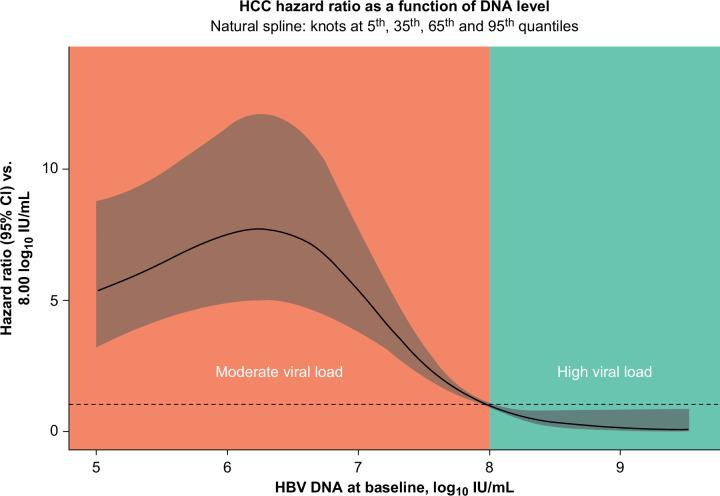
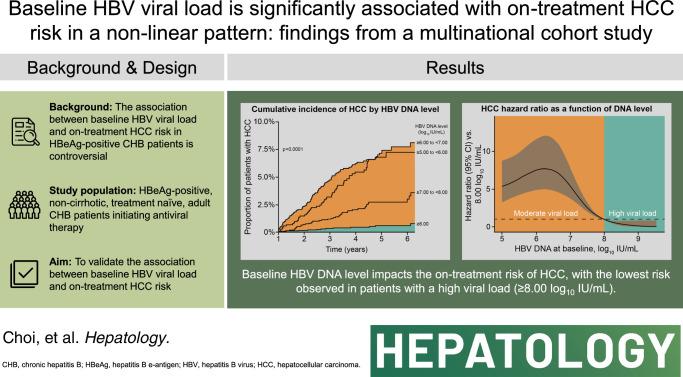
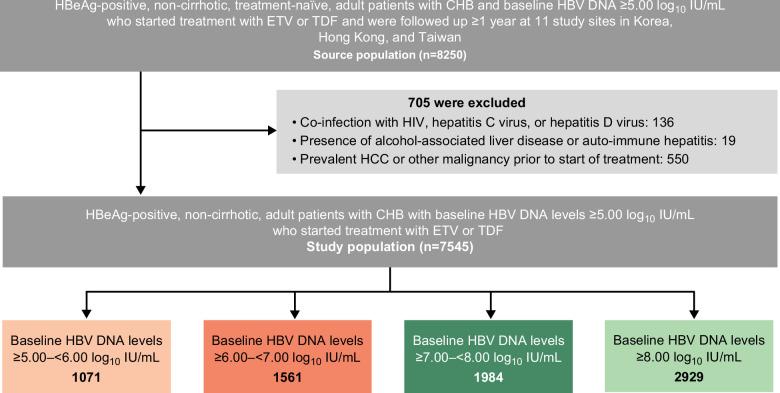
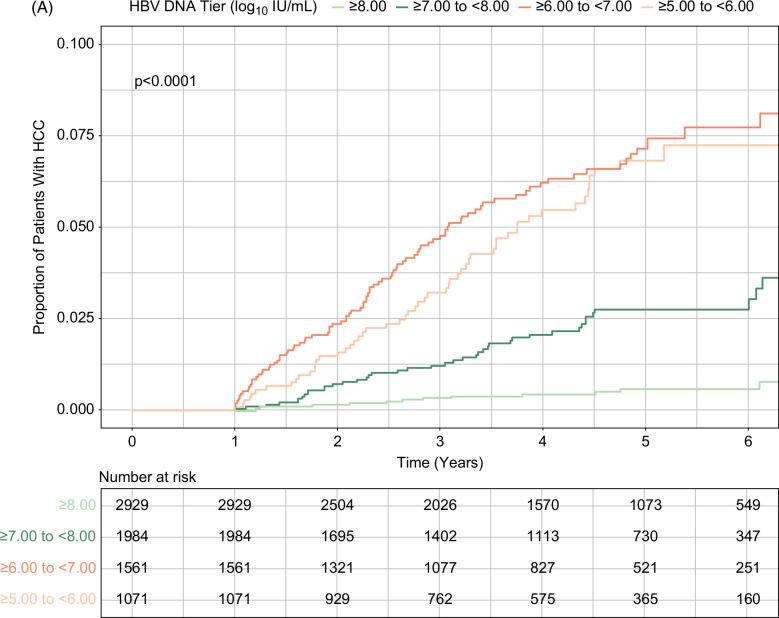
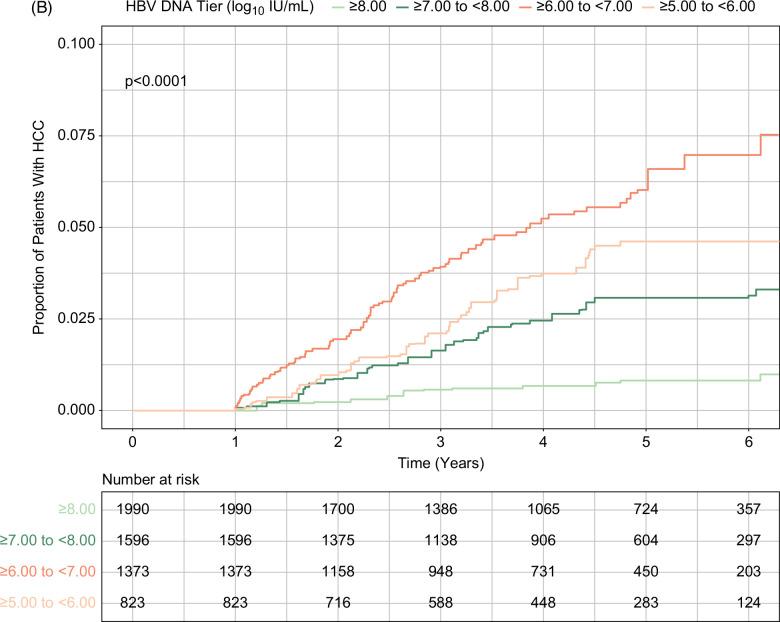
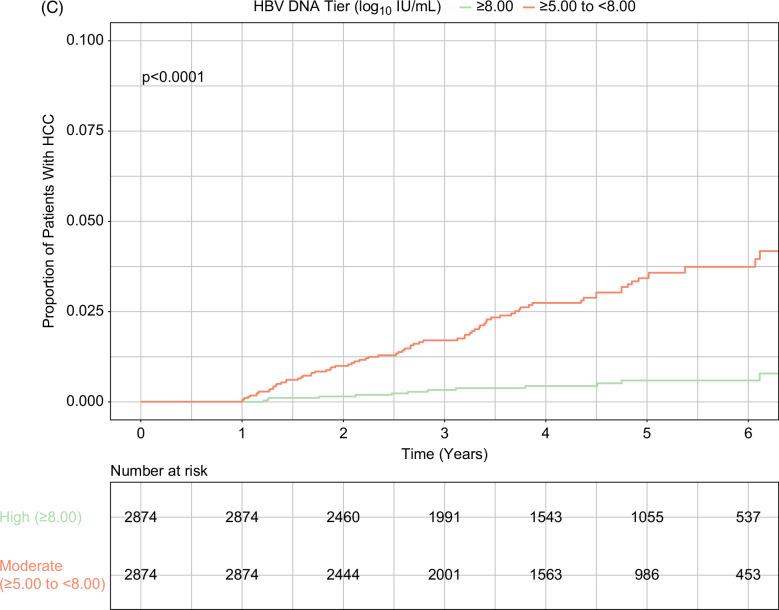
Using a multinational cohort from Korea, Hong Kong, and Taiwan involving 7545 adult patients with HBeAg-positive, without cirrhosis and with chronic hepatitis B who started entecavir or tenofovir treatment with baseline HBV viral load ≥5.00 log 10 IU/mL, HCC risk was estimated by baseline viral load. HBV viral load was analyzed as a categorical variable. During continuous antiviral treatment (median, 4.28 y), HCC developed in 200 patients (incidence rate, 0.61 per 100 person-years). Baseline HBV DNA level was independently associated with on-treatment HCC risk in a nonlinear pattern. HCC risk was lowest with the highest baseline viral load (≥8.00 log 10 IU/mL; incidence rate, 0.10 per 100 person-years), but increased sharply as baseline viral load decreased. The adjusted HCC risk was 8.05 times higher (95% CI, 3.34-19.35) with baseline viral load ≥6.00 and <7.00 log 10 IU/mL (incidence rate, 1.38 per 100 person-years) compared with high (≥8.00 log 10 IU/mL) baseline viral load ( p <0.001).
CONCLUSIONS
In a multinational cohort of adult patients with HBeAg-positive without cirrhosis and with chronic hepatitis B, baseline HBV viral load was significantly associated with HCC risk despite antiviral treatment. Patients with the highest viral load who initiated treatment had the lowest long-term risk of HCC development.
背景与目的
一项单国家研究报告称,在无肝硬化的HBeAg阳性慢性乙型肝炎患者中,治疗前HBV病毒载量与启动抗病毒治疗时发生肝癌的风险相关。我们旨在在一个更大的多国家队列中验证基线HBV病毒载量与治疗期间肝癌风险之间的关联。
方法与结果
使用来自韩国、中国香港和中国台湾的多国家队列,该队列包含7545例无肝硬化的HBeAg阳性慢性乙型肝炎成年患者,这些患者开始使用恩替卡韦或替诺福韦治疗,基线HBV病毒载量≥5.00 log₁₀ IU/mL,根据基线病毒载量估计肝癌风险。将HBV病毒载量作为分类变量进行分析。在持续抗病毒治疗期间(中位数为4.28年),200例患者发生了肝癌(发病率为每100人年0.61例)。基线HBV DNA水平与治疗期间肝癌风险呈非线性独立相关。基线病毒载量最高(≥8.00 log₁₀ IU/mL;发病率为每100人年0.10例)时肝癌风险最低,但随着基线病毒载量降低而急剧增加。与高基线病毒载量(≥8.00 log₁₀ IU/mL)相比,基线病毒载量≥6.00且<7.00 log₁₀ IU/mL(发病率为每100人年1.38例)时,调整后的肝癌风险高8.05倍(95%CI,3.34 - 19.35)(p<0.001)。
结论
在一个多国家队列中纳入的无肝硬化的HBeAg阳性慢性乙型肝炎成年患者中,尽管进行了抗病毒治疗,基线HBV病毒载量仍与肝癌风险显著相关。开始治疗时病毒载量最高的患者发生肝癌的长期风险最低。
 Zotero 插件