Ramsay Santé, Hôpital Privé de Parly 2, Institut Fertilité Maternité Parly 2, Le Chesnay-Rocquencourt, France.
Centre de Biologie Médicale BIOGROUP, Hôpital Privé de Parly 2, Le Chesnay-Rocquencourt, France.
Hum Reprod. 2024 May 2;39(5):936-954. doi: 10.1093/humrep/deae028.
Is there a cumulative toxicity of disposables used in IVF procedures?
A toxicity may be detected when consumables are used cumulatively, while no toxicity is detected when the same consumables are used and tested individually.
Many components of items used in IVF laboratories may impair human embryonic development. Consequently, it is necessary to screen all reagents and materials which could be in contact with gametes and embryos. Toxicity tests, such as the mouse embryo assay and the human sperm motility assay (HSMA), are used by manufacturers as quality control tools to demonstrate the safety of their products. This evaluation is currently individually performed for each single consumable. However, during an IVF cycle, several devices are used sequentially, potentially creating a cumulative exposure to chemical contaminants, which could not be detected for individually tested consumables.
STUDY DESIGN, SIZE, DURATION: The objective of this observational study conducted from March 2021 to October 2022 was to evaluate with the HSMA methodology if there was a cumulative toxicity when several disposables are sequentially used. Fourteen categories of consumables currently used in routine IVF procedures were studied, which included devices used for sperm and oocyte collection (cups, condoms, and oocyte aspiration needles), manipulation (flasks, tubes, tips, pipettes, embryo transfer catheters, syringes, and gloves), culture (dishes), and storage (straws).
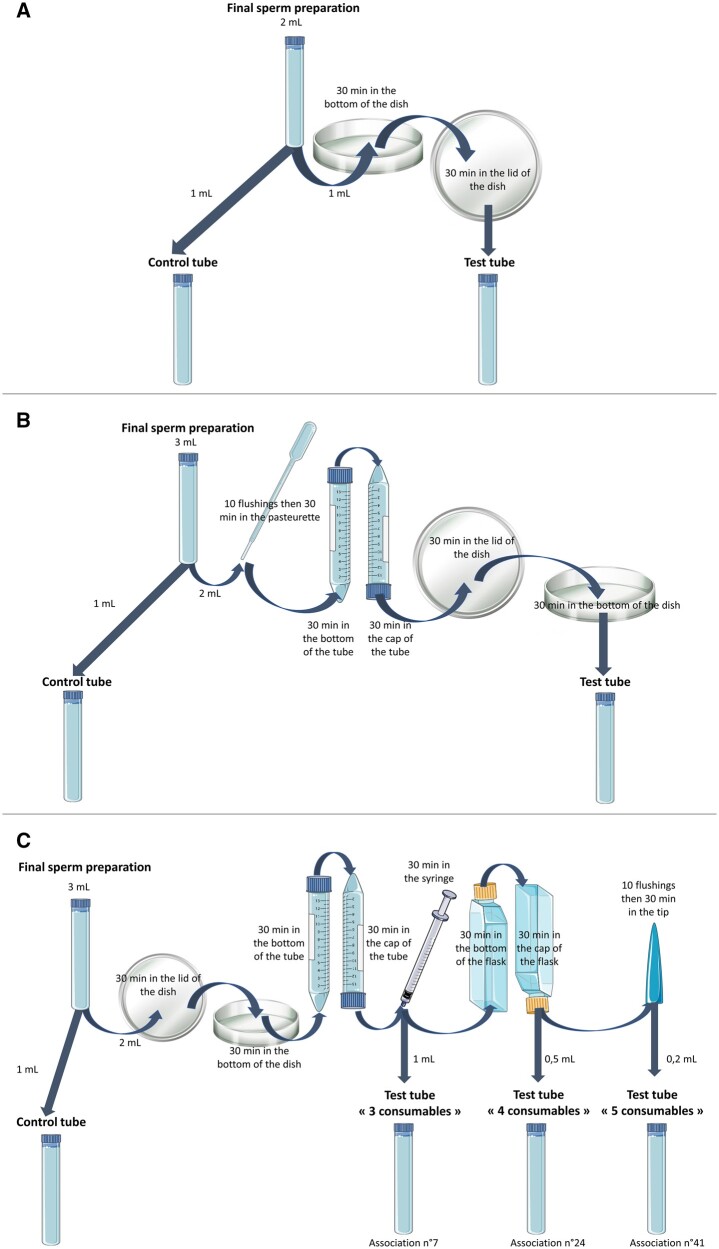
PARTICIPANTS/MATERIALS, SETTING, METHODS: After obtaining patient consent, the surplus semen assessed as having normal parameters according to the World Health Organization 2010 criteria were used to perform the HSMAs. First, each consumable was tested individually. Then, associations of three, four, and five consumables, previously validated as non-toxic when tested individually, were analyzed. HSMAs were conducted three times to ensure reproducibility, with a defined toxicity threshold of a sperm motility index (SMI) below 0.85 in at least two of three tests.
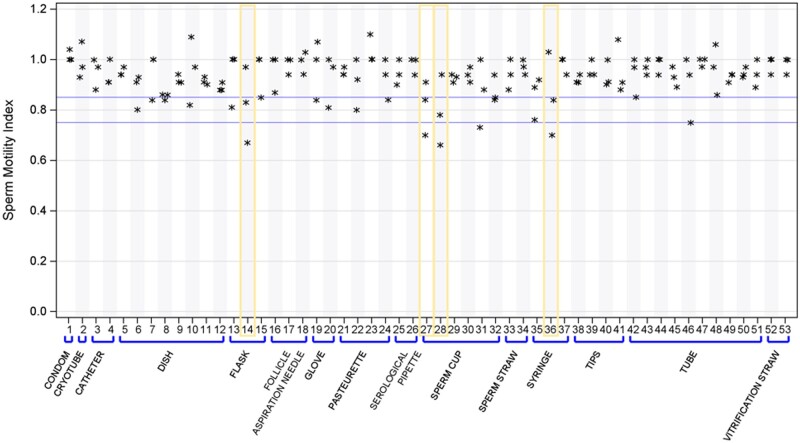
Thirty-six references of disposables were first individually tested across 53 lots. Forty-nine (92%) demonstrated compliance. However, four (8%) devices revealed toxicity: one lot of 1 ml syringes, two lots of sperm cups, and one lot of 25 cm2 flasks. These four references were excluded from the IVF routine procedures. A total of 48 combinations of consumables were assessed, involving 41 lots from 32 references that were previously individually tested. Among the evaluated combinations, 17 out of 48 (35%) associations exhibited toxicity with a SMI below 0.85 for two of the three tests (n = 8) or all the three tests (n = 9). Notably, three out of 17 (18%) of the three-consumable associations, five out of 16 (31%) of the four-consumable associations, and nine out of 15 (60%) of the five-consumable associations were found not compliant. The toxicity did not originate from a single consumable, because only consumables that were individually pre-validated as non-toxic were included in the combinations, but the toxicity had a cumulative origin. The risk of cumulative toxicity increased with the number of consumables included in the association (Cochran-Mantel-Haenszel statistic, P = 0.013).
LIMITATIONS, REASONS FOR CAUTION: The high proportion of non-compliant combinations of disposables can be attributed directly to the extreme rigorous extraction conditions employed during the tests, which could deviate from the conditions encountered in routine clinical use. Also, the methodology employed in the HSMAs (e.g. toxicity extraction duration, sperm concentrations, and protein supplementation of the medium) can influence the sensitivity of the tests.
This study highlights the significance of performing toxicity testing on devices before introducing them into clinical practice. Disposables should be tested individually to detect immediate toxicities and also in combination. Our results advocate rationalizing the number of consumables used in each IVF procedure and re-evaluating the use of glass consumables.
STUDY FUNDING/COMPETING INTEREST(S): This study received fundings from GCS Ramsay Santé pour l'Enseignement et la Recherche (Paris, France) and the Centre de Biologie Médicale BIOGROUP (Le Chesnay-Rocquencourt, France). The authors declare that they have no conflict of interest that could be perceived as prejudicing the impartiality of the reported research.
N/A.
体外受精(IVF)过程中使用的一次性用品是否存在累积毒性?
当耗材被累积使用时,可能会检测到毒性,而当同一耗材被单独使用和测试时,不会检测到毒性。
IVF 实验室中使用的许多物品的成分都可能损害人类胚胎的发育。因此,有必要对所有可能与配子和胚胎接触的试剂和材料进行筛选。制造商使用毒性测试,如小鼠胚胎试验和人类精子活力试验(HSMA),作为质量控制工具,以证明其产品的安全性。目前,每个单独的消耗品都进行这种评估。然而,在一个 IVF 周期中,会连续使用几种设备,这可能会导致化学污染物的累积暴露,而对于单独测试的消耗品则无法检测到这种暴露。
研究设计、规模、持续时间:这项观察性研究于 2021 年 3 月至 2022 年 10 月进行,目的是使用 HSMA 方法评估当几种一次性用品连续使用时是否存在累积毒性。研究中包括了目前在常规 IVF 程序中使用的 14 类耗材,其中包括用于精子和卵子采集的器具(杯子、避孕套和卵子抽吸针)、操作(培养瓶、管、吸头、移液器、胚胎转移导管、注射器和手套)、培养(培养皿)和储存(吸管)。
参与者/材料、设置、方法:在获得患者同意后,使用根据世界卫生组织 2010 标准评估为正常参数的剩余精液进行 HSMAs。首先,单独测试每个消耗品。然后,分析了之前单独测试时被证明为非毒性的三个、四个和五个消耗品的组合。进行了三次 HSMAs,以确保重现性,精子活力指数(SMI)低于 0.85 的定义毒性阈值至少在三次测试中的两次中达到。
首先单独测试了 36 个一次性用品的 53 个批次,结果有 49 个(92%)批次符合要求。然而,有 4 个(8%)设备显示出毒性:1 毫升注射器的一个批次、精子杯的两个批次和 25 平方厘米培养瓶的一个批次。这些四个参考品被排除在 IVF 常规程序之外。总共评估了 48 种耗材的组合,涉及 32 个参考品的 41 个批次,这些参考品之前已经单独进行了测试。在所评估的组合中,有 17 个(35%)组合的精子活力指数(SMI)低于 0.85,在三次测试中的两次(n=8)或所有三次测试(n=9)中达到。值得注意的是,三个三消耗品组合(18%)、五个四消耗品组合(31%)和九个五消耗品组合(60%)中的三个组合不符合要求。毒性不是来自于单一的消耗品,因为只有被预先证明为非毒性的消耗品才被包含在组合中,但毒性是累积的。随着组合中消耗品数量的增加,累积毒性的风险也会增加(Cochran-Mantel-Haenszel 统计量,P=0.013)。
局限性、谨慎的原因:一次性用品组合中不符合要求的比例很高,这直接归因于测试中采用的极端严格的提取条件,这些条件可能与常规临床使用中的条件不同。此外,HSMA 中采用的方法(例如毒性提取时间、精子浓度和培养基中的蛋白质补充)也会影响测试的灵敏度。
这项研究强调了在将设备引入临床实践之前对其进行毒性测试的重要性。消耗品应单独进行测试,以检测即时毒性,也应进行组合测试。我们的结果提倡合理化每个 IVF 程序中使用的消耗品数量,并重新评估玻璃消耗品的使用。
研究资金/利益冲突:这项研究得到了 GCS Ramsay Santé pour l'Enseignement et la Recherche(巴黎,法国)和 Centre de Biologie Médicale BIOGROUP(Le Chesnay-Rocquencourt,法国)的资助。作者声明他们没有可能被视为损害所报告研究的公正性的利益冲突。
无。