ERA Registry, Department of Medical Informatics, Amsterdam UMC Location, University of Amsterdam, Amsterdam, the Netherlands.
Amsterdam Public Health Research Institute, Quality of Care, Amsterdam, the Netherlands.
Nephrol Dial Transplant. 2024 Sep 27;39(10):1593-1603. doi: 10.1093/ndt/gfae040.
This paper compares the most recent data on the incidence and prevalence of kidney replacement therapy (KRT), kidney transplantation rates, and mortality on KRT from Europe to those from the United States (US), including comparisons of treatment modalities (haemodialysis (HD), peritoneal dialysis (PD), and kidney transplantation (KTx)).
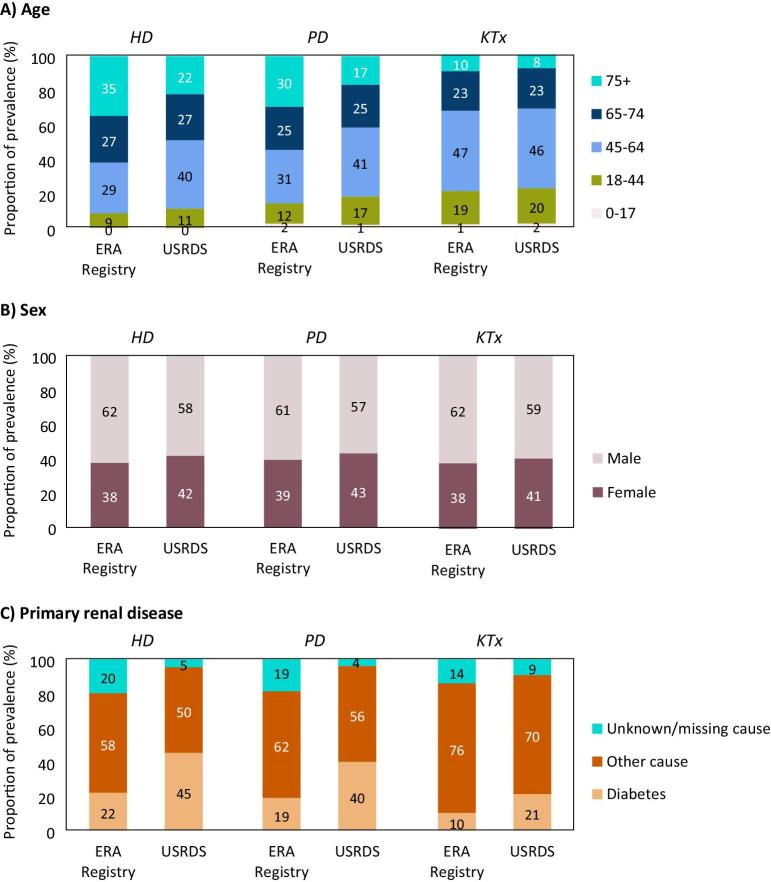
Data were derived from the annual reports of the European Renal Association (ERA) Registry and the United States Renal Data System (USRDS). The European data include information from national and regional renal registries providing the ERA Registry with individual patient data. Additional analyses were performed to present results for all participating European countries together.
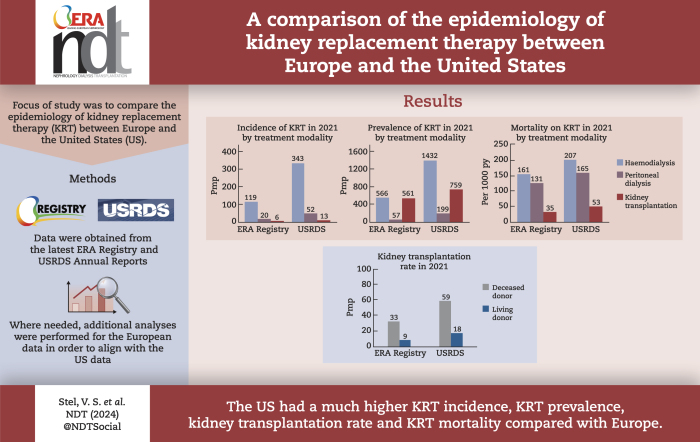
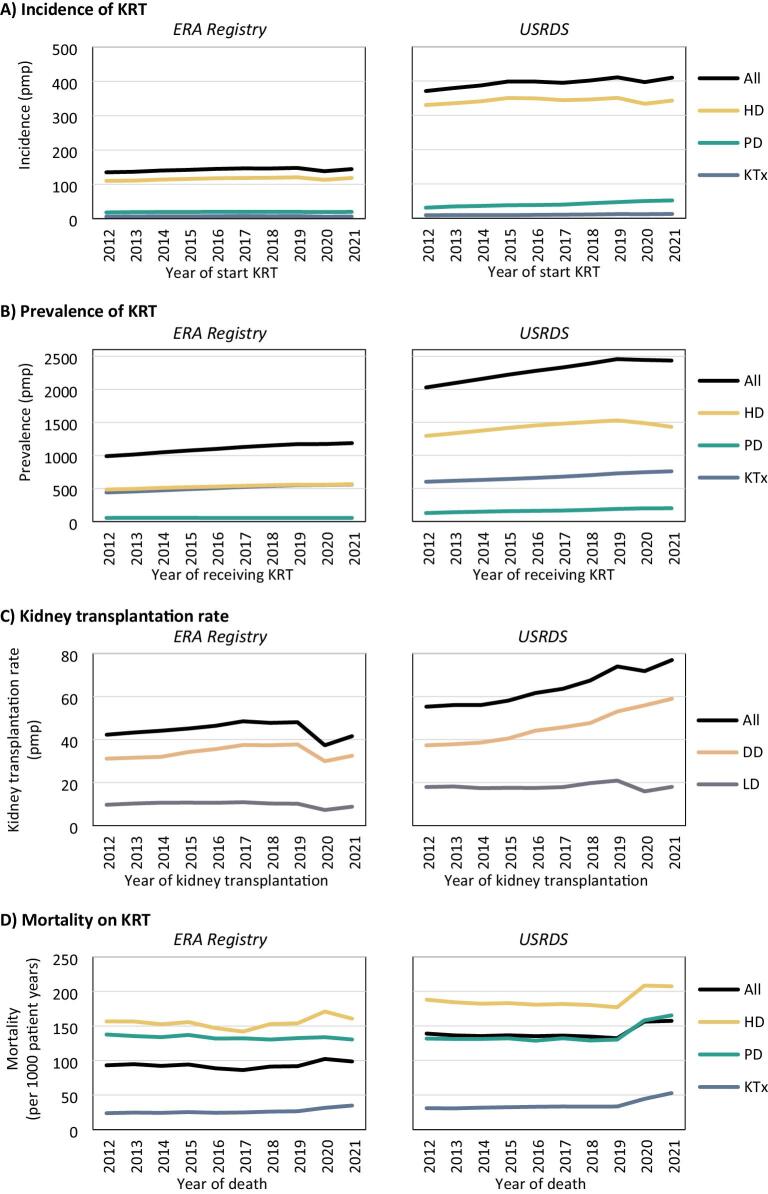
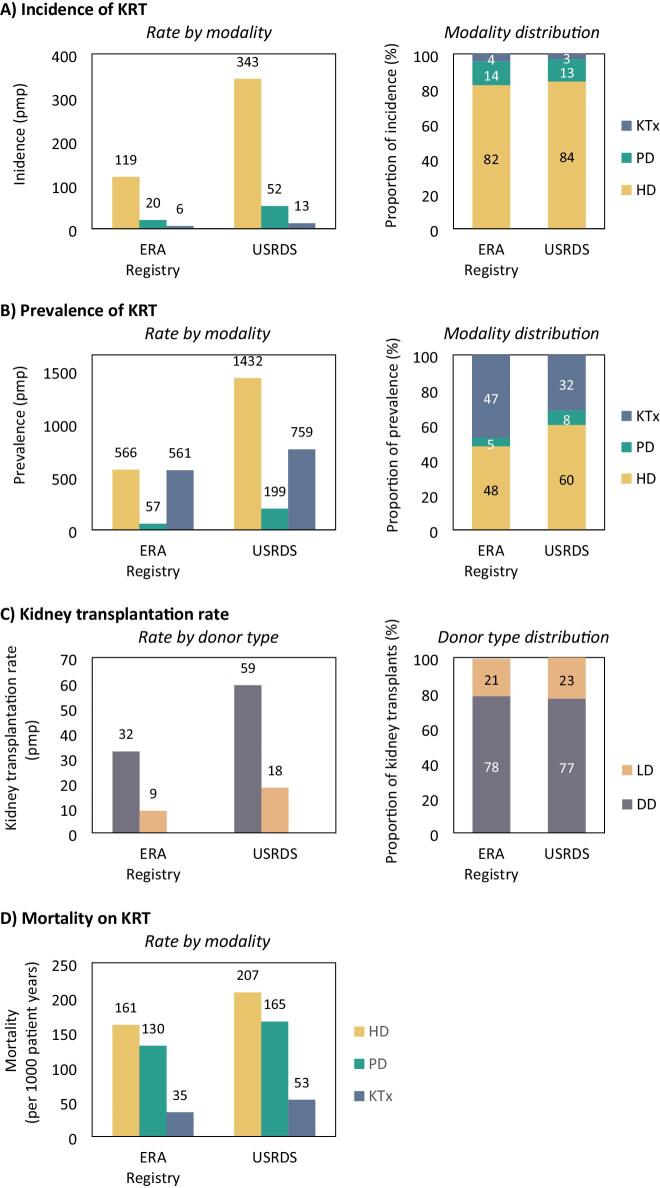
In 2021, the KRT incidence in the US (409.7 per million population (pmp)) was almost 3-fold higher than in Europe (144.4 pmp). Despite the substantial difference in KRT incidence, approximately the same proportion of patients initiated HD (Europe: 82%, US: 84%), PD (14%; 13%, respectively), or underwent pre-emptive KTx (4%; 3%, respectively). The KRT prevalence in the US (2436.1 pmp) was 2-fold higher than in Europe (1187.8 pmp). Within Europe, approximately half of all prevalent patients were living with a functioning graft (47%), while in the US, this was one third (32%). The number of kidney transplantations performed was almost twice as high in the US (77.0 pmp) compared to Europe (41.6 pmp). The mortality of patients receiving KRT was 1.6-fold higher in the US (157.3 per 1000 patient years) compared to Europe (98.7 per 1000 patient years).
The US had a much higher KRT incidence, prevalence, and mortality compared to Europe, and despite a higher kidney transplantation rate, a lower proportion of prevalent patients with a functioning graft.
本文比较了欧洲和美国最近关于肾脏替代治疗(KRT)的发病率和患病率、肾移植率以及 KRT 死亡率的数据,包括治疗方式(血液透析(HD)、腹膜透析(PD)和肾移植(KTx))的比较。
数据来源于欧洲肾脏协会(ERA)登记处和美国肾脏数据系统(USRDS)的年度报告。欧洲数据包括来自国家和地区肾脏登记处的信息,这些登记处为 ERA 登记处提供了个体患者数据。还进行了额外的分析,以展示所有参与欧洲国家的数据结果。
2021 年,美国的 KRT 发病率(409.7/百万人口(pmp))几乎是欧洲的 3 倍(144.4 pmp)。尽管 KRT 的发病率存在显著差异,但接受 HD(欧洲:82%,美国:84%)、PD(14%;分别为 13%)或进行预防性 KTx(4%;分别为 3%)的患者比例大致相同。美国的 KRT 患病率(2436.1 pmp)是欧洲的 2 倍(1187.8 pmp)。在欧洲,大约一半的所有现患患者都有功能移植物(47%),而在美国,这一比例为三分之一(32%)。美国进行的肾移植数量几乎是欧洲的两倍(77.0 pmp),而欧洲为 41.6 pmp。接受 KRT 的患者的死亡率在美国是欧洲的 1.6 倍(每 1000 个患者年 157.3 人),而在欧洲为每 1000 个患者年 98.7 人。
与欧洲相比,美国的 KRT 发病率、患病率和死亡率要高得多,尽管肾移植率较高,但有功能移植物的现患患者比例较低。