ERA Registry, Department of Medical Informatics, Amsterdam UMC location University of Amsterdam, Amsterdam, The Netherlands.
Epidemiology Department, High Institute of Public Health, Alexandria University, Alexandria, Egypt.
Nephrol Dial Transplant. 2024 Aug 30;39(9):1449-1460. doi: 10.1093/ndt/gfae034.
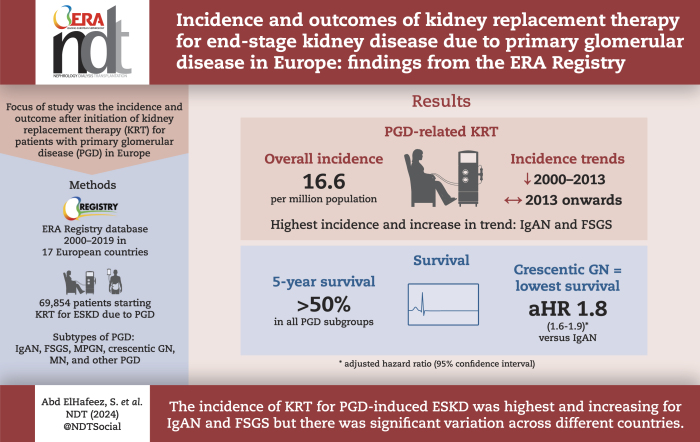
Primary glomerular disease (PGD) is a major cause of end-stage kidney disease (ESKD) leading to kidney replacement therapy (KRT). We aimed to describe incidence (trends) in individuals starting KRT for ESKD due to PGD and to examine their survival and causes of death.
We used data from the European Renal Association (ERA) Registry on 69 854 patients who started KRT for ESKD due to PGD between 2000 and 2019. ERA primary renal disease codes were used to define six PGD subgroups. We examined age and sex standardized incidence, trend of the incidence and survival.
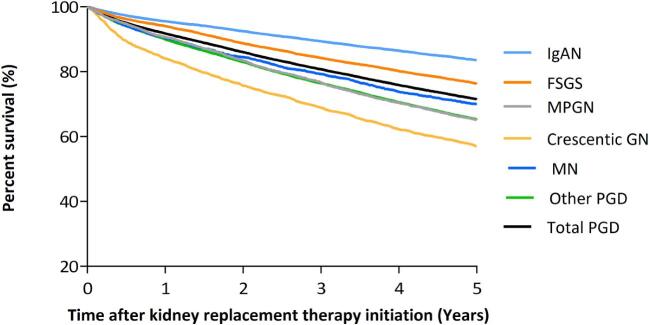
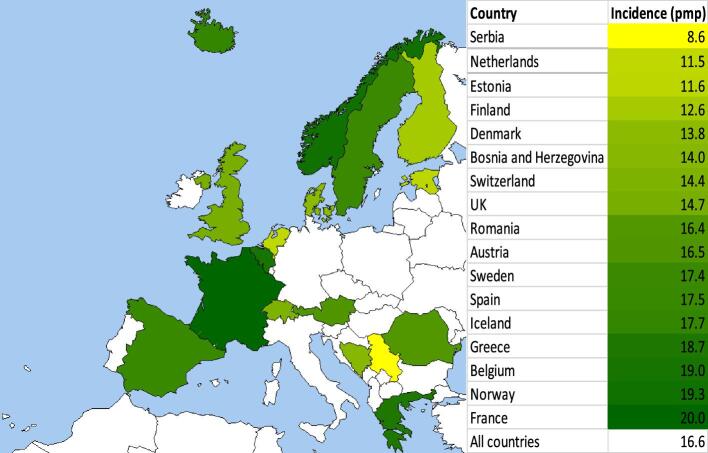
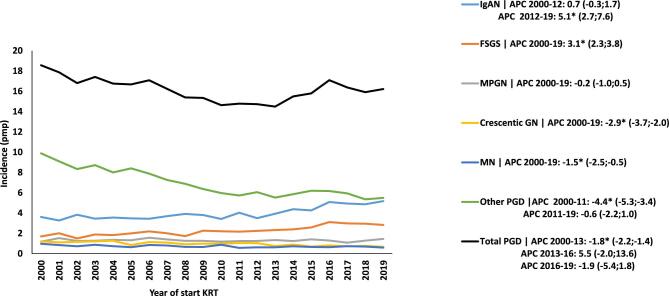
The standardized incidence of KRT for ESKD due to PGD was 16.6 per million population (pmp), ranging from 8.6 pmp in Serbia to 20.0 pmp in France. Immunoglobulin A nephropathy (IgAN) and focal segmental glomerulosclerosis (FSGS) had the highest incidences, of 4.6 pmp and 2.6 pmp, respectively. Histologically non-examined PGDs represented over 50% of cases in Serbia, Bosnia and Herzegovina, and Romania and were also common in Greece, Estonia, Belgium and Sweden. The incidence declined from 18.6 pmp in 2000 to 14.5 pmp in 2013, after which it stabilized. All PGD subgroups had 5-year survival probabilities above 50%, with crescentic glomerulonephritis having the highest risk of death [adjusted hazard ratio 1.8 (95% confidence interval 1.6-1.9)] compared with IgAN. Cardiovascular disease was the most common cause of death (33.9%).
The incidence of KRT for ESKD due to PGD showed large differences between countries and was highest and increasing for IgAN and FSGS. Lack of kidney biopsy facilities in some countries may have affected accurate assignment of the cause of ESKD. The recognition of the incidence and outcomes of KRT among different PGD subgroups may contribute to a more individualized patient care approach.
原发性肾小球疾病(PGD)是导致终末期肾病(ESKD)并需要肾脏替代治疗(KRT)的主要原因。我们旨在描述因 PGD 而开始接受 KRT 治疗 ESKD 的个体的发病率(趋势),并检查他们的生存率和死因。
我们使用了欧洲肾脏协会(ERA)登记处的数据,该数据涵盖了 2000 年至 2019 年间因 PGD 而开始接受 KRT 治疗 ESKD 的 69854 名患者。ERA 原发性肾脏疾病代码用于定义六个 PGD 亚组。我们检查了年龄和性别标准化发病率、发病率趋势和生存率。
PGD 导致的 ESKD 患者接受 KRT 的标准化发病率为 16.6/百万人(pmp),范围从塞尔维亚的 8.6 pmp 到法国的 20.0 pmp。免疫球蛋白 A 肾病(IgAN)和局灶节段性肾小球硬化症(FSGS)的发病率最高,分别为 4.6 pmp 和 2.6 pmp。在塞尔维亚、波斯尼亚和黑塞哥维那以及罗马尼亚,未经组织学检查的 PGD 占病例的 50%以上,在希腊、爱沙尼亚、比利时和瑞典也很常见。发病率从 2000 年的 18.6 pmp 下降到 2013 年的 14.5 pmp,之后趋于稳定。所有 PGD 亚组的 5 年生存率均超过 50%,新月体性肾小球肾炎的死亡风险最高[校正后的危险比为 1.8(95%置信区间 1.6-1.9)],与 IgAN 相比。心血管疾病是最常见的死亡原因(33.9%)。
PGD 导致的 ESKD 患者接受 KRT 的发病率在国家之间存在很大差异,IgAN 和 FSGS 的发病率最高且呈上升趋势。一些国家缺乏肾脏活检设施可能影响 ESKD 病因的准确诊断。认识不同 PGD 亚组的 KRT 发病率和结果可能有助于采取更个体化的患者护理方法。