Shah Muhammad Raza, Fatima Samreen, Khan Sehrosh Naz, Azam Zahid, Shaikh Hafeezullah, Majid Shahid, Chengdong He, Daijun Zhou, Wang Wei
Center for Bioequivalence Studies and Clinical Research, Dr. Panjwani Center for Molecular Medicine and Drug Research, International Center for Chemical and Biological Sciences, University of Karachi, Karachi, Pakistan.
National Institute of Liver & GI Diseases (NILGID), DOW University of Health Sciences, Karachi, Sindh, Pakistan.
Front Pharmacol. 2024 Feb 19;15:1293272. doi: 10.3389/fphar.2024.1293272. eCollection 2024.
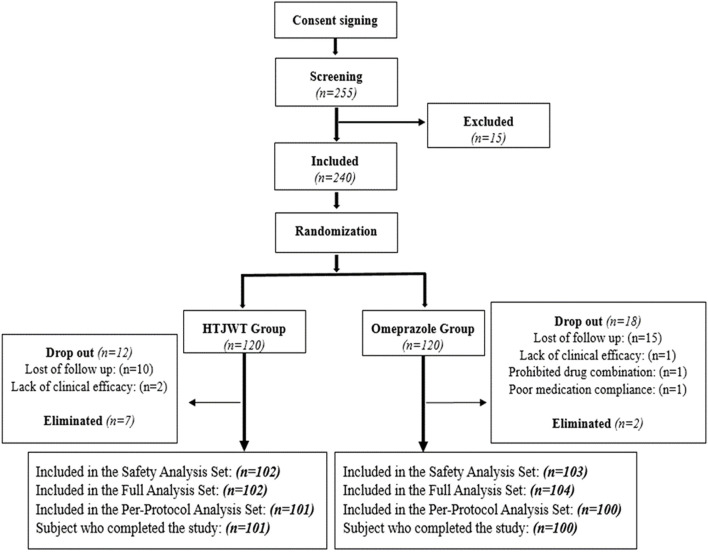
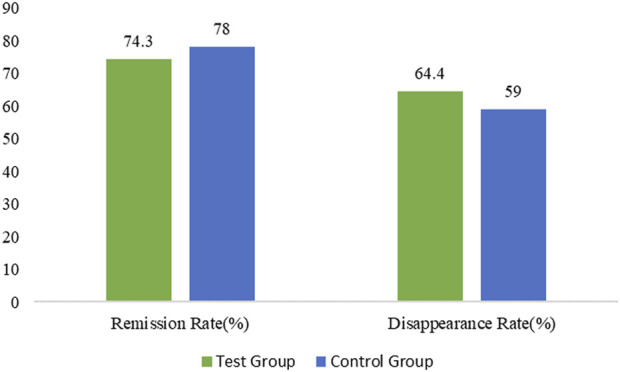
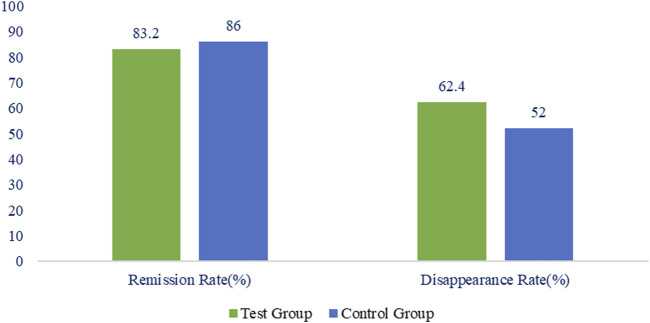
Common symptoms of Chronic Non-atrophic Gastritis (CNAG) include nausea, stomach distension, and abdominal pain. The Houtou Jianweiling Tablet (HTJWT) is a chinese patent medicine (CN1368229A) and it has been used clinically for more than 20 years with proven clinical efficacy in treating CNAG, prompted us to establish the clinical efficacy and safety of HTJWT on patients with mild to moderate CNAG symptoms in Pakistani population. This phase II, double-blind, randomized, parallel-controlled trial was conducted in a single center between November 2022 and February 2023 in Pakistan. In a ratio of 1:1, total 240 CNAG patients with erosion identified by pathological biopsy and gastroscopy were randomly assigned to control (Omeprazole) group ( = 120) and the treatment (HTJWT) group ( = 120). Patients in the treatment group received orally four HTJWT (0.38g/tablet), three times a day and one placebo of Omeprazole enteric-coated tablet prior to breakfast, daily. On the other hand, patients in the control group received one Omeprazole enteric-coated tablet (20 mg/tablet) prior to breakfast and four placebo of HTJWT, thrice a day. The patients consumed the investigated drugs (i.e., treatment and control) treatment regimen was followed for a duration of 28 days. The safety of the patients were evaluated through adverse events, serious adverse events and laboratory tests such as blood biochemistry, urine analysis, liver and renal function tests. Vital signs like; blood pressure, pulse rate, body temperature, respiratory rate for all the patients were recorded. The cardiac status of the patients were assessed through electrocardiogram (ECG). The primary efficacy indicators were the improvement rate of gastric distention and gastralgia as the main clinical symptoms. Secondary indicators were visual analogue score (VAS); improvement rate of secondary clinical symptoms and signs; improvement rate of total clinical signs and symptoms; the disappearance/remission rate of Gastric pain and, remission/disappearance time of gastric distension; and the negative conversion rate of (). The outcomes among each group were compared using the chi-square test. Patients in both groups had good drug compliance (80%-120%), and there was no statistically significant difference in the patients' baseline characteristics. The clinical improvement rate was found to be 91.1% in the treatment group and 91.0% in the control group with negligible variation among the two groups ( = 0.9824; 95% confidence interval: -0.0781-0.0798). Similarly, hardly no difference was found in the negative conversion rate of between the treatment group and the control group (i.e., 70.1% and 71.8% respectively, = 0.8125). There were no significant differences in respiratory rate, vital signs, blood pressure, laboratory results for blood biochemistry, urine analysis, liver and renal function tests between the two groups. The ECG assessment carried out for the treatment and control group revealed no considerable difference. Margin variation in the disappearance time of gastric pain ( = 0.1860) and remission rate ( = 0.5784) between the two groups were observed. The control group exhibited a faster remission period for gastrointestinal discomfort indications as compared to treatment group ( = 0.0430). Only one patient in the control group experienced mild to moderate adverse events, namely,; epigastric pain and dyspepsia. The results were consistent with the intention-to-treat and per-protocol analysis that included patients who were 100% compliant to the assigned therapy. The lower limit of confidence interval (CI, 95%) for the differences in the effective rate between the treatment and the control groups was found to be -0.0781 which is greater than -0.15, hence the treatment group is non-inferior to the control group. The therapeutic dosage used in the trial and treatment period did not cause any significant adverse event, and there were no obvious changes in the ECG profile, vital signs and biochemistry of the patients. Based on the clinical efficacy evaluation and reported adverse events, it can be concluded that the HTJWT is a safe and effective traditional chinese medicine for the treatment of patients suffering from chronic non-atrophic gastritis with mild to moderate symptoms. : [www.clinicaltrials.gov], identifier [NCT04672018].
慢性非萎缩性胃炎(CNAG)的常见症状包括恶心、胃胀和腹痛。猴头健胃灵片(HTJWT)是一种中成药(CN1368229A),已在临床应用20多年,在治疗CNAG方面具有经证实的临床疗效,这促使我们在巴基斯坦人群中确定HTJWT对轻至中度CNAG症状患者的临床疗效和安全性。这项II期双盲、随机、平行对照试验于2022年11月至2023年2月在巴基斯坦的一个单一中心进行。按照1:1的比例,将通过病理活检和胃镜检查确诊的240例伴有糜烂的CNAG患者随机分为对照组(奥美拉唑)组(n = 120)和治疗(HTJWT)组(n = 120)。治疗组患者口服四片HTJWT(0.38g/片),每日三次,并在早餐前服用一片奥美拉唑肠溶片安慰剂。另一方面,对照组患者在早餐前服用一片奥美拉唑肠溶片(20mg/片),并每日三次服用四片HTJWT安慰剂。患者服用研究药物(即治疗药物和对照药物)的治疗方案持续28天。通过不良事件、严重不良事件以及血液生化、尿液分析、肝肾功能检查等实验室检查来评估患者的安全性。记录所有患者的生命体征,如血压、脉搏率、体温、呼吸频率。通过心电图(ECG)评估患者的心脏状况。主要疗效指标是以胃胀和胃痛改善率作为主要临床症状。次要指标是视觉模拟评分(VAS);次要临床症状和体征的改善率;总临床体征和症状的改善率;胃痛的消失/缓解率以及胃胀的缓解/消失时间;以及幽门螺杆菌(Hp)的转阴率。使用卡方检验比较每组的结果。两组患者的药物依从性都很好(80%-120%),并且患者的基线特征没有统计学上的显著差异。治疗组的临床改善率为91.1%,对照组为91.0%,两组之间的差异可忽略不计(P = 0.9824;95%置信区间:-0.0781-0.0798)。同样,治疗组和对照组之间的Hp转阴率几乎没有差异(分别为70.1%和71.8%,P = 0.8125)。两组之间在呼吸频率、生命体征、血压、血液生化实验室结果、尿液分析、肝肾功能检查方面没有显著差异。对治疗组和对照组进行的心电图评估显示没有明显差异。观察到两组之间胃痛消失时间(P = 0.1860)和缓解率(P = 0.5784)的微小差异。与治疗组相比,对照组胃肠道不适症状的缓解期更快(P = 0.0430)。对照组中只有一名患者经历了轻度至中度不良事件,即上腹部疼痛和消化不良。结果与意向性治疗分析和符合方案分析一致,这些分析包括100%遵守指定治疗的患者。治疗组和对照组之间有效率差异的95%置信区间下限为-0.0781,大于-0.15,因此治疗组不劣于对照组。试验和治疗期间使用的治疗剂量未引起任何显著不良事件,患者的心电图、生命体征和生化指标也没有明显变化。基于临床疗效评估和报告的不良事件,可以得出结论,HTJWT是一种治疗轻至中度症状慢性非萎缩性胃炎患者的安全有效的中药。试验注册:[www.clinicaltrials.gov],标识符[NCT04672018]