Schlein Eva, Rokka Johanna, Odell Luke R, van den Broek Sara Lopes, Herth Matthias M, Battisti Umberto M, Syvänen Stina, Sehlin Dag, Eriksson Jonas
Department of Public Health and Caring Sciences, Uppsala University, 751 85, Uppsala, Sweden.
Department of Medicinal Chemistry, Uppsala University, 751 23, Uppsala, Sweden.
EJNMMI Radiopharm Chem. 2024 Mar 6;9(1):21. doi: 10.1186/s41181-024-00250-6.
The brain is a challenging target for antibody-based positron emission tomography (immunoPET) imaging due to the restricted access of antibody-based ligands through the blood-brain barrier (BBB). To overcome this physiological obstacle, we have previously developed bispecific antibody ligands that pass through the BBB via receptor-mediated transcytosis. While these radiolabelled ligands have high affinity and specificity, their long residence time in the blood and brain, typical for large molecules, poses another challenge for PET imaging. A viable solution could be a two-step pre-targeting approach which involves the administration of a tagged antibody that accumulates at the target site in the brain and then clears from the blood, followed by administration of a small radiolabelled molecule with fast kinetics. This radiolabelled molecule can couple to the tagged antibody and thereby make the antibody localisation visible by PET imaging. The in vivo linkage can be achieved by using the inverse electron demand Diels-Alder reaction (IEDDA), with trans-cyclooctene (TCO) and tetrazine groups participating as reactants. In this study, two novel F-labelled tetrazines were synthesized and evaluated for their potential use as pre-targeting imaging agents, i.e., for their ability to rapidly enter the brain and, if unbound, to be efficiently cleared with minimal background retention.
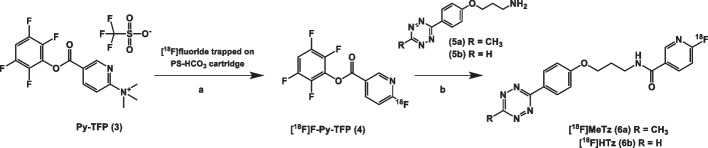
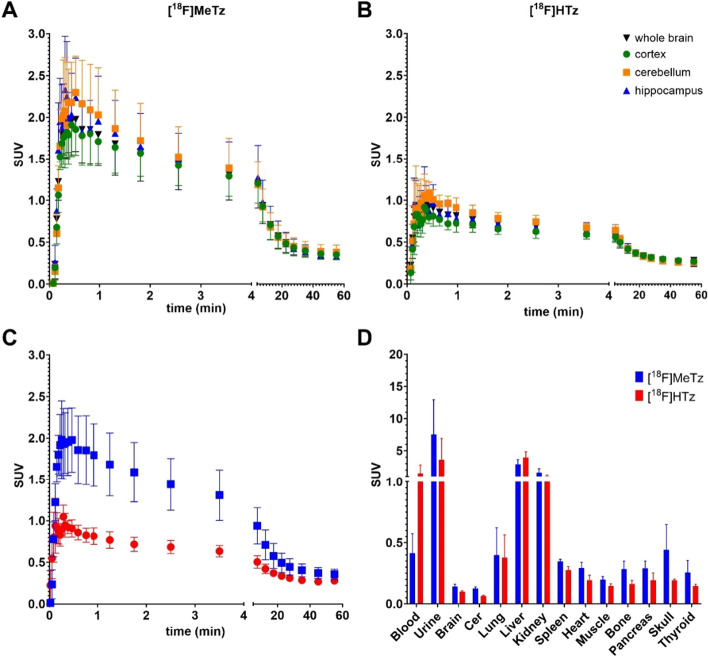
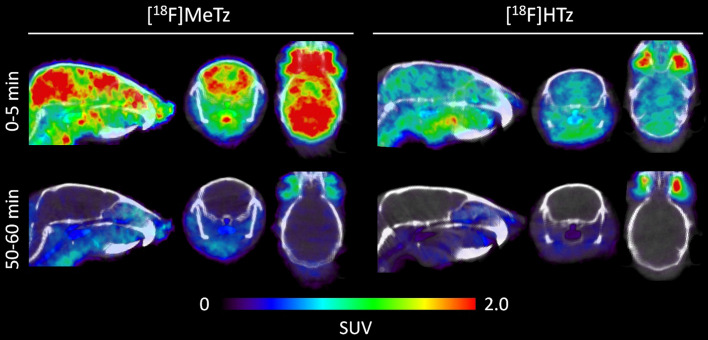
The two compounds, a methyl tetrazine [F]MeTz and an H-tetrazine [F]HTz were radiolabelled using a two-step procedure via [F]F-Py-TFP synthesized on solid support followed by amidation with amine-bearing tetrazines, resulting in radiochemical yields of 24% and 22%, respectively, and a radiochemical purity of > 96%. In vivo PET imaging was performed to assess their suitability for in vivo pre-targeting. Time-activity curves from PET-scans showed [F]MeTz to be the more pharmacokinetically suitable agent, given its fast and homogenous distribution in the brain and rapid clearance. However, in terms of rection kinetics, H-tetrazines are advantageous, exhibiting faster reaction rates in IEDDA reactions with dienophiles like trans-cyclooctenes, making [F]HTz potentially more beneficial for pre-targeting applications.
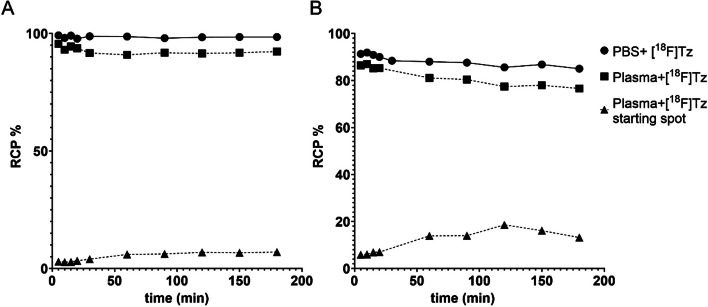
This study demonstrates a significant potential of [F]MeTz and [F]HTz as agents for pre-targeted PET brain imaging due to their efficient brain uptake, swift clearance and appropriate chemical stability.
由于基于抗体的配体通过血脑屏障(BBB)的途径受限,大脑是基于抗体的正电子发射断层扫描(免疫PET)成像的一个具有挑战性的靶点。为了克服这一生理障碍,我们之前开发了双特异性抗体配体,其通过受体介导的转胞吞作用穿过血脑屏障。虽然这些放射性标记的配体具有高亲和力和特异性,但它们在血液和大脑中的长时间停留,这是大分子的典型特征,给PET成像带来了另一个挑战。一个可行的解决方案可能是两步预靶向方法,该方法包括给予一种标记抗体,其在大脑中的靶位点积累然后从血液中清除,随后给予一种具有快速动力学的小放射性标记分子。这种放射性标记分子可以与标记抗体偶联,从而通过PET成像使抗体定位可见。体内连接可以通过使用逆电子需求狄尔斯-阿尔德反应(IEDDA)来实现,其中反式环辛烯(TCO)和四嗪基团作为反应物参与反应。在本研究中,合成了两种新型的F标记四嗪,并评估了它们作为预靶向成像剂的潜在用途,即它们快速进入大脑的能力,以及如果未结合时能够以最小的背景滞留被有效清除的能力。
这两种化合物,甲基四嗪[F]MeTz和H-四嗪[F]HTz,通过在固体支持物上合成的[F]F-Py-TFP,然后与含胺四嗪进行酰胺化反应的两步程序进行放射性标记,放射化学产率分别为24%和22%,放射化学纯度>96%。进行体内PET成像以评估它们在体内预靶向中的适用性。PET扫描的时间-活性曲线显示,[F]MeTz在药代动力学上更适合作为药物,因为它在大脑中分布快速且均匀,并且清除迅速。然而,就反应动力学而言,H-四嗪具有优势,在与反式环辛烯等亲双烯体的IEDDA反应中表现出更快的反应速率,这使得[F]HTz在预靶向应用中可能更有益。
本研究证明了[F]MeTz和[F]HTz作为预靶向PET脑成像剂具有巨大潜力,因为它们具有高效的脑摄取、快速清除和适当的化学稳定性。