Shalgunov Vladimir, Lopes van den Broek Sara, Vang Andersen Ida, García Vázquez Rocío, Raval Nakul Ravi, Palner Mikael, Mori Yuki, Schäfer Gabriela, Herrmann Barbara, Mikula Hannes, Beschorner Natalie, Nedergaard Maiken, Syvänen Stina, Barz Matthias, Moos Knudsen Gitte, Battisti Umberto Maria, Herth Matthias Manfred
Department of Drug Design and Pharmacology, Faculty of Health and Medical Sciences, University of Copenhagen Universitetsparken 2 2100 Copenhagen Denmark
Neurobiology Research Unit and Center for Integrated Molecular Brain Imaging, Rigshospitalet Copenhagen University Hospital Blegdamsvej 9 DK-2100 Copenhagen Denmark.
RSC Med Chem. 2022 Dec 2;14(3):444-453. doi: 10.1039/d2md00360k. eCollection 2023 Mar 22.
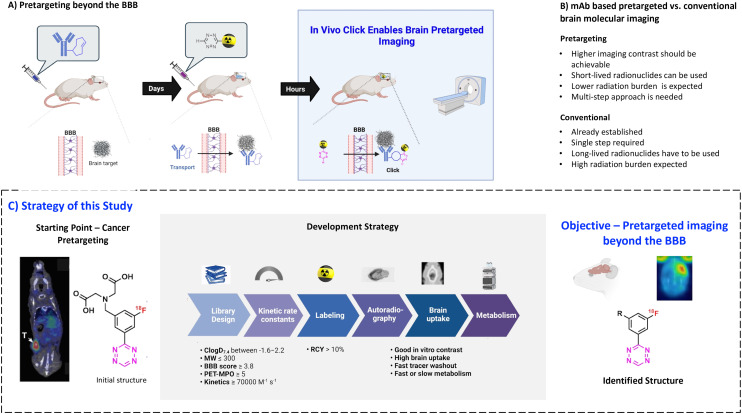
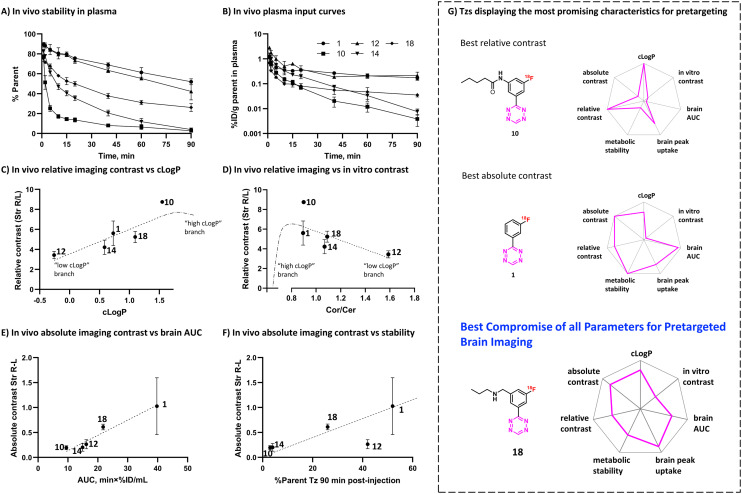
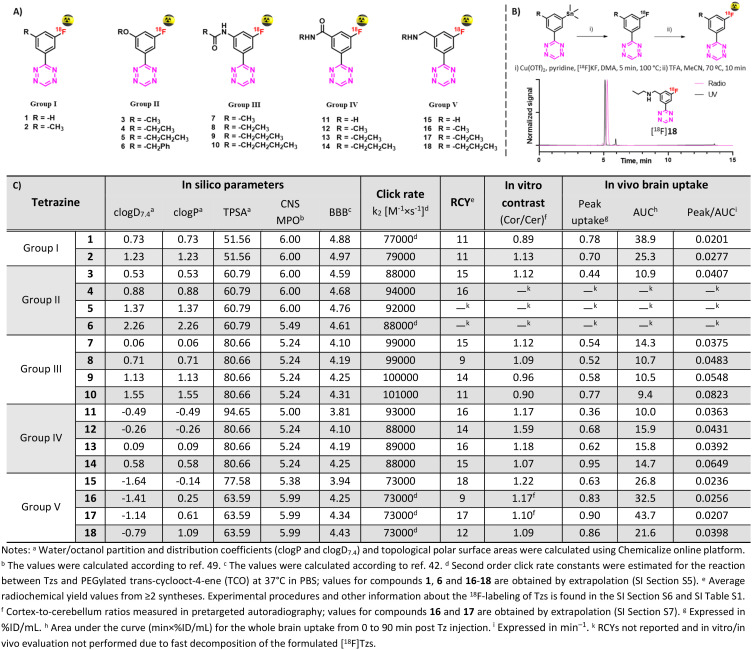
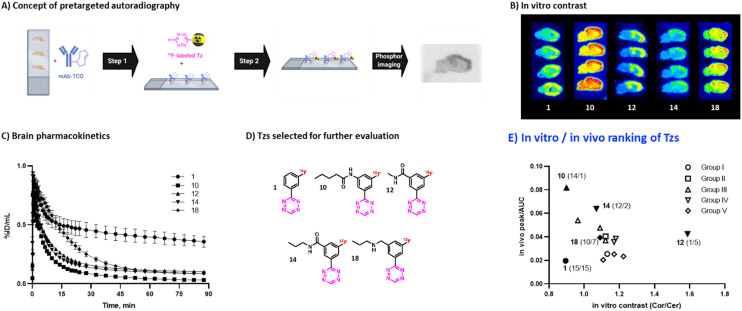
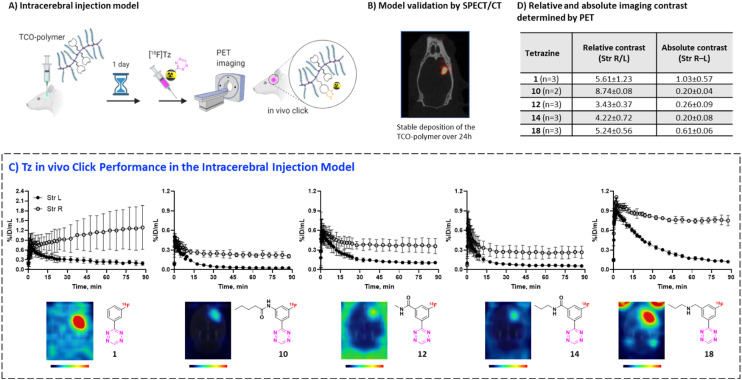
Pretargeting is a powerful nuclear imaging strategy to achieve enhanced imaging contrast for nanomedicines and reduce the radiation burden to healthy tissue. Pretargeting is based on bioorthogonal chemistry. The most attractive reaction for this purpose is currently the tetrazine ligation, which occurs between -cyclooctene (TCO) tags and tetrazines (Tzs). Pretargeted imaging beyond the blood-brain barrier (BBB) is challenging and has not been reported thus far. In this study, we developed Tz imaging agents that are capable of ligating to targets beyond the BBB. We chose to develop F-labeled Tzs as they can be applied to positron emission tomography (PET) - the most powerful molecular imaging technology. Fluorine-18 is an ideal radionuclide for PET due to its almost ideal decay properties. As a non-metal radionuclide, fluorine-18 also allows for development of Tzs with physicochemical properties enabling passive brain diffusion. To develop these imaging agents, we applied a rational drug design approach. This approach was based on estimated and experimentally determined parameters such as the BBB score, pretargeted autoradiography contrast, brain influx and washout as well as on peripheral metabolism profiles. From 18 initially developed structures, five Tzs were selected to be tested for their click performance. Whereas all selected structures clicked to TCO-polymer deposited into the brain, [F]18 displayed the most favorable characteristics with respect to brain pretargeting. [F]18 is our lead compound for future pretargeted neuroimaging studies based on BBB-penetrant monoclonal antibodies. Pretargeting beyond the BBB will allow us to image targets in the brain that are currently not imageable, such as soluble oligomers of neurodegeneration biomarker proteins. Imaging of such currently non-imageable targets will allow early diagnosis and personalized treatment monitoring. This in turn will accelerate drug development and greatly benefit patient care.
预靶向是一种强大的核成像策略,可增强纳米药物的成像对比度并减轻对健康组织的辐射负担。预靶向基于生物正交化学。目前,用于此目的最具吸引力的反应是四嗪连接反应,该反应发生在环辛烯(TCO)标签和四嗪(Tz)之间。血脑屏障(BBB)以外的预靶向成像具有挑战性,迄今为止尚未见报道。在本研究中,我们开发了能够与BBB以外的靶点连接的Tz成像剂。我们选择开发F标记的Tz,因为它们可应用于正电子发射断层扫描(PET)——最强大的分子成像技术。氟-18由于其几乎理想的衰变特性,是PET的理想放射性核素。作为一种非金属放射性核素,氟-18还允许开发具有使被动脑扩散成为可能的物理化学性质的Tz。为了开发这些成像剂,我们应用了合理的药物设计方法。该方法基于估计的和实验确定的参数,如BBB评分、预靶向放射自显影对比度、脑内流入和洗脱以及外周代谢谱。从最初开发的18种结构中,选择了5种Tz来测试它们的点击性能。尽管所有选定的结构都能与沉积在脑中的TCO聚合物发生点击反应,但[F]18在脑预靶向方面表现出最有利的特性。[F]18是我们未来基于穿透BBB的单克隆抗体进行预靶向神经成像研究的先导化合物。BBB以外的预靶向将使我们能够对目前无法成像的脑内靶点进行成像,例如神经退行性生物标志物蛋白的可溶性寡聚体。对这类目前无法成像的靶点进行成像将有助于早期诊断和个性化治疗监测。这反过来将加速药物开发并极大地造福患者护理。