Department of Forensic Medicine, College of Basic Medicine, Chongqing Medical University, Chongqing, 400331, China.
Institute of Rare Diseases, West China Hospital of Sichuan University, Sichuan University, Chengdu, 610000, China.
BMC Biol. 2024 Mar 6;22(1):55. doi: 10.1186/s12915-024-01854-9.
The underrepresentation of human genomic resources from Southern Chinese populations limited their health equality in the precision medicine era and complete understanding of their genetic formation, admixture, and adaptive features. Besides, linguistical and genetic evidence supported the controversial hypothesis of their origin processes. One hotspot case was from the Chinese Guangxi Pinghua Han people (GPH), whose language was significantly similar to Southern Chinese dialects but whose uniparental gene pool was phylogenetically associated with the indigenous Tai-Kadai (TK) people. Here, we analyzed genome-wide SNP data in 619 people from four language families and 56 geographically different populations, in which 261 people from 21 geographically distinct populations were first reported here.
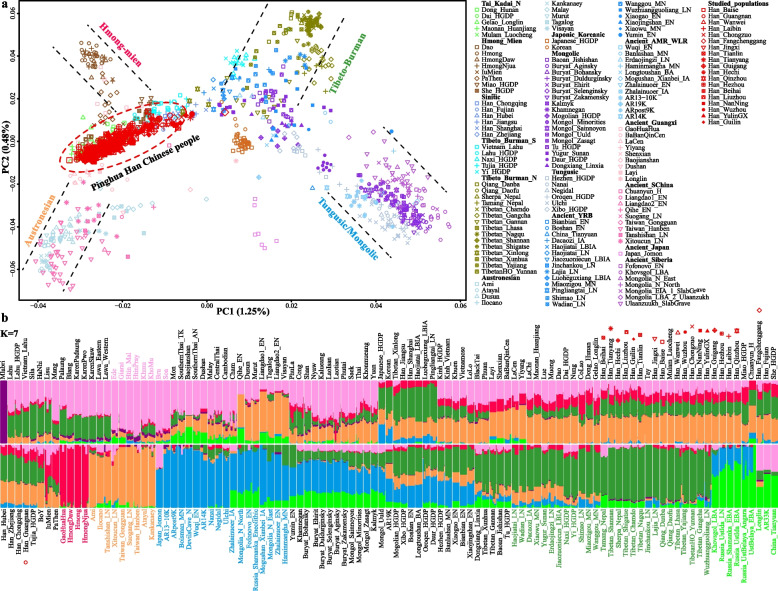
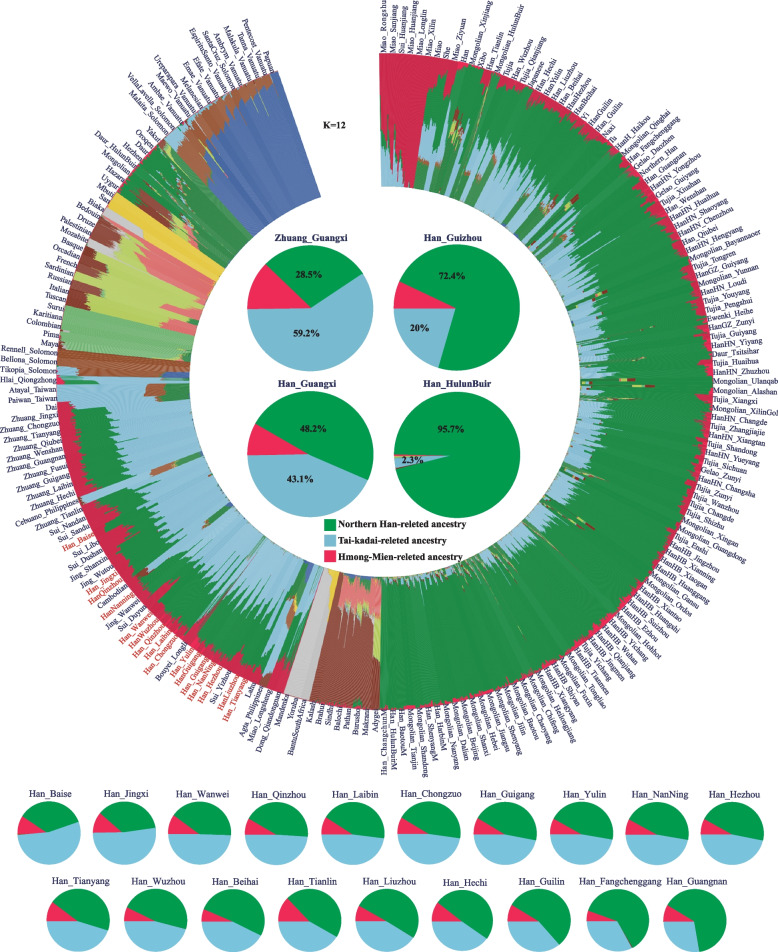
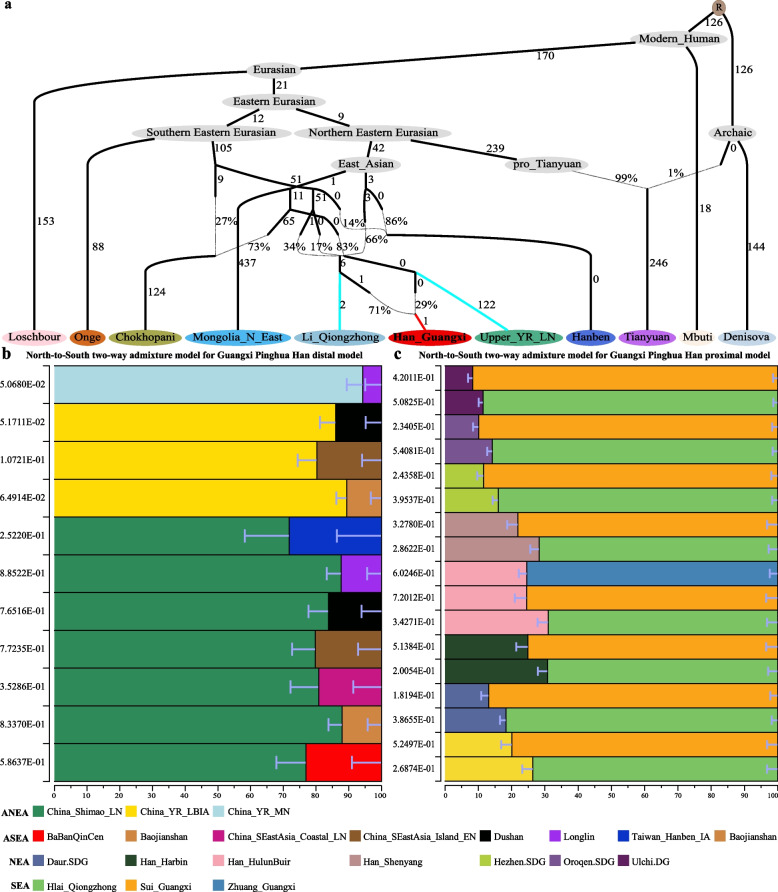
We identified significant population stratification among ethnolinguistically diverse Guangxi populations, suggesting their differentiated genetic origin and admixture processes. GPH shared more alleles related to Zhuang than Southern Han Chinese but received more northern ancestry relative to Zhuang. Admixture models and estimates of genetic distances showed that GPH had a close genetic relationship with geographically close TK compared to Northern Han Chinese, supporting their admixture origin hypothesis. Further admixture time and demographic history reconstruction supported GPH was formed via admixture between Northern Han Chinese and Southern TK people. We identified robust signatures associated with lipid metabolisms, such as fatty acid desaturases (FADS) and medically relevant loci associated with Mendelian disorder (GJB2) and complex diseases. We also explored the shared and unique selection signatures of ethnically different but linguistically related Guangxi lineages and found some shared signals related to immune and malaria resistance.
Our genetic analysis illuminated the language-related fine-scale genetic structure and provided robust genetic evidence to support the admixture hypothesis that can explain the pattern of observed genetic diversity and formation of GPH. This work presented one comprehensive analysis focused on the population history and demographical adaptative process, which provided genetic evidence for personal health management and disease risk prediction models from Guangxi people. Further large-scale whole-genome sequencing projects would provide the entire landscape of southern Chinese genomic diversity and their contributions to human health and disease traits.
在精准医学时代,由于缺乏来自中国南方人群的人类基因组资源,他们在健康方面存在不平等现象,对其遗传构成、混合和适应特征的认识也不完整。此外,语言和遗传证据支持了他们起源过程的有争议假说。一个热点案例来自中国广西平话汉族人(GPH),他们的语言与中国南方方言非常相似,但他们的单倍型基因库在系统发育上与当地的台-卡岱语(TK)人有关。在这里,我们分析了来自四个语系和 56 个地理不同的人群的 619 个人的全基因组 SNP 数据,其中 21 个地理不同的人群中有 261 人是首次报告的。
我们在广西不同民族和语言的人群中发现了显著的群体分层,表明他们具有不同的遗传起源和混合过程。GPH 与壮族相比,与南方汉族相关的等位基因更多,但与壮族相比,北方的祖先更多。混合模型和遗传距离的估计表明,与北方汉族相比,GPH 与地理上相近的 TK 人具有更密切的遗传关系,支持他们的混合起源假说。进一步的混合时间和人口历史重建支持了 GPH 是由北方汉族人和南方 TK 人混合形成的。我们确定了与脂质代谢相关的稳健特征,如脂肪酸去饱和酶(FADS)和与孟德尔疾病相关的医学相关基因座(GJB2)和复杂疾病。我们还探索了具有不同民族但相关语言的广西血统的共同和独特的选择特征,发现了一些与免疫和疟疾抗性相关的共同信号。
我们的遗传分析阐明了语言相关的精细遗传结构,并提供了强有力的遗传证据,支持了可以解释观察到的遗传多样性和 GPH 形成的混合假说。这项工作进行了一次全面的分析,重点关注人口历史和人口适应过程,为广西人的个人健康管理和疾病风险预测模型提供了遗传证据。进一步的大规模全基因组测序项目将提供中国南方人群基因组多样性的全貌及其对人类健康和疾病特征的贡献。