Asmaa Yumna, Kakalia Spenta, Irtza Muhammad, Malik Rahat
Department of Paediatrics, Combined Military Hospital Lahore, Lahore, PAK.
Department of Paediatrics, Combined Military Hospital Lahore Medical College, Lahore, PAK.
Cureus. 2024 Feb 5;16(2):e53626. doi: 10.7759/cureus.53626. eCollection 2024 Feb.
Background Globally, pneumonia is one of the significant causes of death in children under the age of five years. Assessment of disease severity is essential for clinical decision-making. Clinicians in resource-limited settings use the WHO Integrated Management of Childhood Illness (IMNCI) guidelines to diagnose and treat pneumonia. Chest X-rays and blood biomarkers are frequently performed in children presenting with pneumonia, but their role in clinical decision-making is limited. Objective To evaluate the association of chest X-ray results, clinical parameters, and blood inflammatory biomarkers with the severity of community-acquired pneumonia (CAP) in children to decide which tests are helpful in accurately classifying the severity of pneumonia. Methods This cross-sectional, analytical study was conducted at the Combined Military Hospital, Lahore, among 421 children aged two months to five years who were admitted with complaints of cough and difficulty breathing and were COVID-19 negative. Data was collected through a structured questionnaire, including demographic information and clinical categorization of pneumonia severity using WHO criteria, SpO levels, chest X-rays, complete blood count (CBC), and C-reactive protein (CRP) levels obtained within 24 hours of admission. Statistical evaluation of 323 children was done using SPSS version 26, and analysis of variance (ANOVA), chi-square test, and Fisher's exact test were applied to determine statistical significance. p-Value <0.05 was considered significant. Results The median age of the study population was eight months (IQR: 3-20 months); 113 (33.1%) were girls and 127 (37.2%) were underweight children. Eighteen (5.3%) patients had no pneumonia, 245 (71.8%) patients had non-severe pneumonia, and 78 (22.9%) patients had severe pneumonia. The clinical features of severe pneumonia were more common in children with radiologic findings of alveolar CAP than non-alveolar CAP (36.2% and 20%, respectively, p: 0.05). A higher percentage of patients with alveolar CAP had CRP >6 mg/dL than non-alveolar CAP (69.9% and 35%, respectively, p < 0.001). Patients with undernutrition (WAZ <-2 SD), hypoxemia (SpO<95%), and having CRP >6 mg/dL were associated with clinical features of severe pneumonia (46.1% vs. 33.8%, 100% vs 47.3%, and 67.9% vs 48.5%, respectively, p < 0.05). A significantly greater frequency of a bilateral multifocal distribution (p = 0.020), and the involvement of the right paracardiac region (p = 0.043) and the left lower lobe (p = 0.007) in those with severe pneumonia was observed. Conclusion Clinical diagnosis of pneumonia, along with the assessment of risk factors, including undernutrition and hypoxemia, should be adequate to diagnose pneumonia in children. Chest X-rays and CRP levels can be helpful in hospitalized children for whom physicians have difficulty deciding about antibiotic prescriptions, but their role in routinely classifying the severity of pneumonia in children is limited.
在全球范围内,肺炎是五岁以下儿童死亡的重要原因之一。疾病严重程度评估对于临床决策至关重要。资源有限地区的临床医生使用世界卫生组织儿童疾病综合管理(IMNCI)指南来诊断和治疗肺炎。胸部X光检查和血液生物标志物常用于患有肺炎的儿童,但它们在临床决策中的作用有限。
评估胸部X光检查结果、临床参数和血液炎症生物标志物与儿童社区获得性肺炎(CAP)严重程度之间的关联,以确定哪些检查有助于准确分类肺炎的严重程度。
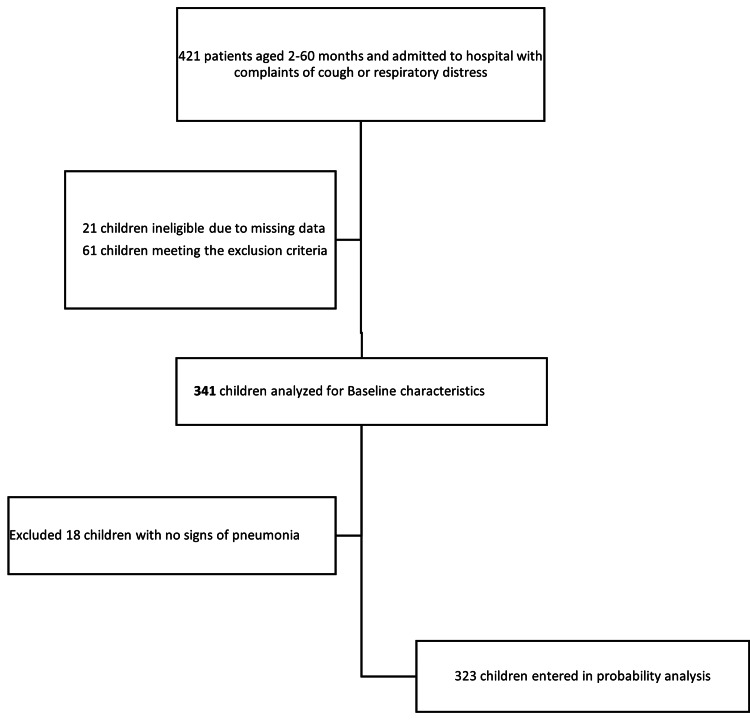
这项横断面分析研究在拉合尔联合军事医院对421名年龄在两个月至五岁之间、因咳嗽和呼吸困难入院且新冠病毒检测呈阴性的儿童进行。通过结构化问卷收集数据,包括人口统计学信息以及使用世界卫生组织标准对肺炎严重程度进行的临床分类、血氧饱和度水平、胸部X光检查、全血细胞计数(CBC)以及入院24小时内获得的C反应蛋白(CRP)水平。使用SPSS 26版本对323名儿童进行统计评估,并应用方差分析(ANOVA)、卡方检验和费舍尔精确检验来确定统计学意义。p值<0.05被认为具有统计学意义。
研究人群的中位年龄为八个月(四分位间距:3 - 20个月);113名(33.1%)为女孩,127名(37.2%)为体重不足儿童。18名(5.3%)患者无肺炎,245名(71.8%)患者患有非重症肺炎,78名(22.9%)患者患有重症肺炎。与非肺泡性CAP相比,肺泡性CAP影像学表现的儿童中重症肺炎的临床特征更为常见(分别为36.2%和20%,p:0.05)。肺泡性CAP患者中CRP>6mg/dL的比例高于非肺泡性CAP患者(分别为69.9%和35%,p<0.001)。营养不良(身高别体重Z评分<-2标准差)、低氧血症(血氧饱和度<9
