Whelen Megan L, Murphy Samuel T, Strunk Daniel R
The Ohio State University.
Clin Psychol Sci. 2021 May;9(3):515-523. doi: 10.1177/2167702620959352. Epub 2021 Mar 12.
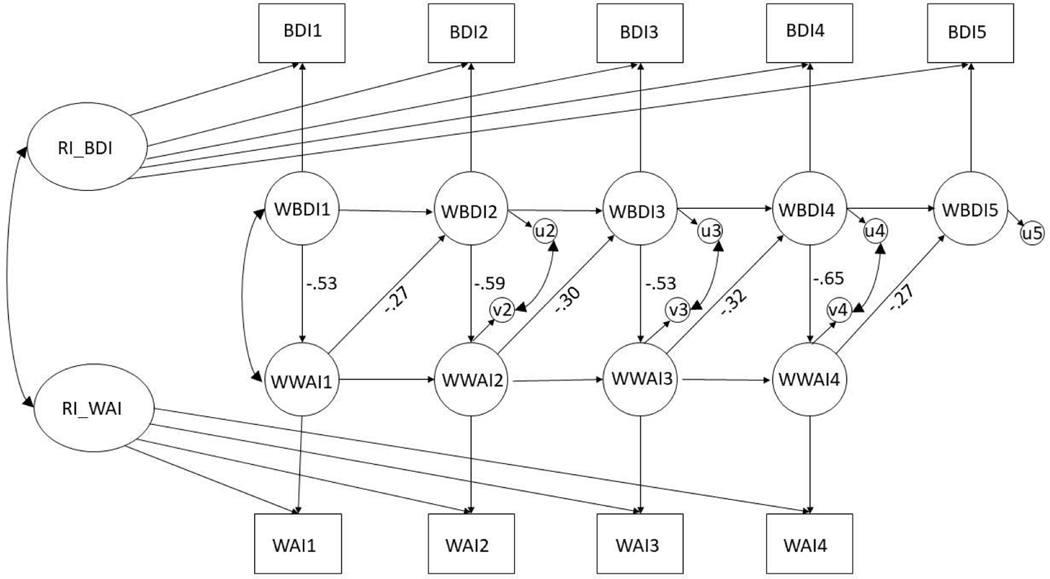
The therapeutic alliance has been reliably associated with outcome across psychotherapies. We investigated the alliance-outcome relationship in the early sessions of cognitive behavioral therapy of depression using a model that disaggregates within- and between-person variance while estimating the reciprocal relation between variables. We utilized this model in a combined dataset from two studies totaling 191 patients. In our primary model, we found evidence for a predictive within-patient relationship between alliance and symptoms such that symptoms predicted regressed change in alliance and alliance predicted regressed change in symptoms. In a more conservative detrended model, these relationships were not significant. Given that a) most of the variability in alliance scores is between-patient; b) the size of the alliance-outcome relationship is modest; and c) the alliance-outcome relationship is not robust to detrending, our findings suggest the alliance plays at most a small role in improving patient outcomes in cognitive behavioral therapy of depression.
治疗联盟与各种心理治疗的结果之间存在可靠的关联。我们使用一种模型来研究抑郁症认知行为疗法早期阶段的联盟与结果之间的关系,该模型在估计变量之间的相互关系时,对个体内和个体间的差异进行了分解。我们在两项研究的合并数据集中使用了该模型,共有191名患者。在我们的主要模型中,我们发现有证据表明联盟与症状之间存在患者内预测关系,即症状预测联盟的回归变化,联盟预测症状的回归变化。在一个更保守的去趋势模型中,这些关系并不显著。鉴于a)联盟分数的大部分变异性存在于患者之间;b)联盟与结果之间的关系规模适中;c)联盟与结果之间的关系对去趋势不稳健,我们的研究结果表明,在抑郁症认知行为疗法中,联盟在改善患者结果方面至多发挥很小的作用。