Horwitz Tanya B, Zorina-Lichtenwalter Katerina, Gustavson Daniel E, Grotzinger Andrew D, Stallings Michael C
Institute for Behavioral Genetics, University of Colorado Boulder, 1480 30 St, Boulder, CO, United States of America 80303.
Psychology and Neuroscience, University of Colorado Boulder, Meunzinger D244, 345 UCB, Boulder, CO, United States of America 80303.
medRxiv. 2024 Feb 27:2024.02.20.24303036. doi: 10.1101/2024.02.20.24303036.
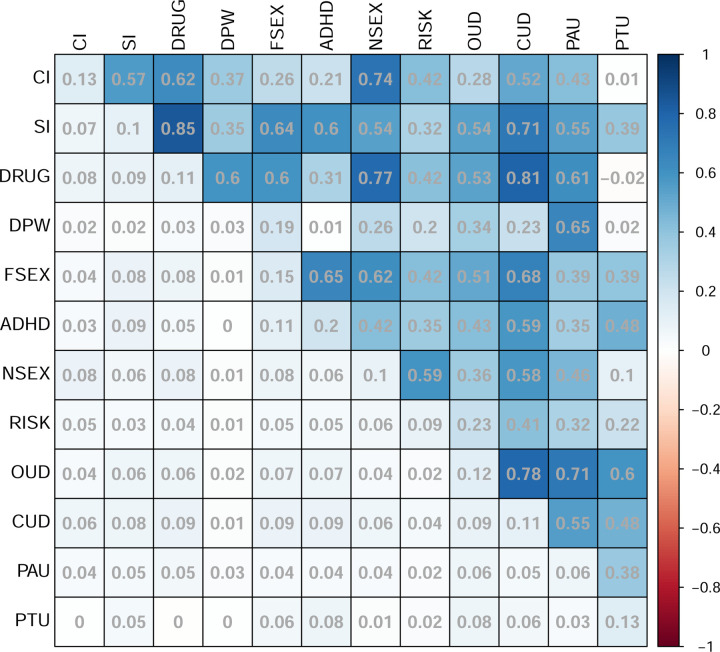
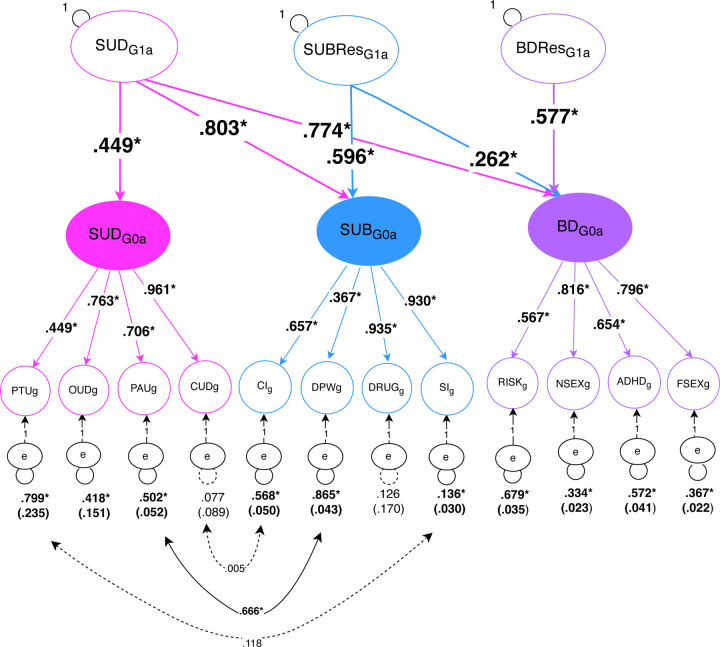
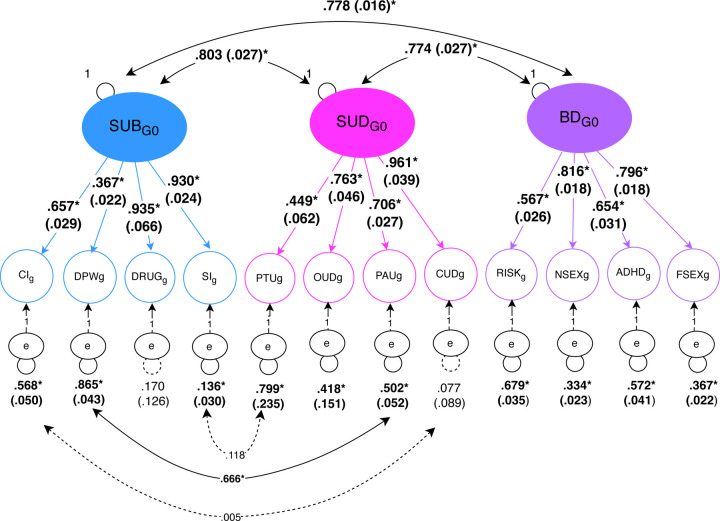
Externalizing behaviors encompass manifestations of risk-taking, self-regulation, aggression, sensation-/reward-seeking, and impulsivity. Externalizing research often includes substance use (SU), substance use disorder (SUD), and other (non-SU/SUD) "behavioral disinhibition" (BD) traits. Genome-wide and twin research have pointed to overlapping genetic architecture within and across SUB, SUD, and BD. We created single-factor measurement models-each describing SUB, SUD, or BD traits--based on mutually exclusive sets of European ancestry genome-wide association study (GWAS) statistics exploring externalizing variables. We then applied trivariate Cholesky decomposition to these factors in order to identify BD-specific genomic variation and assess the partitioning of BD's genetic covariance with each of the other facets. Even when the residuals for indicators relating to the same substance were correlated across the SUB and SUD factors, the two factors yielded a large zero-order correlation (r=.803). BD correlated strongly with the SUD (r=.774) and SUB factors (r=.778). In our initial decompositions, 33% of total BD variance remained after removing variance associated with SUD and SUB. The majority of covariance between BD and SU and between BD and SUD was shared across all factors. When only nicotine/tobacco, cannabis, and alcohol were included for the SUB/SUD factors, their zero-order correlation increased to r=.861; in corresponding decompositions, BD-specific variance decreased to 27%. In summary, BD, SU, and SUD were highly genetically correlated at the latent factor level, and a significant minority of genomic BD variation was not shared with SU and/or SUD. Further research can better elucidate the properties of BD-specific variation by exploring its genetic/molecular correlates.
外化行为包括冒险、自我调节、攻击、寻求感觉/奖励和冲动等表现。外化研究通常包括物质使用(SU)、物质使用障碍(SUD)以及其他(非SU/SUD)“行为抑制不足”(BD)特征。全基因组和双胞胎研究表明,SU、SUD和BD之间存在重叠的遗传结构。我们基于探索外化变量的欧洲血统全基因组关联研究(GWAS)统计数据的互斥集,创建了单因素测量模型——每个模型描述SU、SUD或BD特征。然后,我们对这些因素应用三变量Cholesky分解,以识别BD特有的基因组变异,并评估BD与其他各方面的遗传协方差分配情况。即使与同一种物质相关的指标残差在SU和SUD因素之间存在相关性,这两个因素仍产生了较大的零阶相关性(r = 0.803)。BD与SUD(r = 0.774)和SU因素(r = 0.778)高度相关。在我们最初的分解中,去除与SUD和SU相关的方差后,BD总方差的33%仍然存在。BD与SU以及BD与SUD之间的大部分协方差在所有因素之间共享。当SU/SUD因素仅包括尼古丁/烟草、大麻和酒精时,它们之间的零阶相关性增加到r = 0.861;在相应的分解中,BD特有的方差降至27%。总之,BD、SU和SUD在潜在因素水平上高度遗传相关,并且相当一部分基因组BD变异并非与SU和/或SUD共享。进一步的研究可以通过探索其遗传/分子相关性,更好地阐明BD特有的变异特性。