Poore Holly E, Chatzinakos Chris, Mallard Travis T, Sanchez-Roige Sandra, Aliev Fazil, Hatoum Alexander, Waldman Irwin D, Palme Abraham A, Harden K Paige, Barr Peter B, Dick Danielle M
Department of Psychiatry, Robert Wood Johnson Medical School, Rutgers University.
Department of Psychiatry and Behavioral Science, SUNY Downstate Health Sciences University.
medRxiv. 2024 Nov 30:2024.11.26.24318011. doi: 10.1101/2024.11.26.24318011.
Substance use disorders (SUDs) frequently co-occur with each other and with other traits related to behavioral disinhibition, a spectrum of outcomes referred to as externalizing. Nevertheless, genome-wide association studies (GWAS) typically study individual SUDs separately. This single-disorder approach ignores genetic covariance between SUDs and other traits and may contribute to the relatively limited genetic discoveries to date.
To identify the most effective model for capturing genetic relationships between SUDs and externalizing phenotypes, optimizing the detection of genetic influences on SUDs while maintaining specificity.
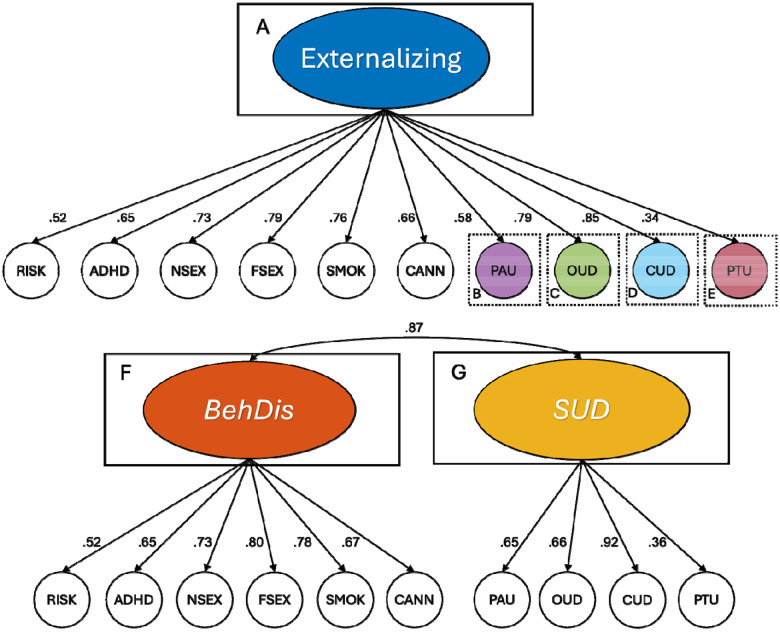
We used Genomic SEM to estimate SNP effects on a broad factor representing liability to externalizing and SUDs, on factors representing liability to behavioral disinhibition and SUDs separately, and on residualized SUDs. Subsequent gene-based, tissue expression, and polygenic score (PGS) analyses were used to compare the ability of these alternative approaches to identify genetic influences on SUDs.
This study was carried out from May 2023 - September 2024.
We used GWAS summary statistics based on samples of European ancestry from previous studies of externalizing and SUD phenotypes in the main multivariate GWAS ( > 2.2 million). We used two independent samples to estimate polygenic associations, a family-based sample enriched for substance use problems (COGA; = 7,530) and a population-based sample representative of the United States, (All of Us; = 77,442).
N/A.
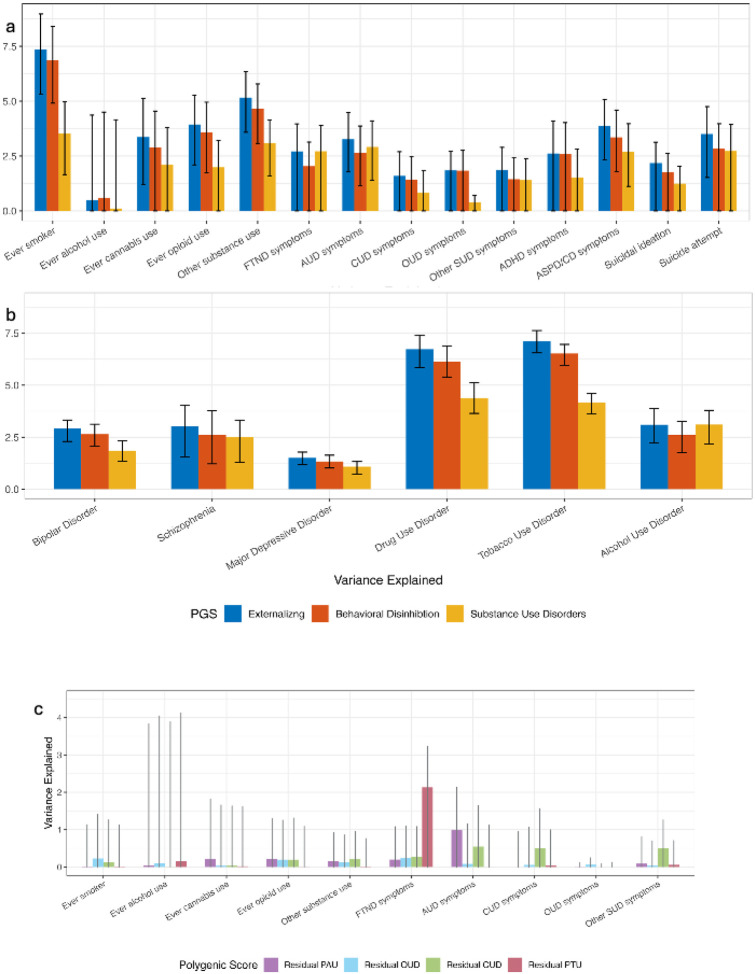
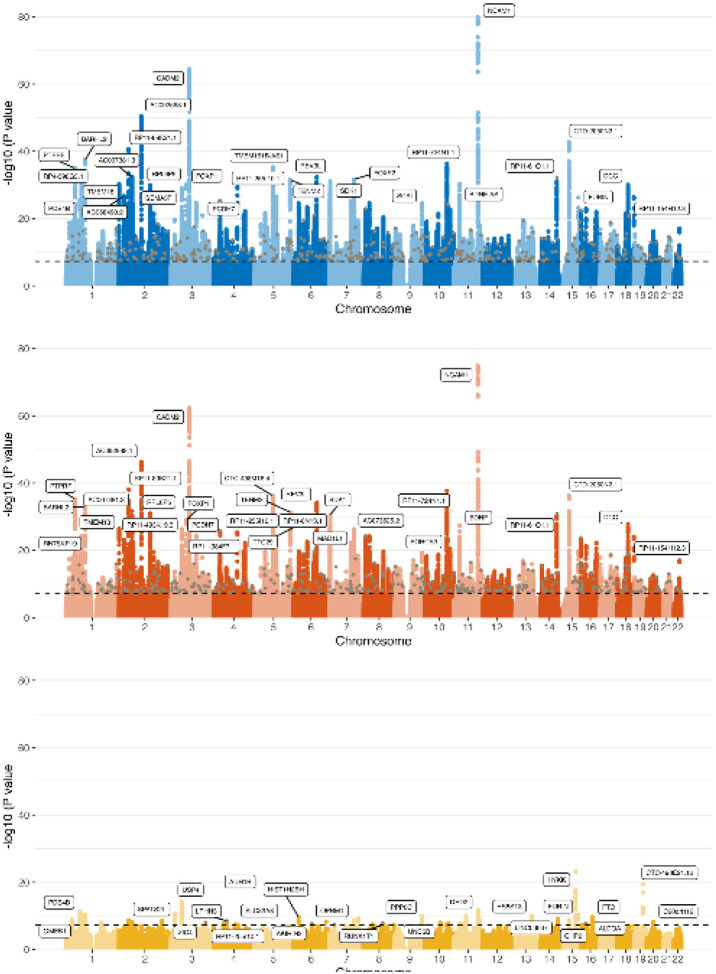
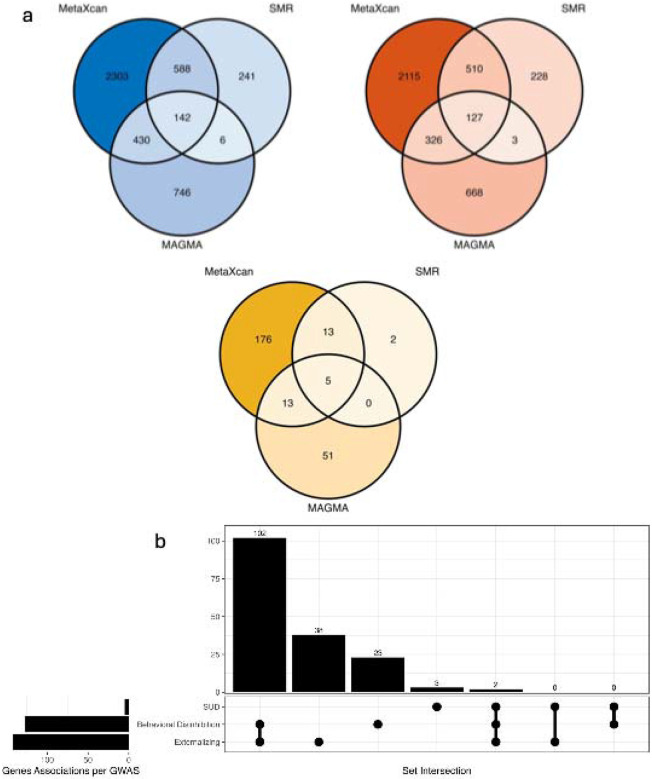
Across the three factors (Externalizing; SUDs; Behavioral Disinhibition) and four residualized SUDs (alcohol, tobacco, opioid, and cannabis), we compared the number, putative function, previous associations of significant genomic risk loci and genes, and variance explained by polygenic scores in substance use outcomes.
We identified genomic risk loci and genes uniquely associated with Externalizing that are relevant to the neurobiology of substance use. Genes identified for residual SUDs were involved in substance-specific processes (e.g., metabolism). The Externalizing PGS accounted for the most variance in substance outcomes relative to the PGS for the other factors and residual PGS appeared to capture substance specific signals.
Our findings suggest that modeling both a broad genetic liability to externalizing behaviors and substance-specific liabilities enhances the detection of genetic effects related to SUDs and explains more variance in substance use outcomes.
物质使用障碍(SUDs)常常相互并发,且与其他与行为抑制相关的特质并发,这一系列结果被称为外化行为。然而,全基因组关联研究(GWAS)通常分别研究个体的物质使用障碍。这种单疾病研究方法忽略了物质使用障碍与其他特质之间的遗传协方差,可能是导致迄今为止遗传发现相对有限的原因之一。
确定最有效的模型,以捕捉物质使用障碍与外化行为表型之间的遗传关系,在保持特异性的同时优化对物质使用障碍遗传影响的检测。
我们使用基因组结构方程模型(Genomic SEM)来估计单核苷酸多态性(SNP)对代表外化行为和物质使用障碍易感性的广泛因素、分别代表行为抑制和物质使用障碍易感性的因素以及剩余物质使用障碍的影响。随后进行基于基因、组织表达和多基因评分(PGS)的分析,以比较这些替代方法识别物质使用障碍遗传影响的能力。
本研究于2023年5月至2024年9月进行。
我们使用了基于欧洲血统样本的GWAS汇总统计数据,这些样本来自之前关于外化行为和物质使用障碍表型的主要多变量GWAS研究(超过220万)。我们使用两个独立样本估计多基因关联,一个富含物质使用问题的家系样本(COGA;n = 7530)和一个代表美国的基于人群的样本(“我们所有人”;n = 77442)。
无。
在三个因素(外化行为;物质使用障碍;行为抑制)和四种剩余物质使用障碍(酒精、烟草、阿片类药物和大麻)中,我们比较了显著基因组风险位点和基因的数量、假定功能、先前关联,以及多基因评分在物质使用结局中解释的方差。
我们确定了与外化行为独特相关的基因组风险位点和基因,这些与物质使用的神经生物学相关。为剩余物质使用障碍鉴定出的基因参与了物质特异性过程(如代谢)。相对于其他因素的多基因评分,外化行为多基因评分在物质使用结局中解释的方差最大,剩余多基因评分似乎捕捉到了物质特异性信号。
我们的研究结果表明,对外化行为的广泛遗传易感性和物质特异性易感性进行建模,可增强对与物质使用障碍相关遗传效应的检测,并解释物质使用结局中更多的方差。