Ghori Humaid, Bagga Rahul, Tathgar Anand, Stone Andrew, Murphy Richard J, Phadnis Joideep
Brighton and Sussex Medical School, BSMS Teaching Building, University of Sussex, Brighton, United Kingdom.
University Hospitals Sussex NHS Trust, Royal Sussex County Hospital, Brighton, United Kingdom.
JSES Int. 2023 Dec 7;8(2):371-377. doi: 10.1016/j.jseint.2023.11.008. eCollection 2024 Mar.
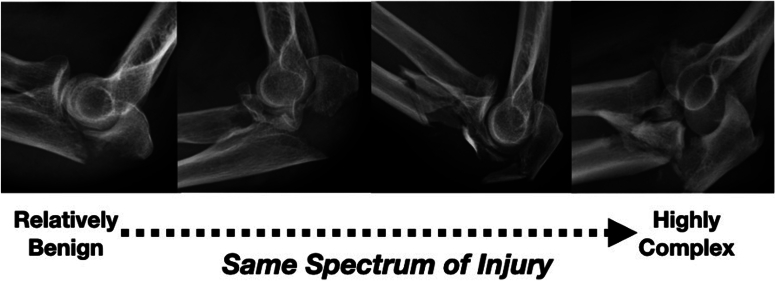
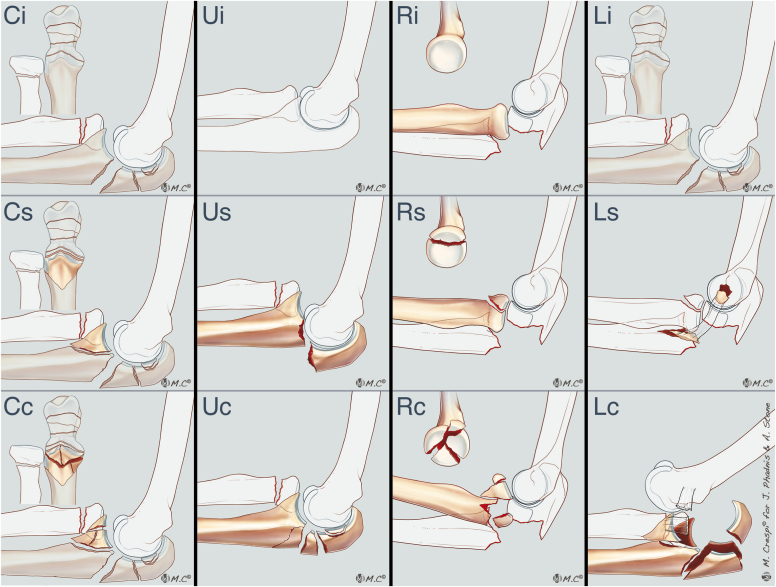
Proximal ulna fracture-dislocations are challenging injuries with a myriad of existing classification systems. The Coronoid, proximal Ulna, Radius, and Ligaments classification (CURL) is a simple framework designed to focus attention on the key components affecting outcome and guide surgical management. This study evaluates interobserver and intraobserver reliability of this new classification.
Four observers independently reviewed plain radiographs and computed tomography (CT) scans of patients with proximal ulna fracture-dislocations. Each observer scored the Coronoid (C), proximal Ulna (U), and Radius (R) components for each fracture on 2 occasions. The osseous components were subclassified as 'intact', 'simple', or 'complex'. The Ligament component (L) was not rated as this requires intraoperative classification. Interobserver and intraobserver reliability was calculated using Cohen's weighted kappa coefficients. X-ray and CT were compared for patients with both imaging modalities. The Landis and Koch criteria were used to interpret the strength of the kappa statistics.
One hundred seventy seven patients had plain X-rays; 58 patients had both X-ray and CT scans. Overall, in the X-ray only cohort, there was ' interobserver reliability for the radial head (k = 0.94) and coronoid (k = 0.83), and ' reliability (k = 0.68) for the proximal ulna. For the X-ray and CT cohort, interobserver reliability was ' across both modalities for the radial head (k = 0.88 and k = 0.93, respectively) and ' for the proximal ulna (k = 0.48 and k = 0.52, respectively). For the coronoid, interobserver reliability for X-ray interpretation was ' (k = 0.74) and for CT was ' (k = 0.89). Intraobserver reliability was ' for all components, other than CT assessment of the proximal ulna which demonstrated ' reliability (k = 0.74).
The Coronoid, proximal Ulna, Radius, and Ligaments classification demonstrates strong interobserver and intraobserver reliability, supporting use of the classification for proximal ulna fracture-dislocations. CT is recommended for improved characterization of any fracture with a coronoid component.
尺骨近端骨折脱位是具有挑战性的损伤,现有众多分类系统。冠突、近端尺骨、桡骨和韧带分类(CURL)是一个简单的框架,旨在将注意力集中在影响预后的关键组成部分上,并指导手术治疗。本研究评估了这种新分类的观察者间和观察者内可靠性。
四名观察者独立回顾尺骨近端骨折脱位患者的平片和计算机断层扫描(CT)图像。每位观察者对每个骨折的冠突(C)、近端尺骨(U)和桡骨(R)组成部分进行两次评分。骨组成部分被细分为“完整”、“简单”或“复杂”。韧带组成部分(L)未进行评分,因为这需要术中分类。使用科恩加权kappa系数计算观察者间和观察者内可靠性。对同时有两种影像学检查的患者比较X线和CT。采用兰迪斯和科赫标准解释kappa统计量的强度。
177例患者有平片;58例患者同时有X线和CT扫描。总体而言,在仅行X线检查的队列中,桡骨头的观察者间可靠性较强(kappa = 0.94),冠突的观察者间可靠性较强(kappa = 0.83),近端尺骨的观察者间可靠性为中等(kappa = 0.68)。对于X线和CT队列,桡骨头在两种检查方式下的观察者间可靠性均较强(分别为kappa = 0.88和kappa = 0.93),近端尺骨的观察者间可靠性为中等(分别为kappa = 0.48和kappa = 0.52)。对于冠突,X线解读的观察者间可靠性为中等(kappa = 0.74),CT解读的观察者间可靠性为较强(kappa = 0.89)。除近端尺骨的CT评估显示中等可靠性(kappa = 0.74)外,观察者内可靠性在所有组成部分均较强。
冠突、近端尺骨、桡骨和韧带分类显示出较强的观察者间和观察者内可靠性,支持将该分类用于尺骨近端骨折脱位。对于任何有冠突组成部分的骨折,建议使用CT以更好地进行特征描述。