Stewart Jessica, Ruiz-Mercado Glorimar, Sperring Heather, Pierre Cassandra M, Assoumou Sabrina A, Taylor Jessica L
Section of Infectious Disease, Boston University Chobanian and Avedisian School of Medicine and Boston Medical Center, Boston, Massachusetts, USA.
Grayken Center for Addiction, Boston Medical Center, Boston, Massachusetts, USA.
Open Forum Infect Dis. 2024 Feb 1;11(3):ofae056. doi: 10.1093/ofid/ofae056. eCollection 2024 Mar.
HIV pre-exposure prophylaxis (PrEP) uptake in women remains low. We developed a laboratory result-driven protocol to link women with a positive bacterial sexually transmitted infection (STI) to HIV PrEP at an urban safety-net hospital.
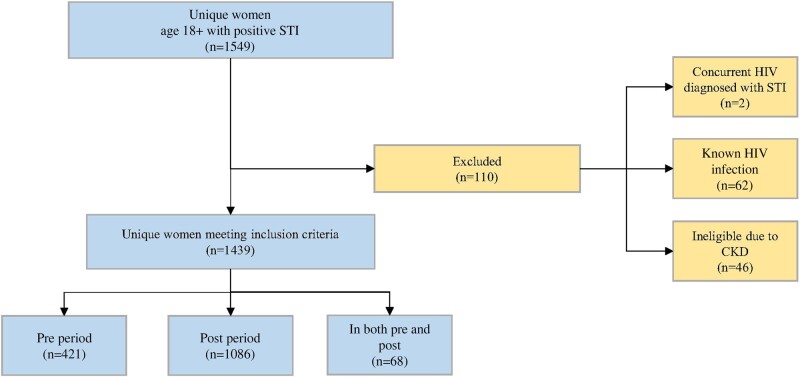
Electronic health records of women with positive chlamydia, gonorrhea, and/or syphilis tests were reviewed, and those eligible for PrEP were referred for direct or primary care provider-driven outreach. We assessed the proportion of women with STIs who received PrEP offers, acceptance, and prescriptions before (July 1, 2018-December 31, 2018) and after (January 1, 2019-June 30, 2020) implementation to evaluate changes in the delivery of key elements of the PrEP care cascade (ie, PrEP offers, acceptance, and prescribing) for women with STIs after protocol implementation.
The proportion of women who received PrEP offers increased from 7.6% to 17.6% ( < .001). After multivariable adjustment, only the postintervention period was associated with PrEP offers (odds ratio [OR], 2.49; 95% CI, 1.68-3.68). In subgroup analyses, PrEP offers increased significantly among non-Hispanic Black (OR, 2.75; 95% CI, 1.65-4.58) and Hispanic (OR, 5.34; 95% CI, 1.77-16.11) women but not among non-Hispanic White women (OR, 1.49; 95% CI, 0.54-4.05). Significant changes in PrEP acceptance and prescriptions were not observed in the sample overall.
A laboratory result-driven protocol was associated with a significant increase in PrEP offers to Black and Hispanic women with STI. These results provide concrete suggestions for health systems seeking to increase PrEP access and equity among women.
女性对HIV暴露前预防(PrEP)的接受率仍然很低。我们制定了一项由实验室结果驱动的方案,以便在一家城市安全网医院将细菌性性传播感染(STI)检测呈阳性的女性与HIV PrEP联系起来。
对衣原体、淋病和/或梅毒检测呈阳性的女性的电子健康记录进行了审查,符合PrEP条件的女性被转介接受直接或由初级保健提供者推动的外展服务。我们评估了在实施该方案之前(2018年7月1日至2018年12月31日)和之后(2019年1月1日至2020年6月30日)接受PrEP提议、接受PrEP以及开具PrEP处方的STI女性的比例,以评估方案实施后STI女性PrEP护理级联关键要素(即PrEP提议、接受和处方开具)的提供情况变化。
接受PrEP提议的女性比例从7.6%增至17.6%(P<0.001)。多变量调整后,仅干预后期与PrEP提议相关(优势比[OR]为2.49;95%置信区间为1.68 - 3.68)。在亚组分析中,非西班牙裔黑人女性(OR为2.75;95%置信区间为1.65 - 4.58)和西班牙裔女性(OR为5.34;95%置信区间为1.77 - 16.11)中PrEP提议显著增加,而非西班牙裔白人女性中未显著增加(OR为1.49;95%置信区间为0.54 - 4.05)。总体样本中未观察到PrEP接受和处方的显著变化。
一项由实验室结果驱动的方案与向患有STI的黑人和西班牙裔女性提供PrEP提议的显著增加相关。这些结果为寻求增加女性PrEP可及性和平等性的卫生系统提供了具体建议。