Matovelle Priscila, Oliván-Blázquez Bárbara, Domínguez-García Marta, Casado-Vicente Verónica, Pascual de la Pisa Beatriz, Magallón-Botaya Rosa
Department of Geriatrics, San Juan de Dios Hospital, Zaragoza, Spain.
Department of Medicine, Psychiatry and Dermatology, University of Zaragoza, Zaragoza, Spain.
Clin Interv Aging. 2024 Mar 6;19:385-397. doi: 10.2147/CIA.S444716. eCollection 2024.
Worldwide, chronic diseases are prevalent among the older adults, significantly affecting their health and healthcare system. The COVID-19 pandemic exacerbated these challenges, disrupting healthcare services. Our study assesses the impact on older individuals with chronic diseases who were not infected with COVID-19, analyzing comorbidities, medication use, mortality rates, and resource utilization using real data from Aragon, Spain.
A retrospective observational study, conducted in Aragon, Spain, focused on individuals aged 75 and older with at least one chronic disease, who were not infected of COVID-19. The research used actual data collected during three distinct periods: the first covered the six months prior to the pandemic, the second the six months after the lockdown, and the third the period between six and twelve months. Key variables included socio-demographics, comorbidities, clinical parameters, medication use, and health services utilization.
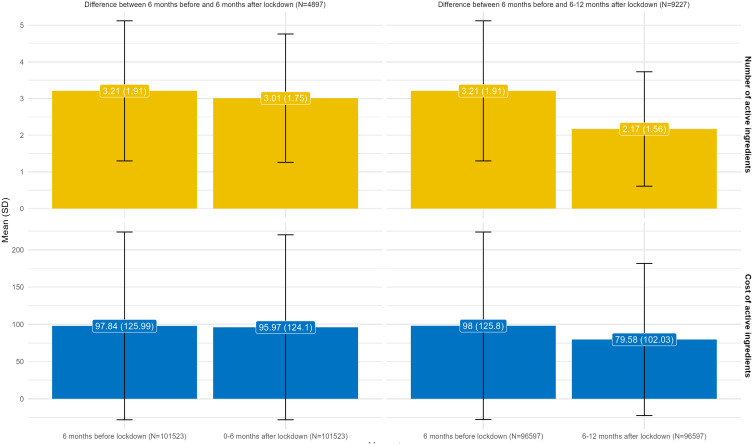
We included 128.130 older adults. Mean age was 82.88 years, with 60.3% being women. The most common chronic diseases were hypertension (73.2%), dyslipidemia (52.5%), and dorsopathies (31.5%). More than 90% had more than 2 conditions. A notable decline in new chronic disease diagnoses was observed, particularly pronounced in the six to twelve months period after lockdown. Although statistically significant differences were observed in all clinical variables analyzed, they were considered clinically irrelevant. Furthermore, a decrease in healthcare services utilization and medication prescriptions was reported.
Our study highlights a decrease in new chronic disease diagnoses, ongoing reductions in healthcare utilization, and medication prescriptions for older adults with pre-existing chronic conditions, unaffected by COVID-19.
在全球范围内,慢性病在老年人中普遍存在,严重影响他们的健康和医疗保健系统。新冠疫情加剧了这些挑战,扰乱了医疗服务。我们的研究评估了对未感染新冠病毒的慢性病老年个体的影响,利用西班牙阿拉贡的真实数据,分析了合并症、药物使用、死亡率和资源利用情况。
在西班牙阿拉贡进行了一项回顾性观察研究,重点关注75岁及以上患有至少一种慢性病且未感染新冠病毒的个体。该研究使用了在三个不同时期收集的实际数据:第一个时期涵盖疫情前的六个月,第二个时期涵盖封锁后的六个月,第三个时期涵盖六个月至十二个月。关键变量包括社会人口统计学、合并症、临床参数、药物使用和医疗服务利用情况。
我们纳入了128130名老年人。平均年龄为82.88岁,女性占60.3%。最常见的慢性病是高血压(73.2%)、血脂异常(52.5%)和背部疾病(31.5%)。超过90%的人患有两种以上疾病。观察到新的慢性病诊断显著下降,在封锁后的六个月至十二个月期间尤为明显。尽管在所有分析的临床变量中观察到了统计学上的显著差异,但认为这些差异在临床上无关紧要。此外,报告显示医疗服务利用和药物处方有所减少。
我们的研究强调,对于患有慢性病的老年人,新的慢性病诊断有所减少,医疗利用和药物处方持续减少,且未受新冠病毒影响。