Yin Chunhui, Zhao Haomiao, Xia Xiaoyi, Pan Zhengyang, Li Daoqun, Zhang Leiliang
Department of Clinical Laboratory Medicine, The First Affiliated Hospital of Shandong First Medical University & Shandong Provincial Qianfoshan Hospital, Jinan, Shandong, China.
Department of Pathogen Biology, School of Clinical and Basic Medical Sciences, Shandong First Medical University & Shandong Academy of Medical Sciences, Jinan, Shandong, China.
Front Cell Infect Microbiol. 2024 Feb 23;14:1347615. doi: 10.3389/fcimb.2024.1347615. eCollection 2024.
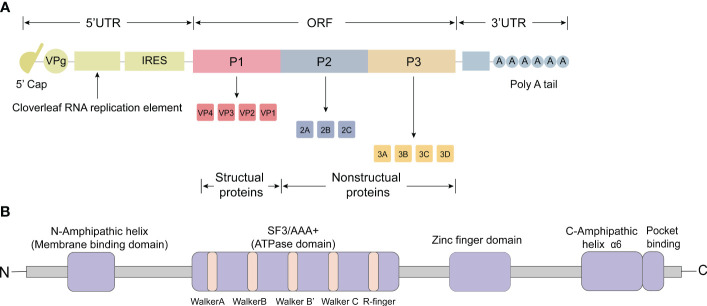
Picornaviruses, which are positive-stranded, non-enveloped RNA viruses, are known to infect people and animals with a broad spectrum of diseases. Among the nonstructural proteins in picornaviruses, 2C proteins are highly conserved and exhibit multiple structural domains, including amphipathic α-helices, an ATPase structural domain, and a zinc finger structural domain. This review offers a comprehensive overview of the functional structures of picornaviruses' 2C protein. We summarize the mechanisms by which the 2C protein enhances viral replication. 2C protein interacts with various host factors to form the replication complex, ultimately promoting viral replication. We review the mechanisms through which picornaviruses' 2C proteins interact with the NF-κB, RIG-I, MDA5, NOD2, and IFN pathways, contributing to the evasion of the antiviral innate immune response. Additionally, we provide an overview of broad-spectrum antiviral drugs for treating various enterovirus infections, such as guanidine hydrochloride, fluoxetine, and dibucaine derivatives. These drugs may exert their inhibitory effects on viral infections by targeting interactions with 2C proteins. The review underscores the need for further research to elucidate the precise mechanisms of action of 2C proteins and to identify additional host factors for potential therapeutic intervention. Overall, this review contributes to a deeper understanding of picornaviruses and offers insights into the antiviral strategies against these significant viral pathogens.
小核糖核酸病毒是正链、无包膜的RNA病毒,已知可感染人和动物并引发多种疾病。在小核糖核酸病毒的非结构蛋白中,2C蛋白高度保守,具有多个结构域,包括两亲性α螺旋、一个ATP酶结构域和一个锌指结构域。本综述全面概述了小核糖核酸病毒2C蛋白的功能结构。我们总结了2C蛋白增强病毒复制的机制。2C蛋白与多种宿主因子相互作用形成复制复合体,最终促进病毒复制。我们回顾了小核糖核酸病毒2C蛋白与核因子κB、视黄酸诱导基因I、黑色素瘤分化相关基因5、核苷酸结合寡聚化结构域样受体家族成员2和干扰素途径相互作用的机制,这些相互作用有助于逃避抗病毒先天免疫反应。此外,我们概述了用于治疗各种肠道病毒感染的广谱抗病毒药物,如盐酸胍、氟西汀和丁卡因衍生物。这些药物可能通过靶向与2C蛋白的相互作用来发挥对病毒感染的抑制作用。该综述强调需要进一步研究以阐明2C蛋白的确切作用机制,并确定其他潜在治疗干预的宿主因子。总体而言,本综述有助于更深入地了解小核糖核酸病毒,并为对抗这些重要病毒病原体的抗病毒策略提供见解。