Baardman R, Lemmink H H, Yenamandra V K, Commandeur-Jan S Z, Viel M, Kooi K A, Diercks G F H, Meijer R, van Geel M, Scheffer H, Sinke R J, Sikkema-Raddatz B, Bolling M C, van den Akker P C
Department of Dermatology, UMCG Centers of Expertise for Blistering Diseases and Genodermatoses, University of Groningen, University Medical Center Groningen, Groningen, The Netherlands.
Department of Genetics, UMCG Centers of Expertise for Blistering Diseases and Genodermatoses, University of Groningen, University Medical Center Groningen, Groningen, The Netherlands.
J Eur Acad Dermatol Venereol. 2025 Jan;39(1):154-160. doi: 10.1111/jdv.19938. Epub 2024 Mar 11.
Genome diagnostics is considered gold standard diagnostics for epidermolysis bullosa (EB), a phenotypically and genetically heterogeneous group of rare disorders characterized by blistering and wounding of mucocutaneous tissues. EB is caused by pathogenic variants in genes encoding proteins of the dermo-epidermal junction. Accurate genetic diagnosis of EB is crucial for prognostication, counselling and precision-medicine. Genome diagnostics for EB started in 1991 with the introduction of Sanger sequencing (SS), analysing one gene at a time. In 2013, SS was superseded by next-generation sequencing (NGS), that allow for high-throughput sequencing of multiple genes in parallel. Several studies have shown a beneficial role for NGS in EB diagnostics, but its true benefit has not been quantified.
To determine the benefit of NGS in EB by systematically evaluating the performance of different genome diagnostics used over time based on robust data from the Dutch EB Registry.
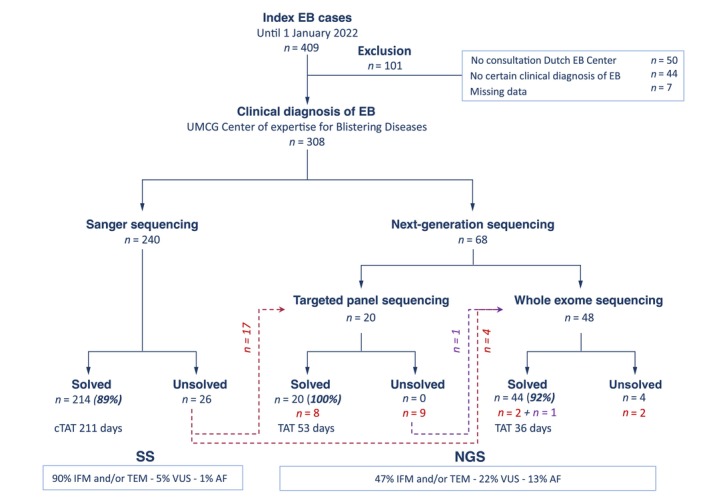
The diagnostic performances of SS and NGS were systematically evaluated in a retrospective observational study including all index cases with a clinical diagnosis of EB in whom genome diagnostics was performed between 01 January 1994 and 01 January 2022 (n = 308), registered at the Dutch EB Expertise Centre.
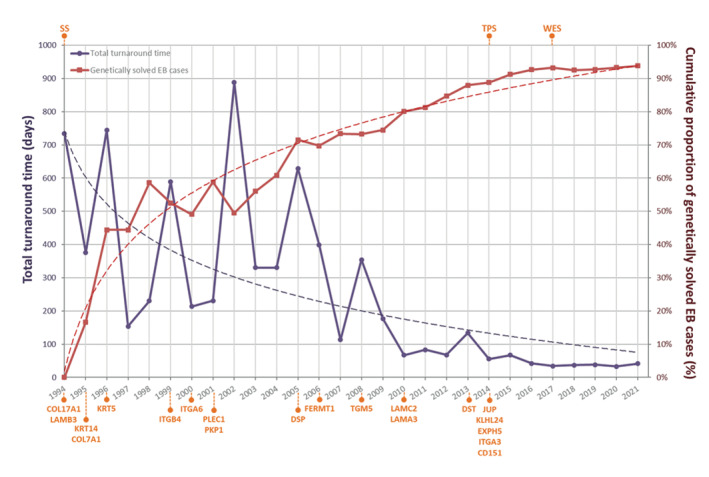
Over time, a genetic diagnosis was made in 289/308 (94%) EB cases. The diagnostic yield increased from 89% (SS) to 95% (NGS). Most importantly, NGS significantly reduced diagnostic turnaround time (39 days vs. 211 days, p < 0.001). The likelihood of detecting variants of uncertain significance and additional findings increased from 5% and 1% (SS) to 22% and 13% (NGS) respectively.
Our study quantifies the benefit of NGS-based methods and demonstrate they have had a major impact on EB diagnostics through an increased diagnostic yield and a dramatically decreased turnaround time (39 days). Although our diagnostic yield is high (95%), further improvement of genome diagnostics is urgently needed to provide a genetic diagnosis in all EB patients.
基因组诊断被认为是大疱性表皮松解症(EB)的金标准诊断方法,EB是一组表型和基因均具有异质性的罕见疾病,其特征为黏膜皮肤组织出现水疱和伤口。EB由编码真皮-表皮连接蛋白的基因中的致病变异引起。准确的EB基因诊断对于预后评估、咨询和精准医疗至关重要。EB的基因组诊断始于1991年,当时引入了桑格测序(SS),一次分析一个基因。2013年,SS被下一代测序(NGS)取代,NGS允许对多个基因进行高通量平行测序。多项研究表明NGS在EB诊断中具有有益作用,但其真正的益处尚未得到量化。
通过基于荷兰EB登记处的可靠数据,系统评估不同时期使用的不同基因组诊断方法的性能,以确定NGS在EB诊断中的益处。
在一项回顾性观察研究中,系统评估了SS和NGS的诊断性能,该研究纳入了1994年1月1日至2022年1月1日期间在荷兰EB专业中心登记的所有临床诊断为EB且进行了基因组诊断的索引病例(n = 308)。
随着时间的推移,289/308(94%)例EB病例得到了基因诊断。诊断率从89%(SS)提高到了95%(NGS)。最重要的是,NGS显著缩短了诊断周转时间(39天对211天,p < 0.001)。检测意义不明确的变异和额外发现的可能性分别从5%和1%(SS)增加到了22%和13%(NGS)。
我们的研究量化了基于NGS方法的益处,并证明它们通过提高诊断率和大幅缩短周转时间(39天)对EB诊断产生了重大影响。尽管我们的诊断率很高(95%),但仍迫切需要进一步改进基因组诊断,以便为所有EB患者提供基因诊断。