Surowka Marlena, Klein Christian
Roche Innovation Center Zurich, Roche Pharma Research & Early Development, Roche Glycart AG, Schlieren, Switzerland.
MAbs. 2024 Jan-Dec;16(1):2321635. doi: 10.1080/19420862.2024.2321635. Epub 2024 Mar 11.
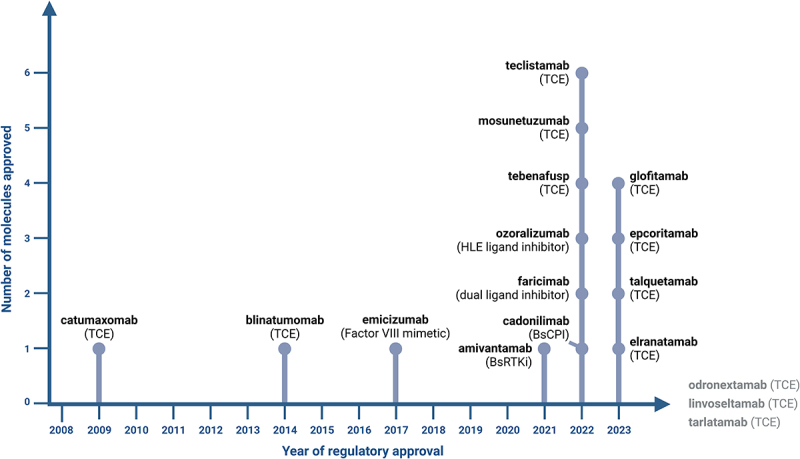
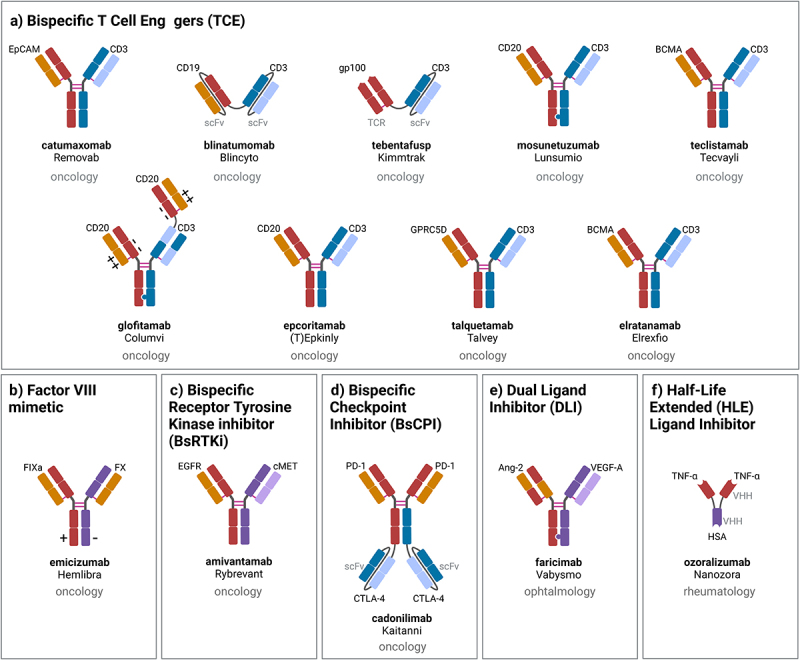
Bispecific antibodies (bsAbs) are a class of antibodies that can mediate novel mechanisms of action compared to monospecific monoclonal antibodies (mAbs). Since the discovery of mAbs and their adoption as therapeutic agents in the 1980s and 1990s, the development of bsAbs has held substantial appeal. Nevertheless, only three bsAbs (catumaxomab, blinatumomab, emicizumab) were approved through the end of 2020. However, since then, 11 bsAbs received regulatory agency approvals, of which nine (amivantamab, tebentafusp, mosunetuzumab, cadonilimab, teclistamab, glofitamab, epcoritamab, talquetamab, elranatamab) were approved for the treatment of cancer and two (faricimab, ozoralizumab) in non-oncology indications. Notably, of the 13 currently approved bsAbs, two, emicizumab and faricimab, have achieved blockbuster status, showing the promise of this novel class of therapeutics. In the 2020s, the approval of additional bsAbs can be expected in hematological malignancies, solid tumors and non-oncology indications, establishing bsAbs as essential part of the therapeutic armamentarium.
双特异性抗体(bsAbs)是一类与单特异性单克隆抗体(mAbs)相比能够介导新型作用机制的抗体。自20世纪80年代和90年代单克隆抗体被发现并用作治疗药物以来,双特异性抗体的开发一直具有巨大吸引力。然而,截至2020年底,仅有三种双特异性抗体(卡妥索单抗、博纳吐单抗、依美珠单抗)获得批准。不过,自那时起,有11种双特异性抗体获得了监管机构的批准,其中九种(阿伐替尼单抗、替雷利珠单抗、莫苏奈妥珠单抗、卡度尼利单抗、替西妥单抗、戈利妥单抗、依泊妥单抗、塔奎单抗、厄兰妥单抗)被批准用于治疗癌症,两种(法西单抗、奥佐利珠单抗)用于非肿瘤适应症。值得注意的是,在目前已批准的13种双特异性抗体中,依美珠单抗和法西单抗两种已成为重磅炸弹药物,显示出这类新型治疗药物的前景。在21世纪20年代,预计在血液系统恶性肿瘤、实体瘤和非肿瘤适应症方面会有更多双特异性抗体获得批准,使双特异性抗体成为治疗药物库的重要组成部分。