Baldwin Molly M, Chadwick Matt R, Benson Alan P, Rossiter Harry B, Ferguson Carrie
School of Biomedical Sciences, Faculty of Biological Sciences & Multidisciplinary Cardiovascular Research Centre, University of Leeds, Leeds, UNITED KINGDOM.
Institute of Respiratory Medicine and Exercise Physiology, Division of Respiratory and Critical Care Physiology and Medicine, The Lundquist Institute for Biomedical Innovation at Harbor-UCLA Medical Center, Torrance, CA.
Med Sci Sports Exerc. 2025 Apr 1;57(4):700-709. doi: 10.1249/MSS.0000000000003414. Epub 2024 Mar 11.
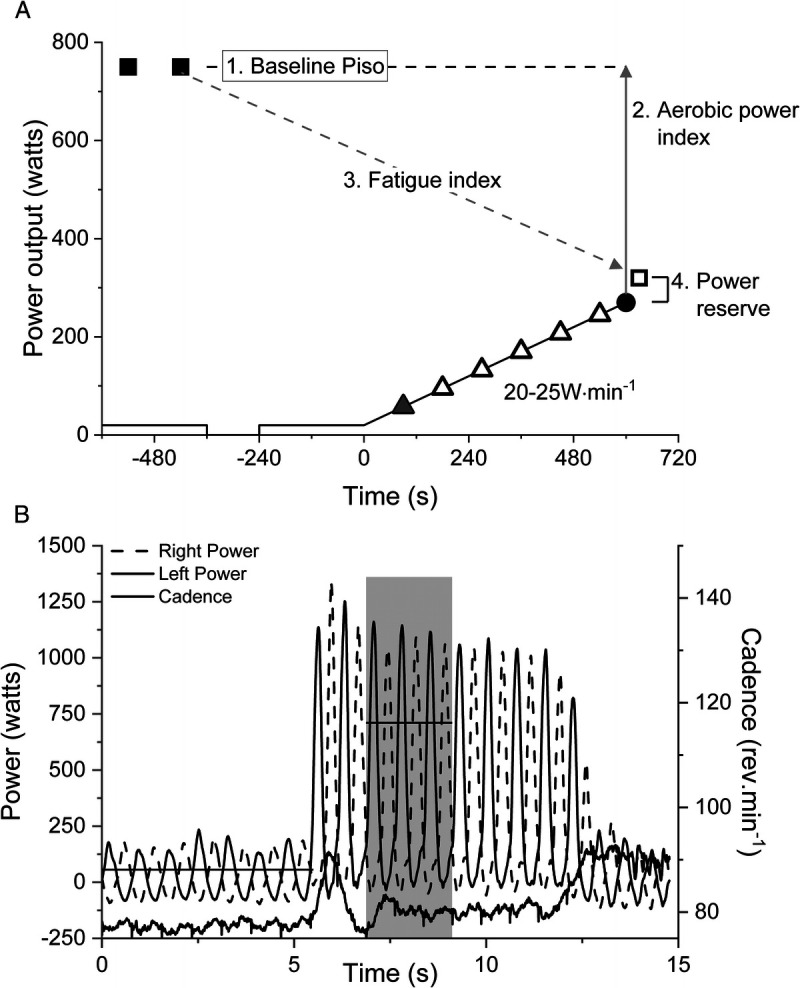
Traditional neuromuscular fatigue assessments are not task-specific and are unable to characterize neuromuscular performance decline during dynamic whole-body exercise. This study used interleaved maximal isokinetic cycling efforts to characterize the dynamics of the decline in neuromuscular performance during ramp-incremental (RI) cycle ergometry exercise to intolerance.
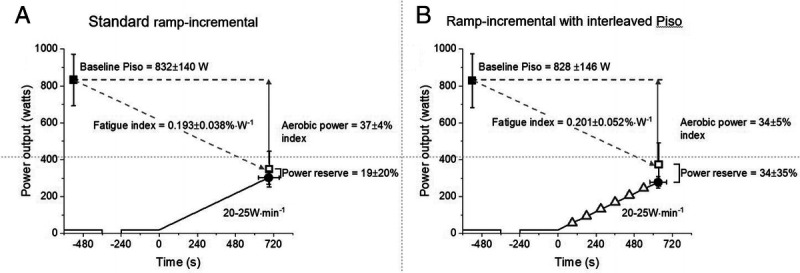
Eleven young healthy participants (10 male/1 female) performed two RI cycle ergometry exercise tests to intolerance: 1) RI exercise with peak isokinetic power (Piso) at 80 rpm measured at baseline and immediately at intolerance from a maximal ~6 s effort, and 2) RI exercise where additional Piso measurements were interleaved every 90 s to characterize the decline in neuromuscular performance during the RI test. Muscle excitation was measured using EMG during all Piso assessments, and pulmonary gas exchange was measured throughout.
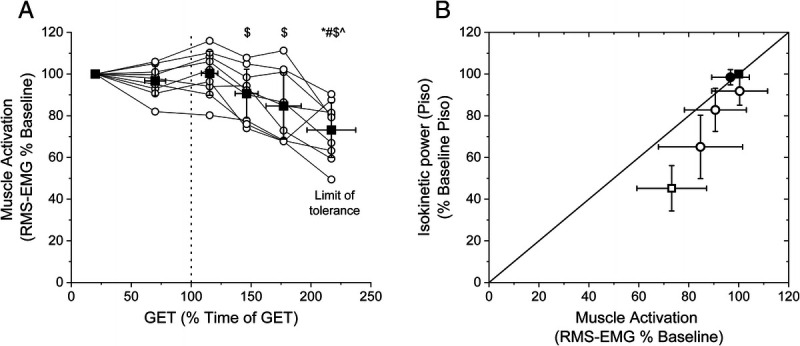
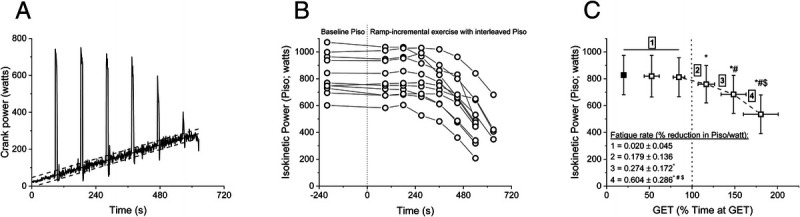
Baseline Piso was 832 ± 140 W and RI exercise reduced Piso to 349 ± 96 W at intolerance ( P = 0.001), which was not different from flywheel power at intolerance (303 ± 96 W; P = 0.292). There was no reduction in Piso between baseline cycling and gas exchange threshold (GET; baseline Piso vs mean Piso below GET: 828 ± 146 vs 815 ± 149 W; P = 1.00). Piso fell progressively above GET until intolerance (Piso every 90 s above GET: 759 ± 139, 684 ± 141, 535 ± 144, 374 ± 117 W; each P < 0.05 vs baseline and mean Piso below GET). Peak muscle excitation (EMG) was also reduced only above GET (73% ± 14% of baseline, at intolerance; P < 0.05). However, the reduction in peak Piso preceded the reduction in peak muscle excitation.
The dynamics of the decline in neuromuscular performance (reduction in Piso and EMG) during RI exercise are consistent with known intensity-dependent metabolic and traditional pre-post neuromuscular fatigue responses to discrete bouts of constant-power exercise.
传统的神经肌肉疲劳评估并非针对特定任务,无法描述动态全身运动过程中神经肌肉性能的下降情况。本研究采用交错式最大等速骑行运动,以描述递增负荷(RI)自行车测力计运动至不耐受时神经肌肉性能下降的动态变化。
11名年轻健康参与者(10名男性/1名女性)进行了两次RI自行车测力计运动测试至不耐受:1)RI运动,在基线时以及从最大约6秒努力至不耐受时立即测量80转/分钟时的峰值等速功率(Piso);2)RI运动,每90秒交错进行额外的Piso测量,以描述RI测试期间神经肌肉性能的下降情况。在所有Piso评估期间使用肌电图测量肌肉兴奋,并全程测量肺气体交换。
基线Piso为832±140瓦,RI运动在不耐受时将Piso降至349±96瓦(P = 0.001),这与不耐受时的飞轮功率(303±96瓦;P = 0.292)无差异。在基线骑行和气体交换阈值(GET)之间,Piso没有降低(基线Piso与GET以下的平均Piso:828±146与815±149瓦;P = 1.00)。Piso在GET以上逐渐下降直至不耐受(GET以上每90秒的Piso:759±139、684±141、535±144、374±117瓦;与基线和GET以下的平均Piso相比,每个P < 0.05)。仅在GET以上,峰值肌肉兴奋(肌电图)也降低(不耐受时为基线的73%±14%;P < 0.05)。然而,峰值Piso的降低先于峰值肌肉兴奋的降低。
RI运动期间神经肌肉性能下降(Piso和肌电图降低)的动态变化与已知的强度依赖性代谢以及传统的前后神经肌肉疲劳对离散恒功率运动发作的反应一致。