Yao Mei, Jiang Liya, Yu Yicheng, Cui Yiqin, Chen Yuwei, Zhou Dongming, Gao Feng, Mao Shanshan
Department of Neurology, Children's Hospital, Zhejiang University School of Medicine, National Clinical Research Center for Child Health, Hangzhou, 310052, China.
Department of Infectious Diseases, Children's Hospital, Zhejiang University School of Medicine, National Clinical Research Center for Child Health, Hangzhou, China.
BMC Neurol. 2024 Mar 11;24(1):93. doi: 10.1186/s12883-024-03592-5.
Spinal muscular atrophy (SMA) is a rare autosomal recessive hereditary neuromuscular disease caused by survival motor neuron 1 (SMN1) gene deletion or mutation. Homozygous deletions of exon 7 in SMN1 result in 95% of SMA cases, while the remaining 5% are caused by other pathogenic variants of SMN1.
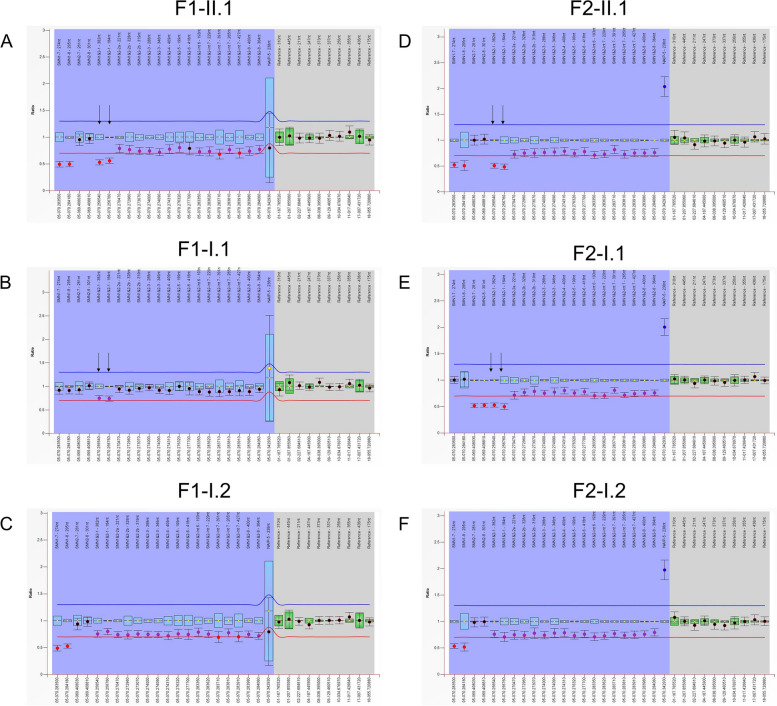
We analyzed two SMA-suspected cases that were collected, with no SMN1 gene deletion and point mutation in whole-exome sequencing. Exon 1 deletion of the SMN gene was detected using Multiplex ligation-dependent probe amplification (MLPA) P021. We used long-range polymerase chain reaction (PCR) to isolate the SMN1 template, optimized-MLPA P021 for copy number variation (CNV) analysis within SMN1 only, and validated the findings via third-generation sequencing.
Two unrelated families shared a genotype with one copy of exon 7 and a novel variant, g.70919941_70927324del, in isolated exon 1 of the SMN1 gene. Case F1-II.1 demonstrated no exon 1 but retained other exons, whereas F2-II.1 had an exon 1 deletion in a single SMN1 gene. The read coverage in the third-generation sequencing results of both F1-II.1 and F2-II.1 revealed a deletion of approximately 7.3 kb in the 5' region of SMN1. The first nucleotide in the sequence data aligned to the 7385 bp of NG_008691.1.
Remarkably, two proband families demonstrated identical SMN1 exon 1 breakpoint sites, hinting at a potential novel mutation hotspot in Chinese SMA, expanding the variation spectrum of the SMN1 gene and corroborating the specificity of isolated exon 1 deletion in SMA pathogenesis. The optimized-MLPA P021 determined a novel variant (g.70919941_70927324del) in isolated exon 1 of the SMN1 gene based on long-range PCR, enabling efficient and affordable detection of SMN gene variations in patients with SMA, providing new insight into SMA diagnosis to SMN1 deficiency and an optimized workflow for single exon CNV testing of the SMN gene.
脊髓性肌萎缩症(SMA)是一种罕见的常染色体隐性遗传性神经肌肉疾病,由生存运动神经元1(SMN1)基因缺失或突变引起。SMN1基因第7外显子的纯合缺失导致95%的SMA病例,其余5%由SMN1的其他致病变异引起。
我们分析了收集的2例疑似SMA病例,全外显子测序未发现SMN1基因缺失和点突变。使用多重连接依赖探针扩增(MLPA)P021检测SMN基因第1外显子缺失。我们使用长程聚合酶链反应(PCR)分离SMN1模板,优化MLPA P021以仅对SMN1内的拷贝数变异(CNV)进行分析,并通过第三代测序验证结果。
两个无关家族共享一种基因型,即SMN1基因孤立的第1外显子中有一个第7外显子拷贝和一个新变异g.70919941_70927324del。病例F1-II.1无第1外显子但保留了其他外显子,而F2-II.1在单个SMN1基因中有第1外显子缺失。F1-II.1和F2-II.1的第三代测序结果中的读数覆盖显示SMN1的5'区域有一个约7.3 kb的缺失。序列数据中的第一个核苷酸与NG_008691.1的7385 bp对齐。
值得注意的是,两个先证者家族显示出相同的SMN1第1外显子断点位点,提示中国SMA中可能存在一个新的突变热点,扩展了SMN1基因的变异谱,并证实了孤立的第1外显子缺失在SMA发病机制中的特异性。优化后的MLPA P021基于长程PCR确定了SMN1基因孤立的第1外显子中的一个新变异(g.70919941_70927324del),能够高效且经济地检测SMA患者的SMN基因变异,为SMN1缺陷的SMA诊断提供了新见解,并为SMN基因的单个外显子CNV检测提供了优化的工作流程。